

Back Extension Machine: The Ultimate Guide to a Stronger Lower Back

That lone piece of equipment in the corner of the gym... is it the key to a stronger back or a one-way ticket to injury? If you've ever looked at a back extension machine with a mix of curiosity and confusion, you're not alone. The fear of tweaking your lower back, or simply not knowing if you're targeting the right muscles, keeps many people away from one of the most effective tools for building a powerful posterior chain.
Forget the uncertainty. This guide is your new workout partner, here to show you exactly how to use this machine safely and effectively. We'll walk you through a step-by-step setup, perfect your form to protect your spine, and unlock its full potential for building a resilient lower back, stronger glutes, and powerful hamstrings. Get ready to build unwavering confidence, improve your posture, and add serious support to your main lifts like squats and deadlifts. It's time to make this machine your ally for a stronger, pain-free back.
What Is a Back Extension Machine and Why Should You Use One?
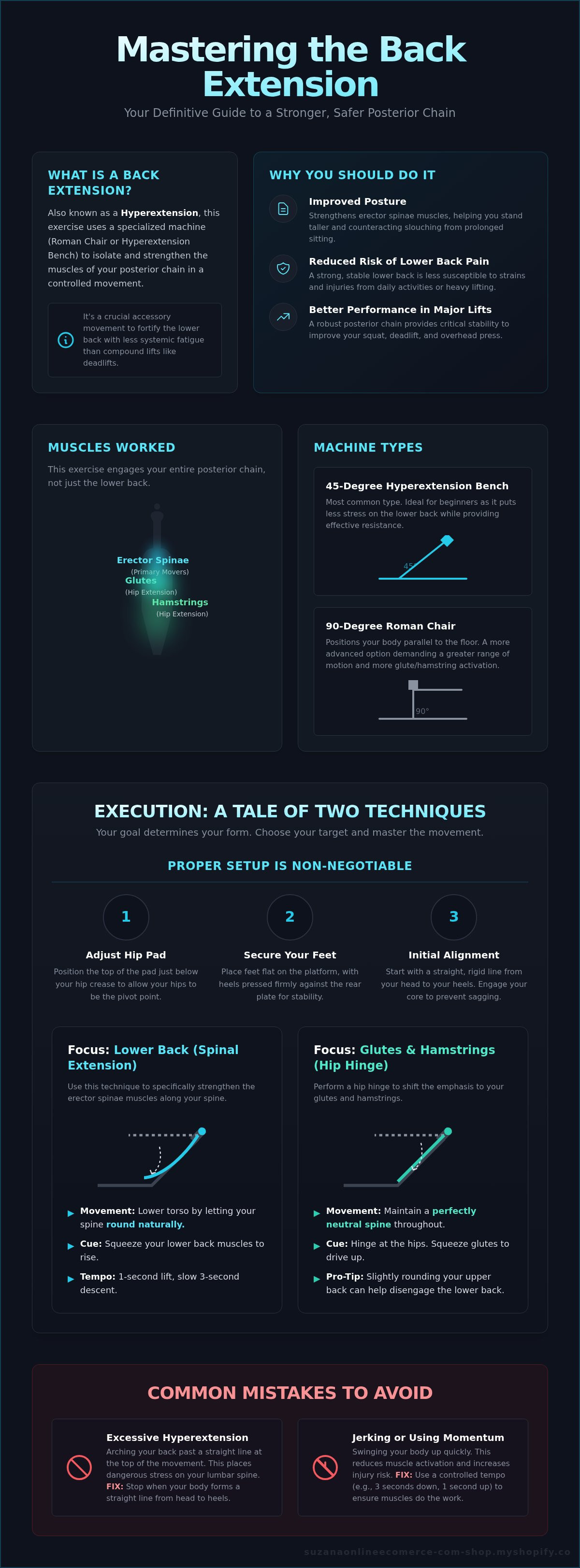
A back extension machine, often called a hyperextension bench or Roman chair, is a specialized piece of gym equipment designed to isolate and strengthen the muscles of your posterior chain. Unlike compound exercises that work multiple large muscle groups at once, this machine allows you to focus specifically on your lower back, glutes, and hamstrings in a controlled movement. The exercise performed, known as a Hyperextension (back extension), is fundamental for building a resilient and powerful core structure.
To see how this machine works and the proper form for preventing injury, take a look at this detailed video guide:
Incorporating back extensions into your routine offers significant benefits. While a deadlift strengthens the entire body, a back extension machine serves as a crucial accessory movement to directly target and fortify the lower back with less overall systemic fatigue. This targeted approach leads to:
- Improved Posture: Strengthening the erector spinae muscles helps you stand taller and counteracts the slouching common from sitting at a desk.
- Reduced Risk of Lower Back Pain: A strong, stable lower back is less susceptible to strains and injuries from daily activities or heavy lifting.
- Better Performance in Other Lifts: A robust posterior chain provides the stability needed to improve your squat, deadlift, and overhead press numbers safely.
Muscles Worked: More Than Just Your Lower Back
While the name suggests a singular focus, this exercise engages your entire posterior chain. The primary movers are the erector spinae muscles running along your spine. However, your glutes and hamstrings work hard to extend your hips, and your core muscles engage to keep your torso stable throughout the movement. This coordinated effort is crucial for everything from lifting groceries to performing explosive athletic movements.
Types of Back Extension Machines: 45-Degree vs. 90-Degree
You will typically encounter two main variations of this equipment, each offering a unique stimulus:
- The 45-Degree Hyperextension Bench: This is the most common type, placing your body at a 45-degree angle. It's ideal for beginners as it puts less stress on the lower back while still providing effective resistance.
- The 90-Degree Roman Chair: This machine positions your body parallel to the floor, demanding a greater range of motion and placing more emphasis on the glutes and hamstrings. It is a more advanced and challenging option.
Some commercial gyms also feature vertical back extension machines. For advanced athletes, the Glute-Ham Developer (GHD) machine offers a similar but far more intense exercise.
How to Use a Back Extension Machine Safely: A Step-by-Step Guide
Mastering the back extension machine is about control, not heavy weight. Before even thinking about holding a plate, your priority must be perfecting the movement with just your body weight. This approach builds a strong mind-muscle connection, minimizes injury risk, and ensures you're targeting the correct muscles from your very first repetition. Proper form is non-negotiable for building a healthy, resilient spine.
Proper Setup for Maximum Safety and Effectiveness
A correct setup is the first step toward a successful and safe lift. Before you begin the exercise, take a moment to adjust the machine to your body's specific proportions. Focus on these key points:
- Adjust the Hip Pad: Position the top of the pad so it sits just below your hip crease. This is crucial as it allows your hips to act as the primary pivot point, enabling a full and unrestricted range of motion.
- Secure Your Feet: Place your feet flat on the platform with your heels pressed firmly against the rear plate. Your ankles and lower legs should feel stable and securely locked in.
- Initial Body Alignment: At the starting position, your body should form a straight, rigid line from your head down to your heels. Engage your core to prevent your lower back from sagging.
Execution for Lower Back Focus (Spinal Extension)
To specifically strengthen your erector spinae muscles, the focus is on controlled spinal articulation. Begin by slowly lowering your torso, allowing your spine to round naturally until you feel a comfortable stretch. Initiate the lift by consciously squeezing your lower back muscles, raising your torso until it's in line with your legs. It is critical to avoid hyperextending (arching excessively) at the top. The benefits of this controlled motion are well-documented; in fact, research on back extension benefits has shown it can significantly improve lumbar strength and stability. For the best results, use a deliberate tempo: a one-second lift followed by a slow, three-second descent.
Execution for Glute and Hamstring Focus (Hip Hinge)
If your goal is to target your glutes and hamstrings, you'll perform a hip hinge variation. The key difference is maintaining a completely neutral spine throughout the entire movement. To help disengage your lower back, you can slightly round your upper back and keep it fixed. Lower your torso by hinging only at your hips, going as far as your hamstring flexibility allows. Drive the movement back up by powerfully squeezing your glutes and pushing your hips forward to return to the straight-line starting position.
Common Back Extension Mistakes (And How to Fix Them)
The back extension machine is an excellent tool for building a stronger, more resilient posterior chain. However, like any exercise, its effectiveness and safety hinge on proper form. Small mistakes can not only reduce the benefits but also increase your risk of strain or injury. To get the most out of every rep, focus on avoiding these common errors.
We highly recommend using a mirror or recording yourself with your phone for a few reps. This provides instant visual feedback, helping you see what you feel and correct your form on the spot.
Mistake 1: Hyperextending at the Top
One of the most frequent and dangerous mistakes is over-arching your back at the peak of the movement. While it might feel like you're working harder, you're actually placing excessive compressive force on your lumbar vertebrae, which can lead to pain and injury over time.
- The Fix: Lift your torso only until it forms a straight line with your legs. Stop when your body is aligned from head to heels. Think of your body as a solid, straight plank of wood at the top of the movement. There should be no arch in your lower back.
Mistake 2: Using Momentum or Jerky Movements
Swinging or jerking your body up and down turns a targeted strength exercise into a risky, momentum-based movement. This approach significantly reduces the engagement of your glutes, hamstrings, and erector spinae muscles, while putting your lower back at risk for a sudden strain.
- The Fix: Perform each repetition slowly and deliberately. Controlling your tempo is a fundamental part of proper back extension form, as it ensures your muscles-not momentum-are doing the work. Try a tempo of one second on the way up and a slow, three-second count on the way down (the eccentric phase).
Mistake 3: Incorrect Pad Placement
The setup of the back extension machine is critical. If the upper pad is positioned too high (on your stomach), it will restrict your ability to hinge at the hips. If it's too low, it can be uncomfortable and fail to provide adequate support, causing you to bend from your lower back instead of your hips.
- The Fix: Adjust the machine so the top edge of the support pad sits just below your hip crease (where your body folds when you bend at the waist). You should be able to hinge forward freely without the pad digging into your abdomen or sliding down your thighs.
Progressions, Variations, and Alternatives
Once you’ve mastered the bodyweight back extension, the key to continued progress is applying the principle of progressive overload. This simply means making the exercise more challenging over time to force your muscles to adapt and grow stronger. Whether you're ready to level up or don't have access to a machine, we have you covered.
How to Make Back Extensions More Challenging
When you can comfortably perform 15-20 reps with perfect form, it’s time to increase the intensity. These progressions will challenge your posterior chain in new ways, leading to greater strength and muscle development.
- Add External Weight: The most straightforward progression is to add resistance. Hold a weight plate, dumbbell, or kettlebell securely across your chest with both hands. Start with a light weight and focus on maintaining a controlled tempo throughout the movement.
- Incorporate Resistance Bands: For accommodating resistance, loop a resistance band around the base of the back extension machine and position the other end across your upper back. The tension will increase as you rise, maximally challenging your muscles at the top of the repetition.
- Introduce Pauses: Increase the time under tension by pausing at the top of the movement. Hold the fully extended position for a count of two to three seconds before slowly lowering yourself back down. This isometric hold builds exceptional stability and endurance.
Machine-Free Alternatives to Strengthen Your Posterior Chain
No back extension machine? No problem. You can build a strong and resilient lower back, glutes, and hamstrings with these highly effective alternatives that require minimal to no equipment.
- Supermans: An excellent beginner exercise. Lie face down on the floor with your arms extended overhead. Simultaneously lift your arms, chest, and legs off the ground, hold for a moment, and lower back down.
- Bird-Dogs: Start on all fours. Extend your right arm forward and your left leg backward, keeping your core engaged and your back flat. This builds crucial core stability and coordination.
- Good Mornings (Bodyweight): A fantastic way to practice the hip-hinge pattern. Stand with your feet shoulder-width apart and hands behind your head. Hinge at your hips, keeping your back straight, until your torso is nearly parallel to the floor.
- Bench Reverse Hyperextensions: Lie face down on a flat bench so your hips are at the very edge. Holding onto the sides for support, use your glutes and hamstrings to lift your straight legs until they are in line with your torso.
Many of these powerful variations can be enhanced with the right gear. Find all the accessories you need for these exercises in our fitness equipment collection.
Choosing the Right Back Extension Machine for Your Home Gym
Now that you understand the benefits and proper form for this powerful exercise, you might be ready to add this equipment to your personal workout space. Investing in a home machine provides the convenience to consistently strengthen your posterior chain. But with so many options available, choosing the right back extension machine can feel overwhelming. Let’s break down the key factors to help you make a confident and informed decision based on your goals, space, and budget.
Key Features to Look For
When comparing models, prioritize function and safety over flashy features. A solid machine should feel like a natural extension of your body, providing a secure platform for every rep. Pay close attention to these four critical aspects:
- Adjustability: Look for a machine with multiple adjustment points for the hip pads and leg rollers. A proper fit is non-negotiable-it ensures you can maintain correct form and target the right muscles without straining your joints.
- Stability and Weight Capacity: A wide, heavy-duty steel base prevents wobbling. Check the manufacturer's maximum user weight capacity and choose one that comfortably exceeds your own body weight, especially if you plan to add plates for resistance.
- Footprint and Storage: Measure your available space before you buy. If you have a dedicated gym area, a larger, fixed machine is fine. For smaller rooms or multi-purpose spaces, consider a foldable model that can be easily stored away.
- Padding and Comfort: High-density foam pads are essential. Thin or low-quality padding can dig into your hips and legs, making the exercise uncomfortable and distracting you from proper execution.
Budget vs. Premium: What's the Difference?
Entry-level machines are typically 45-degree hyperextension benches. They are often foldable, lightweight, and perfectly adequate for most home users looking to build foundational back strength. They offer excellent value and get the job done effectively.
Mid-range and premium models, including Glute-Ham Developers (GHDs), are built with thicker gauge steel, boast higher weight capacities, and feature superior, more durable padding. These are designed for heavy, frequent use and often offer the versatility to perform other exercises. While the investment is higher, the robust build quality provides long-term durability for the serious lifter.
Ultimately, the best back extension machine for you is one that is, above all, stable and adjustable. A secure, well-fitting budget model will always be a better choice than a feature-rich premium machine that doesn’t fit your body correctly. Ready to find the perfect fit? Explore our curated selection of high-quality back extension machines today.
Build a Stronger, More Resilient Back Today
You now have the complete roadmap to unlocking the full potential of this incredible tool. We've covered the fundamentals of safe execution, how to sidestep common errors, and the various ways you can progress your training. Mastering the back extension machine is a powerful step towards building a robust posterior chain, improving your posture, and protecting your spine for years to come.
Now that you're equipped with the knowledge, it's time to take action. You can build your dream home gym with our wide selection of fitness equipment and a secure, easy online checkout. Find the perfect machine to fit your space and goals by exploring our collection today!
Explore our collection of home gym equipment to build your strength!
Invest in your health, commit to consistency, and start forging the strong, supportive back you deserve.
Frequently Asked Questions
Are back extensions bad for your spine or herniated discs?
Back extensions are not inherently bad for your spine when performed with proper form. The key is to avoid hyperextending your lower back at the top of the movement. Instead, focus on creating a straight line from your head to your heels. If you have a pre-existing condition like a herniated disc, it is crucial to consult with a doctor or physical therapist before performing this exercise, as it could potentially aggravate the issue.
How often should I do back extensions in my workout routine?
For most individuals, incorporating back extensions into your routine 1 to 3 times per week is effective for building lower back strength. It's best to perform them on non-consecutive days to allow for adequate muscle recovery. Listen to your body; if your lower back feels fatigued or sore, give it an extra day of rest. Overtraining can lead to injury rather than progress, so focus on quality over quantity and proper form.
What's the difference between a back extension and a reverse hyper?
The primary difference lies in which part of your body is moving. During a back extension, your lower body is anchored while your torso hinges at the hips and moves up and down. In a reverse hyper, your torso is stationary on a pad while your legs swing up from below. While both target the posterior chain, reverse hypers place a greater emphasis on the glutes and hamstrings with less direct spinal compression.
How many reps and sets of back extensions should I do?
The ideal rep and set range depends on your fitness goals. For building strength, aim for 3 to 4 sets of 8 to 12 repetitions, possibly adding weight for a greater challenge. If your goal is muscular endurance and stability, performing 2 to 3 sets of 15 to 20 reps with just your body weight is more appropriate. In either case, prioritize slow, controlled movements over lifting heavy with poor form.
Can back extensions help with my deadlift and squat?
Yes, back extensions are an excellent accessory exercise for improving your squat and deadlift. They directly strengthen the erector spinae muscles, which are crucial for maintaining a neutral spine and preventing back rounding under heavy loads. A stronger lower back, along with the glute and hamstring activation from this exercise, translates directly to greater stability and power in these compound lifts, helping you push past plateaus and reduce your risk of injury.
Is a back extension machine worth it for a home gym?
A back extension machine can be a valuable addition to a home gym, especially if you prioritize posterior chain development. Many 45-degree models are relatively compact and affordable. It provides a dedicated and stable way to isolate your lower back, glutes, and hamstrings-muscles often neglected in home workouts. If you have the space and are serious about building a strong, resilient back for lifting and daily life, it is definitely worth considering.