

Functional Trainer Home Gym: Ultimate 2026 Buying Guide

Why fill a garage with six different machines when one single footprint can outperform them all? Most fitness enthusiasts believe that more equipment equals better results, but the reality of a modern training space is about biomechanical efficiency rather than just adding more steel. Choosing a high-quality functional trainer for home gym use isn't just a space-saving tactic; it's a strategic move to own a movement-based platform that adapts to your body's natural mechanics.
You probably feel the frustration of a cramped spare room or the confusion of weighing 1:1 against 2:1 pulley ratios. It's difficult to justify the high cost of individual machines when you just want a versatile setup that works. We'll show you exactly how to navigate these technical specs to find a machine that replaces an entire commercial gym. This guide covers everything from weight stack configurations to the essential wellness accessories that turn a simple cable machine into a complete home health hub. You'll learn how to maximize your floor space while ensuring you have the tools for hundreds of safe, effective exercises.
Key Takeaways
- Understand how dual-pulley systems provide superior biomechanical efficiency compared to fixed-path machines for diverse training goals.
- Learn to decode pulley ratios and weight stack types to ensure your functional trainer for home gym meets your specific strength requirements.
- Evaluate your training priorities to determine if your space is better suited for a movement-based trainer or a traditional power rack.
- Follow a practical measurement checklist for ceiling height and working area to ensure a seamless installation in limited floor plans.
- Identify the essential accessories, such as adjustable benches and recovery mats, needed to transform a single machine into a comprehensive fitness hub.
What is a Functional Trainer and Why Does Your Home Gym Need One?
A functional trainer is a sophisticated dual-pulley system designed to provide resistance through any plane of motion. Unlike traditional weight machines that lock your body into a single, fixed track, this equipment uses a specialized Cable machine architecture to allow for multi-planar movement. It's the primary choice for athletes who want to move beyond simple muscle isolation and focus on how the body performs as a complete unit. By providing constant tension throughout every rep, it bridges the gap between raw strength and real-world utility.
The "functional" aspect refers to the machine's ability to mimic movements you perform outside the gym. Whether you're swinging a golf club, lifting a heavy box, or sprinting, your body moves in three dimensions. Fixed-path machines often neglect the stabilizing muscles required for these actions, which can lead to imbalances. Integrating a functional trainer for home gym sessions allows you to engage these stabilizers, building more resilient joints and improving overall athletic coordination. It's a shift from just looking strong to actually being capable.
Functional Trainer vs. Standard Cable Crossover
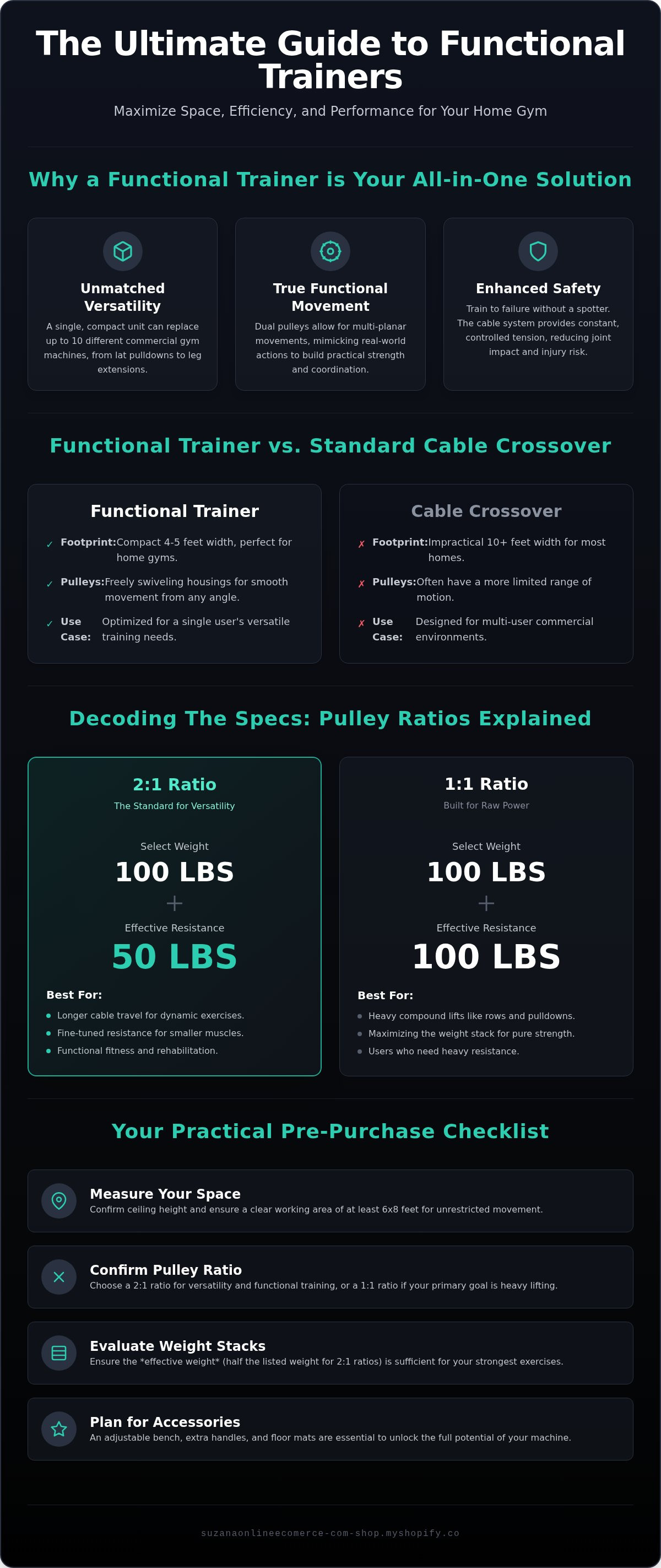
Standard cable crossovers are often ten feet wide, which is impractical for residential spaces. Functional trainers feature a much more compact frame, typically measuring four to five feet in width. The key difference is the adjustability of the swiveling pulleys. A true functional trainer allows the pulley housings to rotate freely, ensuring a smooth path of travel even when you're standing far to the side. This emphasis on smooth, safe rotation is similar to the engineering found in high-performance climbing hardware; for instance, Fusion Climb designs specialized pulleys that prioritize both velocity and safety in demanding environments. This design focuses on a single-user experience, providing a more intimate and adjustable setup than multi-user commercial crossovers.
The Core Benefits of Cable-Based Resistance
Cables offer unique mechanical advantages that free weights cannot replicate. Because the resistance isn't tied to gravity, you maintain constant tension on the muscle through the entire range of motion. This leads to better hypertrophy and muscle engagement. Safety is also a significant benefit; you don't need a spotter when training to failure. If you can't finish a rep, you simply release the handles. Additionally, the ability to micro-adjust your movement path makes cable work joint-friendly, reducing impact on connective tissues during heavy sessions.
To maximize this versatility, many lifters choose to upgrade their setups with specialized gear. SUZANA SHOP offers a range of fitness equipment and accessories, such as extra handles and floor mats, that complement a functional trainer for home gym environments perfectly. Having the right attachments ensures you can transition quickly between hundreds of different exercises without losing momentum.
Decoding Technical Specs: Pulley Ratios and Weight Stacks
Understanding the mechanics of a functional trainer for home gym use prevents buyer's remorse after a major purchase. The pulley ratio is the most misunderstood specification in the industry. A 2:1 ratio means that for every two inches of cable you pull, the weight stack moves one inch. This mechanical advantage cuts the effective resistance in half; a 100lb stack feels like 50lbs. While this sounds like a drawback, it's actually essential for Functional Fitness movements where you need long cable travel and fine-tuned resistance increments for smaller muscle groups.
The 1:1 vs. 2:1 Ratio Debate
A 1:1 ratio machine is built for raw power. If you select 100lbs, you lift 100lbs. These are best for heavy compound movements like lat pulldowns or seated rows where you need the full weight of the stack. However, 2:1 ratios are superior for most home users. They offer double the cable travel distance, allowing you to perform walking lunges or sprints without the weight stack hitting the top. Some high-end hybrid systems now offer both options, but they often come with a significantly higher price tag and a more complex footprint.
Weight stack types also dictate your daily workout flow. You generally choose between selectorized stacks and plate-loaded carriages. Selectorized units use a magnetic pin to change weight instantly, keeping your heart rate up during circuit training. Plate-loaded units require you to manually add Olympic plates. These are more affordable if you already own a weight set, but they lack the streamlined look and speed of pin-loaded machines.
Selectorized vs. Plate-Loaded Units
Selectorized units are the gold standard for convenience. They offer a cleaner aesthetic and usually feature protective shrouds that keep dust and pets away from moving parts. Plate-loaded units are the budget-friendly alternative. They're excellent for garage gyms but require more "working room" on the sides to load and unload plates. Regardless of the type, keeping the guide rods lubricated is vital. A dry guide rod creates friction, making a 50lb lift feel jerky and inconsistent rather than smooth and professional.
Build quality often comes down to the pulleys. Plastic or nylon pulleys are common in entry-level models, but they can develop flat spots over time. Aluminum pulleys are the professional choice. They provide a much smoother "glide" and won't warp under heavy tension. To ensure your cables stay in top shape, you can browse high-quality home fitness equipment and accessories at SUZANA SHOP to complement your new station. Durable handles and smooth-rolling hardware make a massive difference in how the machine feels during high-repetition sets.
Cable travel is the final technical hurdle. Check the "reach" of the cables before buying. For overhead movements or explosive lateral work, you want at least 80 to 90 inches of extension. If the cable is too short, you'll feel a jarring "thud" mid-movement as the stack bottoms out, which can disrupt your rhythm and potentially damage the cable housing.
Functional Trainer vs. Power Rack: Which Should You Buy First?
Deciding between a power rack and a functional trainer for home gym setups often comes down to your primary training philosophy. If your goal is raw strength and competitive powerlifting, the power rack is the foundation of your space. However, if you prioritize hypertrophy, injury prevention, and movement quality, the functional trainer is often the smarter initial investment. The choice isn't just about what you like to lift. It's about how much space you have and what your long-term athletic goals look like.
When to Choose a Power Rack
A power rack is the gold standard for the "Big Three" lifts: the squat, bench press, and deadlift. It's designed for those who need an almost unlimited weight capacity. Most quality racks are rated for 1,000 lbs or more, which is far beyond what a standard cable stack can offer. If you plan on loading heavy barbells, you need the safety of spotter arms and a rigid steel frame. For a deeper look at different rack configurations, you can explore our Ultimate Guide to Home Gym Equipment. Just remember that a rack also requires a barbell and several hundred pounds of iron plates, which increases the total cost and footprint.
When to Choose a Functional Trainer
The functional trainer for home gym enthusiasts excels in isolation and accessory work. It's the perfect tool for aesthetic training where you want to target specific muscles from angles a barbell can't reach. It's also the superior choice for sport-specific movements. If you're training for a better golf swing or a more powerful tennis stroke, the variable cable heights allow you to mimic those movements under tension. Space is the other deciding factor. A power rack requires a 7-foot Olympic bar, meaning you need at least 9 feet of width to safely load plates. A functional trainer is self-contained, making it ideal for narrow rooms or tight corners.
Cost analysis reveals a surprising reality. While a functional trainer has a higher initial price tag, it's a complete system. A power rack might look cheaper on paper, but once you add a high-quality bar, a full set of plates, and a bench, the prices often equalize. Hybrid solutions are becoming more popular in 2026. These all-in-one units combine a power rack with integrated cable pulleys. While they offer the best of mindsets, they require a significant amount of floor space and a larger budget. If you're starting from scratch in a small room, the versatility of a standalone functional trainer usually provides the best return on investment for the first year of training. Similarly, for South African professionals looking to optimize their corporate resources, OneStopBusiness offers a suite of products and services designed to simplify business management.
Practical Buying Checklist for Your Home Gym
Measuring your space is the first step in successfully integrating a functional trainer for home gym use. Many homeowners forget to account for vertical clearance. Most standard units stand between 80 and 84 inches tall. If you're placing this in a garage, you must check the path of your garage door opener and any low-hanging support beams. A pulley housing that hits a metal track every time you perform an overhead press will eventually lead to equipment failure or structural damage. Always leave at least three inches of "buffer" space above the highest point of the machine.
Floor dimensions are equally critical. While the physical footprint might only be 4 feet by 5 feet, the "active zone" is much larger. You need at least 4 feet of clearance in front of the machine to allow for full cable extension during chest flies or walking lunges. If you're cramped against a wall, you lose the primary benefit of multi-planar movement. Additionally, check for attachment compatibility. Ensure the machine uses standard carabiners so you can easily swap in third-party handles or specialized bars as your training evolves.
Essential Attachments to Look For
A versatile setup starts with the right connections. Look for a package that includes a long bar for squats and presses, along with a short bar for curls and rows. D-handles are the most used accessory; metal handles offer a commercial feel, while nylon handles are quieter for early morning sessions. Don't overlook the importance of a heavy-duty rope attachment for tricep work and ankle straps for lower body isolation. If your chosen machine lacks these, you can find a variety of fitness equipment and attachments at SUZANA SHOP to fill the gaps in your routine.
Floor Protection and Stability
Heavy cable units exert significant downward pressure. High-density rubber stall mats, typically 3/4 inch thick, are non-negotiable to protect your subfloor and dampen noise. Stability is also a safety concern. While many modern trainers are heavy enough to be free-standing, bolting the unit to the floor or a dedicated platform provides the most secure experience during explosive movements. Once the physical setup is complete, remember that recovery is just as vital as the workout itself. You can explore our Guide to Wellness Products for post-training tools like foam rollers and massage gear that help you bounce back faster.
Finally, scrutinize the warranty and support terms. A quality manufacturer usually offers a lifetime warranty on the steel frame, but cables and pulleys are considered "wear items." Look for at least one to two years of coverage on these moving parts. Knowing you can easily source replacement cables ensures your functional trainer for home gym stays operational for decades rather than becoming a giant paperweight after a few years of heavy use.
Setting Up Your Training Space with SUZANA SHOP
A functional trainer for home gym use provides a powerful foundation, but the machine alone doesn't complete a high-performance training environment. To unlock the full spectrum of exercises, an adjustable bench is the most critical addition to your space. Without a bench, you're limited to standing movements. Adding a high-quality, inclinable surface allows you to perform seated rows, chest presses, and supported isolation work that targets the muscles from various angles. It's the difference between a basic cable station and a professional-grade setup that mimics a commercial facility.
Beyond the heavy machinery, your training space requires a layer of versatility that only accessories can provide. Resistance bands, for instance, can be hitched to the trainer's frame to create variable resistance or used for dynamic warm-ups. Floor work is equally important. Even with heavy-duty stall mats in place, a dedicated yoga mat provides the necessary cushioning for cable-resisted core exercises and floor-based stretches. These smaller tools bridge the gap between heavy lifting and functional mobility, ensuring your body stays balanced and resilient.
Must-Have Accessories for Cable Workouts
Precision training requires specific gear. High-density yoga mats are essential for floor-based cable core work, protecting your joints during planks or leg raises. Recovery tools like foam rollers and massage balls should also have a dedicated spot in your gym. These items keep you training consistently by managing muscle soreness and improving blood flow after intense sessions. To see how these pieces fit together, you can check out our latest workout equipment to round out your gym with professional-grade gear.
The SUZANA SHOP Advantage
Building a home gym is a significant investment, and the quality of your accessories matters as much as the machine itself. SUZANA SHOP offers a curated selection of fitness and wellness essentials designed for the modern at-home athlete. We focus on providing objective advice and durable gear that stands up to the rigors of daily use. With global shipping capabilities, we ensure that 2026 home gym enthusiasts can access the tools they need regardless of their location. Our goal is to help you build a training environment that is both functional and sustainable for long-term health.
Integrating wellness products into your routine is the final step in a professional setup. Health gear like specialized recovery mats and mobility tools ensure that your functional trainer for home gym use remains a place of progress rather than injury. By choosing high-quality components for every part of your gym, from the pulleys to the recovery gear, you create a space that supports your fitness journey for years to come. Professional results require a professional environment, and we're here to provide the equipment that makes that possible.
Build Your Ultimate Training Foundation
Investing in a functional trainer for home gym use is a commitment to biomechanical efficiency and long-term health. By prioritizing adjustable pulley systems and understanding the mechanics of weight ratios, you ensure that your equipment evolves alongside your fitness goals. A well-planned space that accounts for ceiling height and floor protection turns a single corner into a comprehensive training center. It's the most effective way to gain commercial-grade variety within a residential footprint.
Completing your setup requires more than just the machine; it involves selecting the right benches and recovery tools to support your body through every phase of training. SUZANA SHOP offers a curated selection of wellness and recovery products alongside professional-grade gear for at-home enthusiasts. With global shipping for all fitness equipment, we help you source the reliable attachments and mats needed to maximize your investment. Upgrade your home workout with SUZANA SHOP fitness gear and start building a training environment that truly works for you.
Frequently Asked Questions
How much ceiling height do I need for a functional trainer?
You generally need a minimum ceiling height of 84 to 90 inches to accommodate most standard units safely. While the physical frame of a functional trainer for home gym use often sits around 82 inches, you must account for the pulley housing at its highest setting. If you plan on performing overhead presses or pull-ups, ensure there's at least a 6 to 10 inch clearance above the machine's top beam to avoid hitting the ceiling.
Is a 2:1 pulley ratio better than a 1:1 ratio for home use?
A 2:1 pulley ratio is typically superior for home environments because it offers longer cable travel and finer weight increments. This ratio makes the weight feel half as heavy, which is ideal for isolation exercises and functional movements like sports-specific swings. While a 1:1 ratio is better for heavy powerlifting movements, it lacks the smooth versatility and extended reach required for most multi-planar training routines.
Can I build muscle using only a functional trainer?
You can absolutely build significant muscle mass using only a functional trainer. These machines provide constant tension throughout the entire range of motion, which is a primary driver for hypertrophy. By adjusting the pulleys, you can target every major muscle group from various angles. This versatility allows for high-volume training and muscle isolation that effectively stimulates growth without needing a full rack of free weights.
What maintenance does a functional trainer require?
Routine maintenance involves cleaning the guide rods and inspecting the cables for fraying every few months. You should apply a thin layer of high-quality silicone lubricant to the guide rods to keep the weight stacks gliding smoothly. It's also important to check the pulley wheels for any debris or flat spots. Keeping the hardware tight and the cables properly tensioned ensures your functional trainer for home gym stays safe and operational.
Do I need to bolt my functional trainer to the floor?
Bolting the machine to the floor isn't always mandatory, but it's highly recommended for stability during explosive or lateral movements. If your unit is exceptionally heavy or features a wide base, it may remain stable as a free-standing piece. However, performing high-velocity pulls can cause lighter machines to shift or tip slightly. Using heavy-duty bolts or placing the unit on high-traction rubber mats provides the most secure training environment.
What are the best exercises to do on a functional trainer for beginners?
Beginners should start with foundational movements like the standing chest press, seated row, and cable squats. These exercises help you get used to the constant tension of the cables while building core stability. Woodchoppers are another excellent choice for developing rotational strength. Because the pulleys are adjustable, you can easily find a comfortable starting position that matches your height and current strength level without complex setups.
Are functional trainers better than dumbbells for home gyms?
Functional trainers offer constant tension and variable resistance angles that dumbbells simply can't replicate. While dumbbells are limited by the vertical pull of gravity, cables allow you to apply resistance horizontally or diagonally. This makes them more effective for isolation work and rehabilitative exercises. However, dumbbells are excellent for raw strength and grip development. Using both in a single routine often provides the most balanced results for at-home athletes.