

Home Gym Equipment: The Ultimate Buyer's Guide

Does the dream of a perfect home workout space quickly turn into a nightmare of endless browser tabs and analysis paralysis? You envision skipping the gym commute but are immediately overwhelmed by the sheer volume of options. From smart treadmills to complex cable machines and every kettlebell in between, it's hard to know which pieces of home gym equipment are a smart investment and which will become a very expensive clothes rack. You're worried about your limited space, your budget, and whether you’re buying the right gear for your specific goals, be it weight loss or muscle gain.
Forget the confusion and the fear of buyer's remorse. This is your clear, simple roadmap to building a home gym you'll actually be excited to use. In this ultimate buyer's guide, we'll walk you step-by-step through choosing the perfect equipment tailored to your fitness ambitions, your available space, and your budget. Get ready to feel confident in your choices and create a convenient, effective workout sanctuary that fits seamlessly into your life.
Before You Buy: 3 Critical Questions for Your Home Gym
Jumping into the world of home fitness is exciting, but the sheer volume of options can be overwhelming. Before you spend a single dollar, it's crucial to start with a plan. Answering a few foundational questions first will save you time, money, and the frustration of owning expensive equipment that gathers dust. This initial clarity ensures your investment in home gym equipment is perfectly tailored to your life, making the shopping process simple and effective.
To see how these principles come together in a real-world setup, take a look at this home gym tour:
What Are Your Fitness Goals?
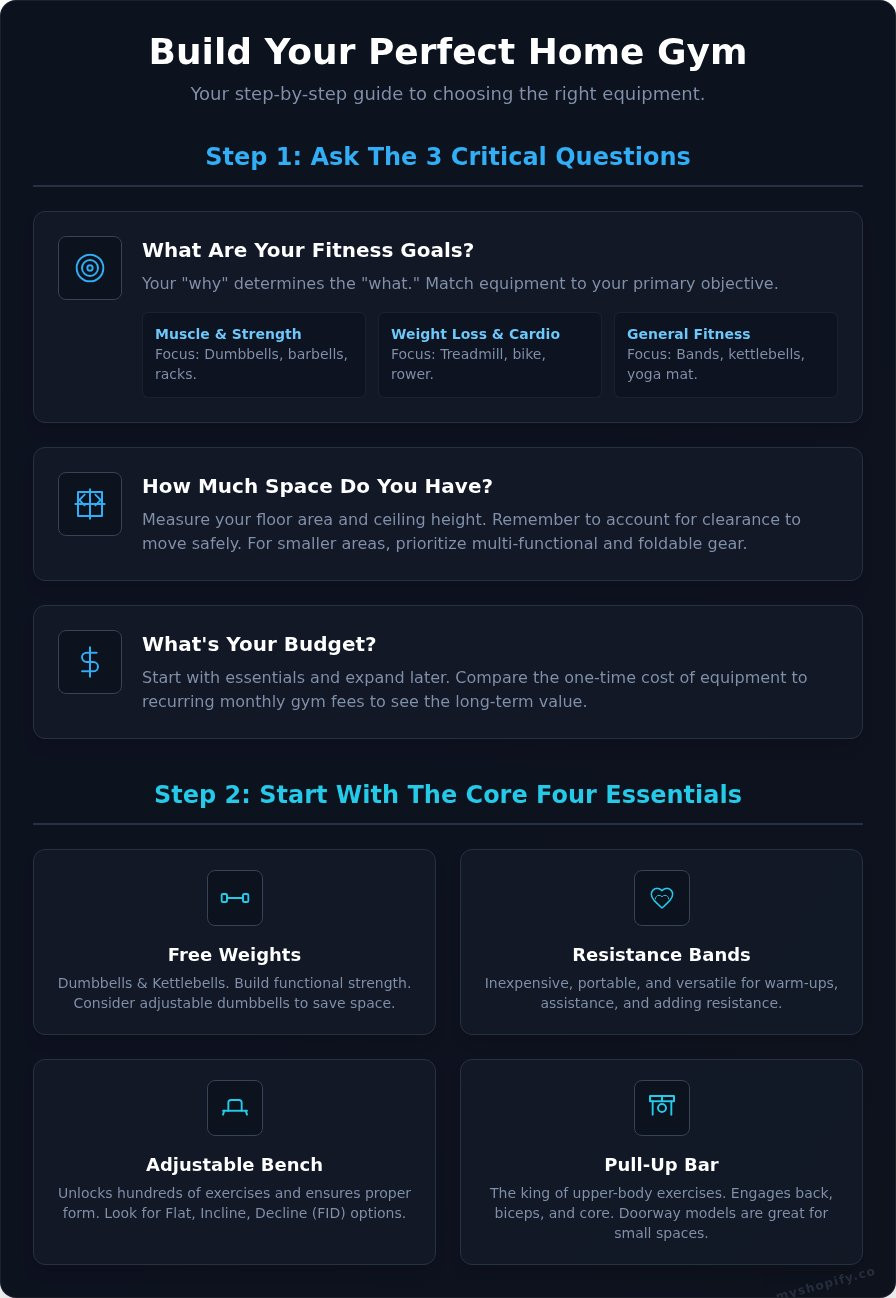
Your "why" is the single most important factor in choosing your gear. Are you looking to build serious muscle, improve your cardiovascular health, or simply stay active and flexible? Your primary goal will determine which of the many different types of exercise equipment you should prioritize. Defining this upfront prevents you from buying a treadmill when what you really need is a power rack.
- Building Muscle & Strength: Your focus should be on resistance. Prioritize items like dumbbells, barbells, a weight bench, and a squat rack.
- Weight Loss & Cardio Health: Concentrate on equipment that elevates your heart rate and burns calories, such as a treadmill, stationary bike, or rowing machine.
- General Fitness & Flexibility: A balanced approach works best. Consider a mix of resistance bands, a yoga mat, kettlebells, and perhaps one versatile cardio machine.
How Much Space Do You Have?
Your available space is a non-negotiable reality. Before you start browsing, grab a tape measure and determine the exact floor space and ceiling height you can dedicate to your gym. Remember to account for clearance-you need enough room to move safely around and on the equipment. For smaller spaces like apartments or spare bedrooms, look for multi-functional or foldable gear. A garage or basement might accommodate a full power rack, while a living room corner might be perfect for adjustable dumbbells and resistance bands.
What's Your Budget?
Building your ideal home gym doesn't have to happen overnight. Establish a realistic budget for your initial setup and focus on acquiring the essentials first. You can always add more specialized pieces later. Think of it as a long-term investment in your health. When you compare the one-time cost of quality home gym equipment to the recurring monthly fees of a commercial gym membership, the value becomes clear. Start with a solid foundation and build upon it as your needs and budget allow.
The Core Four: Essential Equipment for Any Home Gym
Diving into the world of home gym equipment can feel overwhelming, but it doesn't have to be. If your budget or space is limited, focus on a few key pieces that deliver the most bang for your buck. These four items are the cornerstones of an effective fitness space, providing the versatility needed for a complete, full-body workout. They are perfect for beginners and form the foundation upon which you can build for years to come.
Free Weights (Dumbbells & Kettlebells)
Nothing builds functional strength and lean muscle like free weights. They force your stabilizer muscles to engage, improving balance and real-world strength. For maximum efficiency, consider adjustable dumbbells-they replace an entire rack of weights in a tiny footprint. Kettlebells are fantastic for dynamic movements like swings and cleans, blending strength training with cardiovascular conditioning. As a rule of thumb, start with a weight that challenges you to complete 8-12 repetitions with good form.
Resistance Bands
Resistance bands are the unsung heroes of fitness. They are inexpensive, incredibly portable, and surprisingly versatile. Use them for warming up, assisting with challenging exercises like pull-ups, or adding resistance to bodyweight movements like squats and glute bridges. There are two main types:
- Loop Bands: Large, continuous loops ideal for pull-up assistance and stretching.
- Tube Bands: Often come with handles, perfect for mimicking cable machine exercises like bicep curls and chest presses.
Adjustable Workout Bench
An adjustable bench is a force multiplier, instantly unlocking hundreds of new exercise possibilities. It is crucial for maintaining proper form and targeting muscles effectively during exercises like dumbbell presses, chest-supported rows, and Bulgarian split squats. Look for a sturdy model with flat, incline, and decline (FID) options. A stable bench is a critical safety investment, so understanding what to look for when buying is essential before you make a purchase.
Pull-Up Bar
Often called the king of upper-body exercises, the pull-up bar is a true test of functional strength that heavily engages your back, biceps, and core. There are several options to fit any space, including simple doorway models, more permanent wall-mounted bars, and free-standing power towers. If you're just starting, you can use resistance bands looped around the bar to assist you, gradually reducing the support as you get stronger.
Level Up: Strength Training Machines and Racks
Ready to move beyond dumbbells and bodyweight? This is where your setup transforms into a true powerhouse. Strength training machines and racks add critical structure and safety to your workouts, allowing you to lift heavier with confidence. While this level of home gym equipment requires a larger footprint and a higher budget, the investment pays off in serious strength gains. The main choice you'll face is between the versatility of free weight racks and the guided precision of all-in-one machines.
Power Racks and Squat Racks
Often called the centerpiece of a strength-focused home gym, a power rack is an investment in both safety and progress. Its key feature is a set of adjustable safety catches (spotter arms) that let you safely perform heavy compound lifts like squats and bench presses without a human spotter. Most racks also include a pull-up bar, making them a multi-functional hub for your most important exercises. For those tight on space, a half rack offers a smaller footprint while still providing the essential safety features for heavy lifting.
All-in-One Home Gym Machines
If you prefer guided movements and want to consolidate multiple exercises into one station, an all-in-one machine is an excellent choice. These systems typically use either a pin-loaded weight stack or flexible resistance rods to provide tension. They are fantastic for isolating specific muscle groups with exercises like lat pulldowns, chest presses, and leg extensions. Experts often include versatile cable machines in their lists of the Best Home Gym Equipment due to their smooth motion and functional training capabilities.
Specialized Machines
Once your foundational setup is complete, you might consider specialized machines to target specific goals. Think of these as luxury additions, not day-one essentials. A leg press machine, for example, allows you to build serious quad and glute strength without the spinal compression of a heavy back squat. Similarly, a Smith machine features a barbell fixed within steel rails, providing a stable, predictable path that many find reassuring for pushing to failure safely.
Cardio Equipment: Choosing Your Calorie-Burning Engine
No home gym is complete without a dedicated cardio machine. This is your engine for improving heart health, boosting endurance, and managing weight effectively. Before you invest, consider the critical factors: the machine's footprint (how much space it takes), its noise level, and the impact on your joints. If possible, try different types at a local gym to see what movement style you enjoy most. Many modern machines now include interactive classes and performance tracking to keep you motivated on your fitness journey.
Treadmills
The quintessential choice for walking, jogging, and running, a treadmill offers versatile and intuitive workouts. Key features to look for include a powerful motor (at least 2.5 CHP for regular running), a spacious belt for a comfortable stride, and automatic incline settings to increase intensity. For those with limited space, a folding treadmill can be a game-changer. Just be mindful of noise levels, especially if you live in an apartment or have housemates.
Stationary Bikes
A fantastic low-impact option, stationary bikes are gentle on your knees and ankles while delivering a potent workout. There are three main types:
- Upright bikes: Mimic a traditional bicycle posture.
- Recumbent bikes: Offer back support, ideal for comfort and longer sessions.
- Spin bikes: Designed for high-intensity interval training (HIIT).
Look for models with quiet, low-maintenance magnetic resistance for a smooth ride every time.
Rowing Machines and Ellipticals
For a comprehensive, low-impact workout, both rowers and ellipticals are top contenders. A rowing machine engages over 85% of your muscles for a true full-body burn, with resistance types including air, water, or magnetic. An elliptical, on the other hand, simulates running without the harsh impact on your joints. Both are exceptional pieces of home gym equipment for building cardiovascular stamina and torching calories efficiently.
Ready to find the machine that will power your workouts? Explore our curated collection of cardio equipment and take the next step in your fitness journey.
Flooring, Storage & Accessories: The Final Touches
You’ve selected your core machines and weights, but the setup isn’t complete. Overlooking the final details of flooring, storage, and accessories can impact your safety, the longevity of your gear, and even your motivation. A well-organized and properly outfitted space is not just about aesthetics; it’s about creating an efficient and inviting environment that makes you want to work out. These final touches transform a collection of home gym equipment into a functional, personal fitness sanctuary.
Gym Flooring Essentials
The right foundation is non-negotiable. Quality gym flooring protects your home's floors from scratches and cracks caused by dropped weights, and it also protects your equipment from damage. Furthermore, it significantly reduces noise and vibration-a huge benefit for you and anyone else in the house. The most popular choices include:
- Interlocking Rubber Tiles: Easy to install and customize for any room size.
- Horse Stall Mats: A highly durable, budget-friendly option often found at farm supply stores.
Consider the thickness based on your workouts. A 3/8-inch mat is great for general fitness, while heavy lifters performing deadlifts should opt for 3/4-inch thickness for maximum protection.
Smart Storage Solutions
A cluttered gym is a hazardous one. Tripping over a stray dumbbell or plate is an easily avoidable risk. Smart storage keeps your space tidy, safe, and mentally clear for a focused workout. Invest in dedicated solutions like weight trees for bumper plates and A-frame or tiered racks for dumbbells. Wall-mounted hooks and shelves are perfect for keeping resistance bands, jump ropes, and barbells off the floor. Browse our home gym accessories and storage solutions.
Must-Have Accessories
Small accessories can add immense variety and value to your fitness routine, often for a minimal investment. They are the versatile tools that complete your home gym equipment arsenal and support everything from warm-ups to recovery. Consider adding these essentials:
- Yoga Mat: Provides cushioning and a clean surface for stretching, yoga, and any floor-based exercises.
- Foam Roller: An indispensable tool for post-workout recovery, helping to relieve muscle tightness and improve mobility.
- Jump Rope: A simple, high-intensity tool for a quick and effective cardio warm-up or a full workout.
- Lifting Belt & Gloves: For those who lift heavy, a belt provides crucial core support, while gloves can improve grip and prevent calluses.
Your Fitness Journey Starts at Home
Building your personal workout sanctuary is an exciting and empowering process. We've covered the essential steps, from asking the critical questions about your space and goals to selecting the core pieces that will form the foundation of your routine. Remember, the best gym is the one that you'll use consistently, so choosing equipment that aligns with your fitness aspirations is paramount.
You now have the roadmap to confidently select the perfect home gym equipment for your needs. At our store, we've curated a wide selection for every budget and goal, offering everything you need from essential free weights to advanced cardio machines and accessories. You can shop from the convenience of your home and have your ideal setup delivered right to your door.
Explore our complete collection of home gym equipment and start building your dream setup today!
The convenience of a home gym removes barriers and makes achieving your health goals more accessible than ever. Take that first step and invest in yourself. Your future self will thank you.
Frequently Asked Questions About Home Gym Equipment
What is the single most important piece of home gym equipment?
This depends entirely on your fitness goals. For serious strength training, a power rack with a barbell and weight plates offers the most versatility and safety for compound lifts. For general fitness and muscle building in a smaller space, a high-quality set of adjustable dumbbells is unmatched. They allow for progressive overload across dozens of exercises, from bicep curls to goblet squats, making them an incredibly efficient and space-saving foundation for any home gym.
How much does a decent home gym cost to set up?
The cost varies significantly based on your ambitions. A basic but effective setup with resistance bands, a pull-up bar, and a kettlebell can be assembled for $150-$300. A more robust mid-range gym with adjustable dumbbells, a bench, and a squat stand might cost between $700 and $1,500. A comprehensive setup with a full power rack, barbell, extensive weight plates, and a cardio machine can easily exceed $2,500. You can always start small and expand over time.
Can you really build muscle with just home gym equipment?
Absolutely. The key to building muscle is progressive overload-consistently challenging your muscles with more resistance or volume. This is easily achieved with the right home gym equipment. Adjustable dumbbells, barbells, and even heavy-duty resistance bands provide the necessary tension to stimulate muscle growth. Paired with proper nutrition and consistent training, you can achieve significant strength and size gains without ever leaving your house. Your muscles respond to resistance, not the location of your workout.
How do I create a home gym in a small apartment?
Focus on versatile, space-saving equipment. A set of adjustable dumbbells or a few kettlebells can replace an entire rack of weights. A doorway pull-up bar requires no floor space, and a foldable workout bench can be slid under a bed or into a closet. Resistance bands are another excellent, compact tool for a full-body workout. Prioritize gear that is multi-functional and easy to store, proving you don't need a large room to get a great workout.
Is it cheaper to build a home gym or get a membership?
In the long run, building a home gym is almost always cheaper. While the upfront cost is higher, it's a one-time investment. The average gym membership costs around $50 per month, or $600 per year. A solid, basic home gym can be built for that same amount, paying for itself within a year. Over five years, you could save thousands of dollars while enjoying the convenience and privacy of working out whenever you want.
What's the best home gym equipment for weight loss?
The most effective approach to weight loss combines cardio and strength training. For cardio, a jump rope is an inexpensive and highly effective calorie-burner. For strength, kettlebells and dumbbells are perfect for high-intensity interval training (HIIT) and full-body workouts that build metabolism-boosting muscle mass. A combination of these tools will help you burn calories during your workout and increase your resting metabolic rate, accelerating your weight loss results.