

How to Build a Home Gym on a Budget: Your Complete 2026 Guide

Tired of that monthly gym membership fee draining your bank account? Or maybe it’s the hassle of commuting, waiting for equipment, and working out on someone else's crowded schedule. What if you could get a fantastic workout just steps from your bedroom, without the hefty price tag? It's not a fantasy; it's entirely possible. This guide is dedicated to showing you exactly how to build a home gym on a budget that works for you, your space, and your fitness goals in 2025.
Forget the overwhelming sea of equipment options and the fear of wasting money on useless gear. In this complete guide, we'll walk you through everything, step-by-step. You will learn how to strategically plan your space (no matter how small!), get a prioritized list of the most effective and affordable equipment, and gain the confidence to make smart purchases. It's time to create a functional, motivating fitness sanctuary at home that will save you money in the long run. Let's start building.
Step 1: Planning Your Budget Home Gym (Before You Buy Anything)
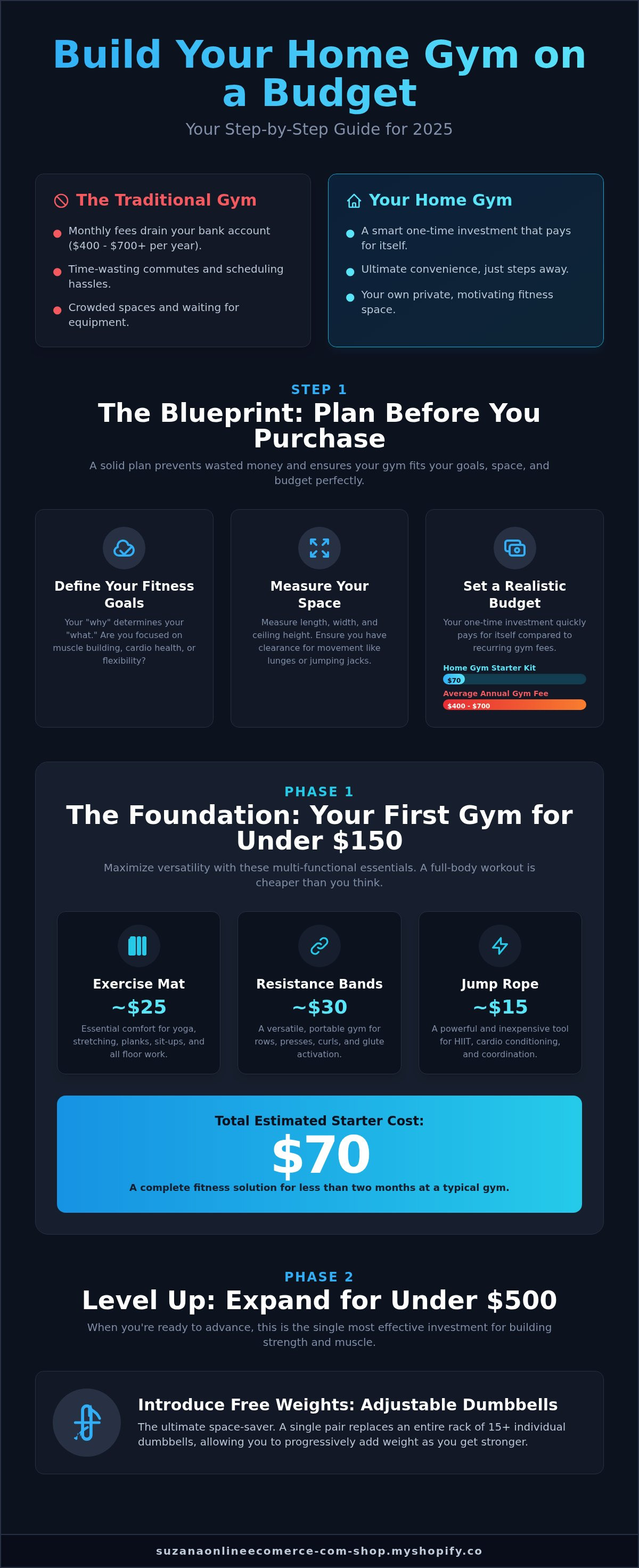
Welcome to the most important step in your home gym journey. Before you spend a single dollar, a solid plan will prevent you from buying expensive equipment that ends up as a laundry rack. This initial phase is all about self-assessment-defining your goals, measuring your space, and setting a realistic budget. This is the secret to success for anyone learning how to build a home gym on a budget that they will actually use and love for years to come.
To see just how little you need to get started, this video offers some fantastic inspiration:
Define Your Fitness Goals
Your "why" determines your "what." Are you aiming to build muscle, improve cardiovascular health, or focus on general wellness and flexibility? Your goals are the single most important factor because they determine which types of exercise equipment you should even consider. Someone focused on bodybuilding will need a set of adjustable dumbbells, while a person interested in HIIT workouts might just need a kettlebell and some open floor space. To get started, write down 3 specific and measurable goals for your first 6 months. For example: "perform 10 unassisted push-ups" or "run a 5k without stopping."
Measure and Assess Your Space
You don't need a massive room to create an effective workout zone. A spare bedroom, basement, garage, or even a dedicated corner of your living room can work. Grab a tape measure and get the exact dimensions: length, width, and-crucially-ceiling height. Think beyond the footprint of the equipment itself; you need clearance for movement. Can you do a jumping jack without hitting the ceiling? Do you have room to lunge forward? Also, consider your flooring. If you have hardwood or tile, investing in a few inexpensive rubber mats is essential to protect both your floor and your equipment.
Set a Realistic Budget
Decide how much you are willing and able to invest right now. Whether your starting point is $100, $500, or $1000, having a firm number keeps your search focused. To put it in perspective, the average annual gym membership costs between $400 and $700. Your home gym is a one-time investment that pays for itself quickly. A great strategy for how to build a home gym on a budget is to create two lists:
- Essentials: The absolute must-have items to reach your primary goals.
- Nice-to-Haves: Equipment you can add later as your budget allows and your fitness progresses.
The Foundation Phase: Your First Home Gym for Under $150
Diving into fitness doesn't require a four-figure investment. The foundation phase is all about maximizing versatility with minimal spending. The secret to how to build a home gym on a budget is choosing smart, multi-functional equipment. With just a few key items, you can create a setup that allows for dozens of exercises targeting every major muscle group. This approach is perfect for beginners establishing a routine or anyone working with limited space who needs an effective, full-body workout solution.
Core Bodyweight and Flexibility Essentials
The ground is your starting point, so make it comfortable and effective. A quality exercise mat provides crucial cushioning for your spine and joints during floor work, while a simple jump rope is one of the most efficient cardio tools available, burning calories and improving coordination. These two items unlock a world of foundational exercises.
- Exercise Mat: Essential for comfort during yoga, stretching, planks, sit-ups, and push-ups.
- Jump Rope: An inexpensive and powerful tool for high-intensity interval training (HIIT) and cardiovascular conditioning.
The Ultimate Budget Strength Tool: Resistance Bands
Forget bulky, expensive weights for now. Resistance bands are the undisputed champion of budget-friendly strength training. Experts agree that a good set of bands is a cornerstone when you want to build a home gym on a budget, offering unparalleled versatility. A complete set gives you a portable, full-body gym that fits in a small bag.
- Loop Bands: Perfect for glute activation, hip thrusts, and assisting with pull-ups.
- Bands with Handles: Effectively mimic cable machine exercises like rows, chest presses, bicep curls, and tricep extensions.
Sample Under-$150 Starter Kit
Ready to get started? Here is a sample shopping list that delivers a complete workout solution while staying well under budget. This investment provides everything you need to begin your fitness journey right at home.
- High-Density Exercise Mat: (Est. Cost: $25)
- Full Resistance Band Set (Loop & Handled): (Est. Cost: $30)
- Adjustable Speed Jump Rope: (Est. Cost: $15)
- Total Estimated Cost: $70
With this foundational equipment, you're ready to build strength, improve your cardio, and increase flexibility. Shop our collection of workout accessories to get started today!
The Expansion Phase: Leveling Up Your Gym for Under $500
You’ve built a solid foundation with bodyweight and resistance band training. Now, it’s time to introduce the single most effective tool for building strength and muscle: free weights. This phase is where your investment pays serious dividends, allowing you to incorporate progressive overload and unlock a massive library of new exercises. This is the crucial next step in your journey of how to build a home gym on a budget without sacrificing results.
Introducing Free Weights: Dumbbells and Kettlebells
The smartest purchase you can make for a small space is a set of adjustable dumbbells. A single pair can replace an entire rack of 15+ traditional dumbbells, allowing you to quickly change weights from 5 to over 50 pounds. Alternatively, you can start with a few pairs of versatile fixed hex dumbbells (e.g., 15, 25, and 40 lbs). Complement these with one or two kettlebells (a 16kg is a great starting point) for powerful movements like swings, goblet squats, and loaded carries.
The Unsung Hero: An Adjustable Workout Bench
To truly maximize your new dumbbells, an adjustable bench is non-negotiable. It provides the stability and proper positioning needed for key pressing movements, protecting your shoulders and ensuring correct form. Look for a model that offers flat, incline, and decline settings. This single piece of equipment is a true workhorse, essential for exercises like:
- Dumbbell Bench Press (incline, flat, decline)
- Bent-Over Dumbbell Rows
- Bulgarian Split Squats
- Seated Shoulder Presses
- Step-Ups
Pull-Up Power
While dumbbells build pulling strength, nothing develops your back and biceps like the classic pull-up. A simple doorway pull-up bar is an affordable, effective tool that requires no drilling or permanent installation. It’s the king of vertical pulling exercises. Still working your way up to your first full pull-up? Use the resistance bands from your Foundation Phase to provide assistance and build strength gradually. This synergy between phases is key to how to build a home gym on a budget that grows with you.
The Power Phase: Building a Serious Setup for Under $1000
If you're ready to move beyond the basics and focus on serious strength training with heavy compound lifts, this is your blueprint. For under $1000, you can build a setup that rivals the core functionality of any commercial gym. This phase requires more space and a higher commitment, but the rewards in strength and performance are immense. This is the ultimate guide on how to build a home gym on a budget that will serve you for years to come.
The Barbell and Weight Plates
The centerpiece of any serious gym is the barbell. Your goal is a standard 45 lb (20 kg) Olympic barbell. Pair it with a 300 lb set of weight plates to get started. You have two main options:
- Iron Plates: The classic, cost-effective choice. They are extremely durable and perfect for powerlifting-style movements like the squat, bench press, and deadlift.
- Bumper Plates: Coated in thick rubber, these are designed to be dropped safely. They are essential for Olympic lifts (like the snatch and clean & jerk) and are much quieter for deadlifts.
For most people starting out, a set of iron plates offers the best value and will cover all your essential lifting needs.
The Squat Stand or Power Rack
This is the single most important safety purchase you will make, especially if you train alone. A quality rack allows you to push your limits on squats and bench presses without needing a spotter. A squat stand has a smaller footprint and is great for basic movements, while a full power rack offers the ultimate in safety with adjustable pins to catch the barbell on a failed lift. Don't compromise here; your safety is paramount.
Essential Flooring Protection
Dropping or setting down hundreds of pounds of weight will destroy both your equipment and your foundation. The classic budget hack is to buy 3/4-inch thick horse stall mats from a local tractor or farm supply store. These dense rubber mats are incredibly durable and provide the perfect protection for deadlifts and other heavy movements. This small investment protects your biggest assets: your home and your gear.
With these three core components, you have everything you need to build foundational strength. For those serious about how to build a home gym on a budget, this setup provides the best possible return on investment. Ready to find the perfect rack for your space? Explore our collection of strength training essentials today.
Pro Tips: How to Squeeze Every Drop of Value From Your Budget
You’ve mapped out your space and picked your essential equipment. Now comes the fun part: making your money work as hard as you do. The secret to how to build a home gym on a budget isn’t just buying cheap items; it’s about acquiring high-value pieces smartly. Forget shiny new equipment and brand names. Focus on function, be patient, and get ready to unlock massive savings with a little creativity.
Master the Second-Hand Market
Your first stop should be the digital classifieds. Scour platforms like Facebook Marketplace, Craigslist, and local buy/sell groups daily. Remember, weights are weights. A 45-pound plate is a 45-pound plate, whether it’s gleaming or has a bit of surface rust you can easily remove. Always inspect gear in person for cracks or structural damage, but don't sweat the cosmetic stuff.
- Best items to buy used: Cast iron plates, dumbbells, barbells, and kettlebells.
- Pro Tip: People often sell entire sets for a huge discount after New Year's resolutions fade. Be ready to act fast!
The Power of Multi-Purpose Equipment
Every piece of equipment must earn its footprint in a budget gym. A quality power rack is the ultimate centerpiece, serving as your station for squats, bench presses, overhead presses, and pull-ups. Another game-changer is a set of gymnastic rings. For under $40, you get an incredibly versatile tool for building immense upper body strength with dips, rows, and push-up variations. When paired with the versatile resistance bands we mentioned earlier, your training options become nearly limitless.
Simple DIY Gym Equipment Hacks
Why buy when you can build? A few simple DIY projects can save you hundreds and deliver the same function as expensive commercial equipment. Protecting your floor is crucial, and you can build a sturdy deadlift platform with a few sheets of plywood and a rubber horse stall mat for a fraction of the cost of a pre-made one. Need a heavy object for carries or loading? Make your own sandbag using a military surplus duffel bag and bags of play sand from a hardware store.
Your Home Gym Journey Starts Now
Building your own fitness sanctuary doesn't have to be a distant dream or a financial burden. As this guide has shown, the key is to start with a clear plan and build incrementally. You can create a powerful and effective workout space by beginning with a solid foundation of essential, versatile equipment and expanding as your budget and needs grow. The secret to how to build a home gym on a budget lies in strategic choices, not a massive upfront investment.
When you're ready to turn your plan into action, we're here to help. With a wide selection of versatile fitness gear and affordable options for every budget, we make it easy to find exactly what you need. Plus, with worldwide shipping, we deliver your new equipment right to your door.
Ready to start building? Shop our essential fitness equipment today! Your fitness goals are waiting, and the perfect workout space is within your reach.
Frequently Asked Questions
How much space do I really need for a basic home gym?
You don't need a massive room to get started. A dedicated space of about 6x6 feet (36 sq. ft.) is often sufficient for free weights, resistance bands, and bodyweight exercises. This could be a corner of a spare room, basement, or garage. The most important factor is having enough clear space to move safely and fully extend your limbs without hitting walls or furniture, which is a key part of planning how to build a home gym on a budget.
Is building a home gym cheaper than a gym membership in the long run?
Absolutely. While there is an upfront cost, a home gym saves you significant money over time. The average gym membership can cost over $600 per year. You can easily purchase essential, durable equipment for less than that amount. Within just one or two years, your initial investment pays for itself, and you eliminate recurring monthly fees, travel costs, and other hidden gym expenses for good.
What's the single most important piece of equipment to start with?
For maximum versatility on a tight budget, a set of adjustable dumbbells is the best starting point. They consolidate an entire rack of weights into a single pair, saving you a tremendous amount of space and money. They allow you to perform hundreds of exercises for every muscle group, from chest presses to weighted lunges. A quality kettlebell is another excellent and highly versatile single-item alternative for full-body conditioning.
How do I stay motivated to work out at home?
Treat your home workouts like non-negotiable appointments by scheduling them in your calendar. Set clear, achievable goals and track your progress to see how far you've come. Create an energizing environment with a great playlist and an organized space. Following a structured online program or finding a virtual workout buddy can also provide the accountability and community needed to stay consistent and push through motivational slumps.
Is it safe to lift heavy weights at home by myself?
Safety is paramount. If you plan to lift heavy with barbells for exercises like squats or bench presses, a power rack with safety spotter arms is an essential investment. These will catch the bar if you fail a lift. Always prioritize perfect form over heavy weight, and never attempt a new one-rep max without someone present. For most people, using dumbbells or kettlebells within a manageable weight range is a safer solo option.
What are the best flooring options to protect my floors on a budget?
Interlocking rubber or high-density foam tiles are the most popular and affordable solution. You can buy just enough to cover your specific workout area, and they provide excellent shock absorption to protect both your floors and your joints. For an even more durable and cost-effective option for heavy lifting, look into rubber horse stall mats from a local farm supply store. They are incredibly tough and often cheaper than traditional gym flooring.