

How to Stop Feeling Guilty About an Unused Home Gym: A Practical Guide

What if that stationary bike gathering dust isn't a monument to your lack of discipline, but simply a sign that your home environment no longer matches your current lifestyle? Every time you walk past a treadmill used as a clothes rack, it's natural to feel a wave of financial regret and self-criticism. You aren't alone in this feeling. Many people struggle with the visual clutter and heavy emotions tied to fitness investments that didn't stick. This article provides a professional framework for how to stop feeling guilty about an unused home gym by transforming that shame into a practical strategy for your well-being.
You'll learn how to assess whether your current equipment aligns with your actual goals or if it's time to pivot toward more accessible wellness products. We provide clear instructions on how to lower the barrier to entry for home workouts; alternatively, we'll give you permission to repurpose your space for relaxation or different forms of movement. By the end of this guide, you'll have a decisive plan to either restart your routine with smaller accessories like yoga mats or clear the clutter to reclaim your home. It's time to stop looking at your gym as a failure and start seeing it as a flexible resource.
Key Takeaways
- Understand the emotional burden of the sunk cost fallacy and why keeping unused equipment often creates more stress than health benefits.
- Learn an objective fitness audit method for how to stop feeling guilty about an unused home gym by calculating the real value of your space.
- Discover how to lower the barrier to entry for exercise with micro-workouts that focus on consistency instead of high-intensity machinery.
- Find out how to pivot your high-stress gym environment into a low-stress wellness sanctuary using smaller accessories and relaxation tools.
- Follow a practical step-by-step plan to make a final decision on your equipment today and reclaim your home for your current lifestyle needs.
Understanding Gym Guilt: Why Unused Equipment Weighs on Your Mind
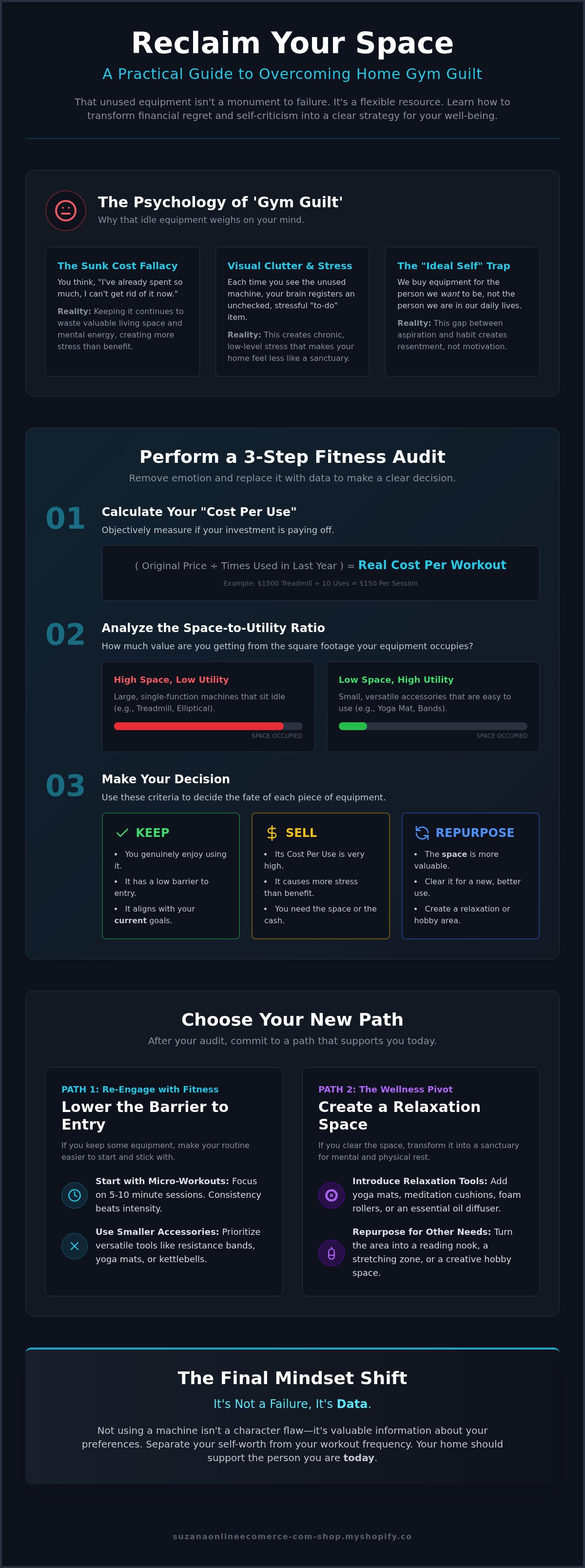
Gym guilt is more than just a fleeting feeling of laziness. It's a complex emotional state rooted in the gap between our current actions and our past intentions. Understanding Gym Guilt requires looking at it as an emotional burden of unmet expectations and financial regret. When you see a treadmill sitting idle in the corner of your bedroom, you don't just see a machine. You see the money you spent and the promises you made to yourself that remain unfulfilled.
The Sunk Cost Fallacy plays a major role in why we keep equipment we haven't touched in months. This psychological trap convinces us to continue an endeavor or keep an item simply because we've already invested heavily in it. You might think that selling the equipment means admitting defeat or wasting money. In reality, keeping it is what continues the waste. It occupies valuable living space and drains your mental energy every time you walk past it.
Visual clutter significantly impacts mental well-being and daily stress levels. Every time your eyes land on that unused weight bench, your brain processes a "to-do" list item that remains unchecked. This creates a low-level, chronic stress that can dampen your mood and make your home feel less like a sanctuary. Learning how to stop feeling guilty about an unused home gym starts with acknowledging that lifestyle changes are normal. Your fitness needs evolve over time. What worked for you two years ago might not fit your current schedule or physical preferences today.
The Psychology of the "Ideal Self"
We often purchase high-ticket fitness items for the person we want to be, rather than the person we actually are in our daily lives. This aspirational purchasing creates a significant gap between our actual habits and our home environment. Aspirational clutter is a physical reminder of a goal that no longer fits your schedule. When your home is filled with tools for a version of yourself that doesn't exist right now, it creates friction and resentment instead of motivation.
Breaking the Cycle of Self-Criticism
To move forward, you must shift your perspective from "failure" to "learning about your preferences." Not using a specific piece of equipment isn't a character flaw; it's valuable data. It tells you that this specific form of exercise or this specific environment doesn't suit your current life. Separate your self-worth from your workout frequency. You aren't a better person because you used a rowing machine, and you aren't a worse person because your home gym is quiet. Re-frame the presence of the equipment as a tool you've simply outgrown, much like a piece of clothing that no longer fits your style or size.
Assessing Your Home Gym: Should You Keep, Sell, or Repurpose?
Moving from the psychological weight of guilt to a logical assessment is the most effective way to regain control of your living space. To understand how to stop feeling guilty about an unused home gym, you must perform a "Fitness Audit." This process removes emotion and replaces it with data. Start by calculating your "Cost Per Use" for each major item. Divide the original price by the number of times you've actually used it over the last year. If a piece of equipment cost 500 dollars and you've used it five times, each session cost you 100 dollars. This objective view helps you realize that the investment isn't "working" for you, which makes the decision to let go much easier.
Analyze the space-to-utility ratio of your equipment. Large machines like treadmills or ellipticals often consume significant square footage while offering only one type of movement. If a machine takes up a large portion of a room but sits idle, it's a liability to your home’s functionality. Contrast this with smaller accessories, such as yoga mats or resistance bands, which provide high utility with minimal footprint. Understanding how societal pressure creates gym guilt can help you see that you don't need a commercial-grade setup to be healthy. If an item causes more stress than physical benefit, its value is negative.
Criteria for Keeping Equipment
Keep an item only if it supports a type of exercise you genuinely enjoy. For instance, if you find strength building rewarding, you might prioritize keeping specific machines for weight training. Another critical factor is the barrier to entry. If a machine requires 10 minutes of setup or is buried under laundry, you won't use it. An item is worth keeping if you can reasonably integrate it into a 15-minute routine without significant friction.
When to Sell or Donate
Apply the "Six-Month Rule." If you haven't touched a piece of equipment through two full seasons, your lifestyle has likely moved past it. You should also consider selling if a machine is physically uncomfortable or poorly suited for your body type; pushing through pain only increases your avoidance. Selling the equipment provides immediate mental relief. It clears the "visual debt" from your home and allows you to reclaim square footage for activities that actually serve your current needs. You might find that replacing heavy machinery with compact fitness equipment better aligns with your daily habits.
How to Re-Engage with Your Home Fitness Routine
If you decide to keep your equipment, the immediate priority is reducing the friction of starting. A primary reason people search for how to stop feeling guilty about an unused home gym is that their expectations for a "proper" workout are too high. Shift your focus to micro-workouts. These are five-to-ten-minute sessions that feel manageable even on your busiest days. During the first two weeks, prioritize consistency over intensity. The goal isn't to burn a specific number of calories; it's to rebuild the habit of entering your workout space. Once the habit is established, intensity will follow naturally.
Habit stacking offers a practical way to integrate exercise into your existing life. You don't need to find "new" time. You simply need to pair the equipment with a current habit. If you watch a specific show every evening, commit to using your equipment only during that time. This turns a sedentary habit into an active one without requiring a massive shift in your daily schedule. By linking the equipment to a reward you already enjoy, you lower the psychological barrier to entry.
Redesigning the Workout Experience
The environment plays a massive role in your motivation. Equipment tucked away in a cold, dark corner of a garage is unlikely to be used. Move your gear to a high-traffic or well-lit area where it's visible and accessible. You should also ensure you have the necessary workout equipment to complement your machines. Often, a lack of supporting items, like a proper floor mat or adequate lighting, creates a subtle resistance to the space. Adding a television or a dedicated tablet stand can also transform a boring session into an enjoyable entertainment window.
Setting Realistic 2026 Fitness Goals
Looking toward 2026, it's vital to move away from the all-or-nothing mindset. Hour-long sessions are great, but they aren't the only way to see results. Focus on functional movement and overall health and wellness rather than just aesthetics. This shift in perspective makes every small effort count. Instead of tracking weight, track the number of days you engaged with your equipment. This method rewards the act of showing up, which is the most difficult part of any fitness journey. When you celebrate showing up, the guilt of the past begins to dissolve.
The Wellness Pivot: Turning a Gym into a Relaxation Space
True wellness encompasses more than high-intensity interval training or heavy lifting. If your home gym feels like a source of pressure, it's time to redefine its function. Transforming a high-stress workout environment into a low-stress sanctuary is a powerful way to understand how to stop feeling guilty about an unused home gym. Instead of viewing the room as a place where you "must" perform, view it as a space where you "can" recover. This shift allows you to maintain a health-focused environment without the weight of unmet athletic expectations. By clearing the floor space and removing the visual noise of unused machinery, you create a physical opening for new, restorative habits.
Transitioning the space requires signaling a new purpose to your brain. This isn't just about moving furniture; it's about changing the sensory experience of the room. When the environment no longer looks like a commercial gym, the psychological trigger for guilt begins to fade. You can integrate stretching, mobility exercises, and meditation into the existing area to make it a multifaceted wellness hub. This approach ensures the square footage remains useful even if you never touch a barbell again. It turns a room associated with failure into a room associated with self-care.
Incorporating Wellness Products
Small environmental changes signal a new purpose for the room. Integrating wellness products like aromatherapy diffusers or high-quality candles can immediately shift the mood from clinical to comforting. Consider swapping out bulky, intimidating weights for softer alternatives like yoga mats and resistance bands. These items facilitate a gentler approach to health that is often more sustainable for a busy lifestyle. Adjusting the lighting to a warmer tone or using lamps instead of overhead fluorescent lights helps the brain transition from a state of exertion to one of relaxation. Scent and light are powerful tools that redefine the room's utility without requiring a full renovation.
Mindful Movement as an Alternative
Mindful movement, such as restorative yoga, Tai Chi, or intentional stretching, offers significant health benefits without the mental exhaustion of a traditional gym session. For many busy professionals, a dedicated "recovery space" is actually more valuable than a high-performance work space. By focusing on how your body feels rather than how much weight it can move, you reduce the psychological pressure to perform. Restorative yoga focuses on holding poses for longer periods to release tension in the fascia, which is often more beneficial for desk-bound workers than another 20 minutes on a treadmill. If you're ready to reclaim your space for relaxation, you can browse high-quality wellness and fitness accessories to start your transition today.
Next Steps: Curating a Home Environment That Supports You
Reaching the end of this guide means you've identified the psychological and practical reasons for your stalled routine. To truly master how to stop feeling guilty about an unused home gym, you must take immediate action. Pick one piece of equipment today and make a final decision: are you committing to a 10-minute daily habit or listing it for sale? Momentum is built through small, decisive acts. By removing just one source of visual debt, you clear the path for a home that supports your current reality. Action is the most effective antidote to the lingering weight of financial regret.
Moving forward, adopt a "one-in, one-out" policy for all home additions. This simple rule ensures that your living space never becomes a museum of past goals or aspirational purchases. When you do choose to add new items, prioritize multi-functional tools that serve both your fitness needs and your daily life. For example, a high-quality yoga mat can be used for stretching, core work, or even as a soft surface for floor based tasks. Your home should be a functional tool for your present self, not a warehouse for a version of you that no longer exists. This shift in perspective allows you to curate an environment that actively reduces stress rather than contributing to it.
Smart Shopping for Future Fitness
Before making any future investments in your health, consult a professional home gym equipment guide. This helps you evaluate items based on versatility and ease of storage rather than just initial excitement. Focus on high-quality materials that offer long-term satisfaction. Choosing smaller, high-utility items over bulky machinery prevents future clutter and keeps the barrier to entry low. If an item cannot be easily stored or used for multiple types of movement, it may not be the right fit for a modern home environment.
Finalizing Your Wellness Strategy
The path from guilt to action involves an honest assessment of your lifestyle and the courage to pivot when necessary. We've explored the psychological traps of the sunk cost fallacy and provided a framework for auditing your current setup. Embrace your current stage of life, whether it requires high-intensity training or restorative recovery. If you're ready to rebuild your environment with intention, we invite you to explore our curated selection of fitness equipment and wellness products. These professional-grade tools are designed to simplify home wellness and support a balanced, stress-free lifestyle. Your journey to a guilt-free home starts with the decision to prioritize your current well-being over past expectations.
Reclaim Your Space and Peace of Mind
Transforming your relationship with your home environment requires moving past the weight of former aspirations. We've explored how a logical fitness audit and a shift toward mindful movement can replace self-criticism with a productive wellness strategy. Understanding how to stop feeling guilty about an unused home gym isn't about forced discipline; it's about aligning your physical surroundings with your current lifestyle needs. Whether you choose to restart with micro-workouts or repurpose your room into a relaxation sanctuary, the goal is to make your home a resource for health rather than a source of stress.
If you're ready to curate a space that truly supports your well-being, we're here to help. Browse our curated Fitness and Wellness collections at SUZANA SHOP to find professional-grade equipment designed for home use. We offer global shipping on all fitness and wellness essentials, backed by supportive customer service for your healthy lifestyle journey. Take the first step today toward a home that empowers you. You deserve a living space that reflects who you are now, not who you thought you would be years ago.
Frequently Asked Questions
Why do I feel so much guilt over my unused treadmill or weights?
You feel guilt because these items represent a financial investment and a personal promise that hasn't been met. Every time you see the treadmill, it acts as a visual reminder of an ideal self that doesn't align with your current lifestyle. This emotional weight is often tied to the sunk cost fallacy. You feel obligated to keep things simply because you spent money on them, even if they no longer serve you.
Is it better to sell my home gym equipment or keep trying to use it?
The decision depends on whether the equipment supports a type of movement you actually enjoy. It's better to sell the equipment if it has been unused for over six months and doesn't fit your current physical preferences. If you find yourself wondering how to stop feeling guilty about an unused home gym, selling the item provides immediate mental relief. This allows you to reclaim your home for activities you truly value.
How can I motivate myself to use my home gym when I’m tired?
Focus on micro-workouts that last only five to ten minutes instead of full-length sessions. Motivation is often lower when you set high expectations for long, intense workouts. A commit to just five minutes of movement creates a low barrier to entry. This makes it easier to start when you're exhausted. Once you begin, you may find the energy to continue, but the primary goal is simply showing up to maintain the habit.
Can a home gym actually decrease my mental health?
An unused home gym can negatively impact your mental health by creating visual debt. This constant reminder of unfinished goals can trigger chronic low-level stress and feelings of inadequacy. When your living space is filled with items that cause shame rather than health, it stops being a sanctuary. Removing or repurposing the equipment can significantly improve your mood. It reduces the psychological burden of unmet expectations and self-criticism.
What are the best low-impact exercises to start using my equipment again?
Start with gentle movements like steady-state walking or basic stretching to rebuild your confidence. If you have weights, focus on slow, controlled repetitions with lighter loads to avoid injury and burnout. Low-impact exercises reduce physical strain while helping you re-establish a connection with your gear. This gradual approach is much more sustainable than jumping back into high-intensity training after a long break. It helps you transition back into fitness without the fear of failure.
How do I repurpose a room that was meant for a gym?
Repurpose the room by removing heavy machinery and adding softer elements like rugs, lamps, and comfortable seating. You can turn the area into a meditation space, a reading nook, or a dedicated zone for hobbies. Changing the lighting and adding wellness products like diffusers helps signal to your brain that the room's purpose has changed. This effectively eliminates the gym guilt previously associated with the square footage. It transforms a place of pressure into a place of rest.
Is it worth buying more accessories to make my home gym better?
Buying more items is only worthwhile if they make your current equipment more accessible or enjoyable. For example, a tablet holder might make a stationary bike more inviting. However, avoid purchasing more gear as a way to fix a lack of motivation. Focus on quality over quantity. If you're looking for how to stop feeling guilty about an unused home gym, sometimes removing bulky items is more effective than adding new ones. Only invest in what you'll use daily.
How do I know if my fitness goals are realistic for 2026?
Your goals are realistic if they can be achieved during your busiest weeks, not just your best ones. Evaluate your 2026 plans by asking if you can maintain the routine when work or family demands increase. If a goal requires perfect conditions to succeed, it's likely too ambitious. Focus on functional health and consistency rather than specific aesthetic outcomes. Realistic goals fit into your existing life without requiring a complete overhaul of your daily schedule.