

How to Use a Leg Press Machine Safely & Effectively

Staring down the leg press machine can be intimidating. You see others piling on the plates, but a voice in your head whispers, “What if I hurt my knees? Am I even doing this right?” That hesitation is completely normal, and it’s what keeps many people from unlocking one of the most powerful tools for building serious leg strength. The fear of a lower back tweak or knee pain is real, and the confusion over where to even place your feet can stop you before you even start.
This guide is here to eliminate that uncertainty for good. We’re breaking down everything you need to master the leg press with total confidence. You’ll learn the secrets to perfect form, how to choose the right weight for your goals, and precisely where to place your feet to target your quads, glutes, or hamstrings. Forget the guesswork and the fear of injury. By the end of this article, you’ll be ready to sit down, set up, and safely press your way to stronger, more powerful legs.
What is a Leg Press Machine and What Muscles Does it Work?
The leg press machine is a cornerstone of lower-body training, allowing you to perform a powerful compound exercise with a focus on building raw strength and muscle mass. Its primary advantage over exercises like the barbell squat is the reduced axial load on the spine, as your back is supported throughout the movement. The Leg press is an excellent tool for developing the major muscle groups of your legs, making it a staple in both beginner and advanced fitness programs.
To see how the machine works in action, take a look at this helpful visual guide:
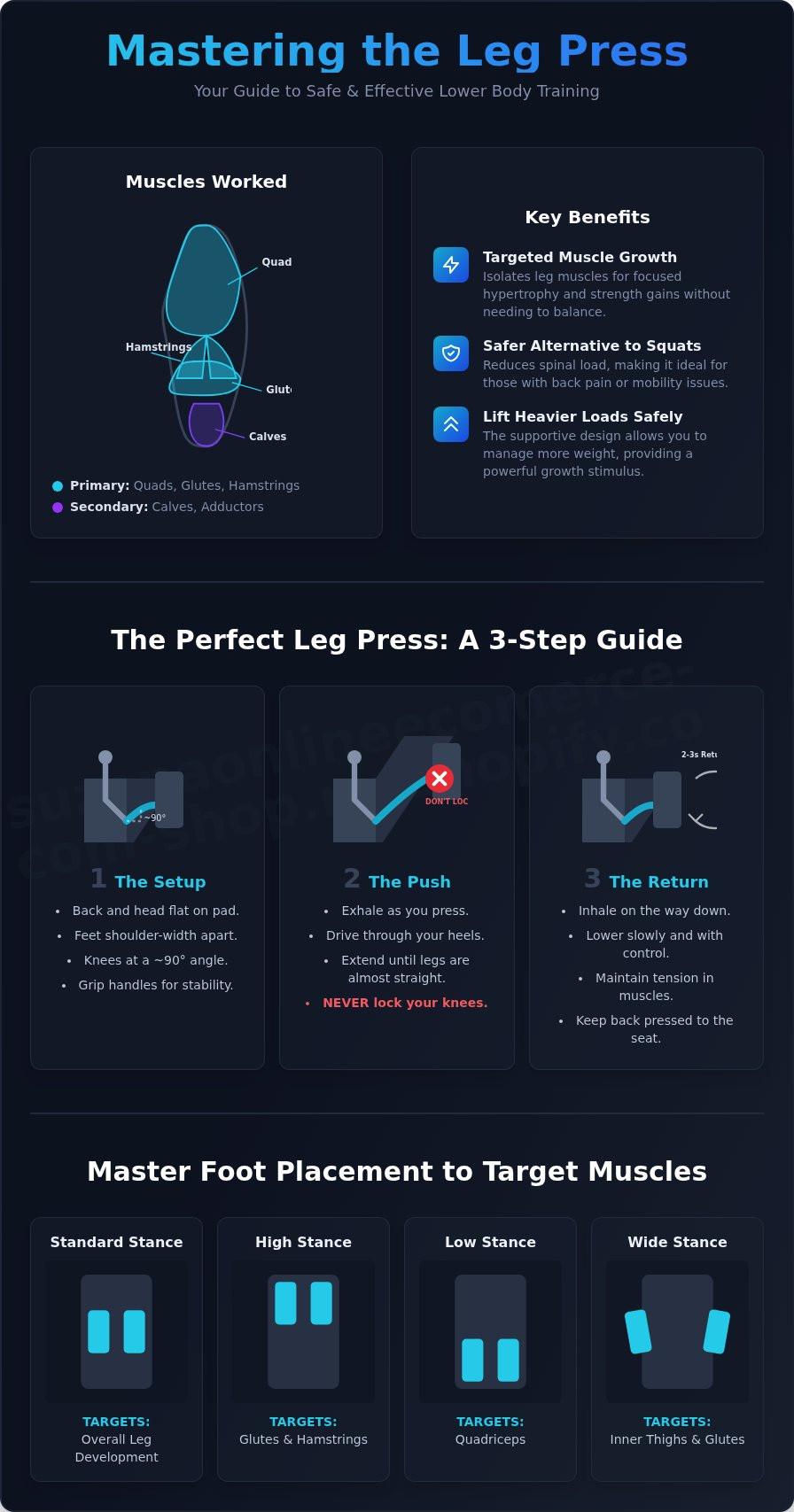
The leg press primarily targets the powerhouse muscles of your lower body. The quadriceps, located on the front of your thighs, do the heavy lifting as you extend your knees. The gluteus maximus (your glutes) and the hamstrings at the back of your thighs assist powerfully in hip extension. Additionally, secondary muscles like the adductors (inner thighs) and calves are engaged to stabilize the movement and contribute to the overall push.
Types of Leg Press Machines
You'll typically encounter three main variations in the gym, each with a slightly different feel:
- The Standard 45-Degree Leg Press (Sled Type): This is the most common model, where you sit in a reclined position and push a weighted sled upwards at a 45-degree angle.
- The Horizontal/Seated Leg Press: On this machine, you sit upright and push a platform away from your body horizontally. It often uses a weight stack, making it very user-friendly for beginners.
- The Vertical Leg Press: A less common type where you lie flat on your back and press a platform directly upwards. This variation requires strict form to protect the lower back.
Key Benefits of Using a Leg Press
Incorporating the leg press into your routine offers several distinct advantages:
- Targeted Muscle Growth: The fixed movement path helps isolate the leg muscles, allowing you to focus purely on hypertrophy and strength without worrying about balance.
- A Safer Alternative to Squats: For individuals with back pain, spinal issues, or shoulder mobility limitations, it provides a way to train legs heavily with significantly less risk.
- Lift Heavier Loads: The supportive design enables you to safely manage more weight than you could with most free-weight exercises, which can be a powerful stimulus for growth.
- Build a Strong Foundation: Using a leg press machine is an effective way for beginners to build foundational leg strength before progressing to more complex movements like squats and lunges.
The Perfect Leg Press: A Step-by-Step Form Guide
Before you even think about loading up the plates, remember this golden rule: form trumps weight, every single time. A properly executed rep with lighter weight will build more strength and prevent injury far better than a sloppy, heavy one. The leg press machine is a powerful tool for developing your quads, hamstrings, and glutes, but only when you master the fundamentals. Let's break down the perfect leg press into three simple phases.
Step 1: Setting Up for Success
Your setup determines the safety and effectiveness of the entire exercise. Take a moment to adjust the machine to your body before adding weight. A poor setup can lead to an ineffective workout or even injury.
- Adjust the Seat: Position the backrest so that when your feet are on the platform, your knees form roughly a 90-degree angle. Your hips should be comfortably below your knees.
- Place Your Feet: Plant your feet flat on the platform, about shoulder-width apart, with your toes pointing slightly outwards or straight ahead.
- Secure Your Body: Ensure your entire back and head are pressed firmly and flatly against the padded support. There should be no arch in your lower back.
- Grip the Handles: Lightly grip the support handles to keep your upper body stable and prevent your hips from lifting off the seat during the movement.
Step 2: The Push Phase
With your body locked in, you're ready to move the weight. This is the "concentric" part of the lift. As you push, focus on driving the force through your heels and midfoot, not your toes. Exhale forcefully as you extend your legs. Crucially, press until your legs are almost straight, but never lock your knees at the top. This keeps tension on the muscles and protects your joints from hyperextension. While the debate over the Leg Press vs. Squat highlights different benefits, the controlled path of this machine is a key safety feature when you avoid this mistake. Once the platform is up, release the safety catches.
Step 3: The Controlled Return
The "negative" or "eccentric" phase is just as important as the push. Don't just let the weight drop. Inhale and slowly lower the platform back to the starting position over a count of 2-3 seconds. Maintain control throughout the entire descent, ensuring your lower back remains pinned to the seat. As soon as you reach the starting 90-degree angle, smoothly transition into your next repetition without resting at the bottom. This maintains constant tension on the muscles, maximizing the exercise's effectiveness.
Mastering Foot Placement to Target Different Muscles
Once you’ve nailed the basic movement, you can unlock the full potential of the leg press machine by making small adjustments to your foot placement. These subtle shifts can change the emphasis of the exercise, allowing you to target specific muscle groups more effectively. Think of this as advanced knowledge to fine-tune your lower body workouts. However, always master the standard position with a comfortable weight before experimenting with these variations.
Standard Foot Placement (Overall Development)
This is your foundational stance and the best place to start. Place your feet shoulder-width apart in the center of the platform with your toes pointing slightly outward. This neutral position provides the most balanced muscle activation, engaging your quadriceps, glutes, and hamstrings almost equally. Before trying any variations, it's crucial to perfect this foundational movement. For a detailed breakdown of proper form, this Seated Leg Press Exercise Guide from ACE Fitness is an excellent resource to ensure you're performing the exercise safely and correctly.
High Foot Placement (Glute and Hamstring Focus)
To shift the focus to your posterior chain, place your feet higher on the platform. This position increases the degree of hip flexion and extension required during the movement, which forces your glutes and hamstrings to do more of the work. Many people find this variation is also kinder on the knees, making it a great option if you experience knee discomfort with the standard placement.
Low Foot Placement (Quadriceps Focus)
For greater quad activation, position your feet lower on the platform. This placement increases the range of motion at the knee joint, putting a greater load on the quadriceps, particularly the muscles just above the kneecap. Be cautious with this variation, as it can increase stress on the knee joint. It's wise to reduce the weight until you are comfortable with the form.
Wide vs. Narrow Stance
Adjusting the width of your stance on the leg press machine platform also changes the muscular emphasis. Keep your toes pointed slightly out and always ensure your knees track in line with your feet to protect your joints.
- Wide Stance: Placing your feet wider than shoulder-width apart will activate your inner thigh muscles (adductors) and gluteus medius more effectively.
- Narrow Stance: A hip-width or narrower stance tends to target the outer quadriceps (vastus lateralis) and can help build the coveted "quad sweep."
7 Common Leg Press Mistakes and How to Avoid Them
Using the leg press machine correctly is the key to unlocking its full potential while protecting yourself from injury. Ego lifting-piling on more weight than you can handle with proper form-is the fastest way to get hurt and slow your progress. By focusing on technique over tonnage, you build a stronger, more resilient lower body.
Are you making one of these common errors? Here’s how to identify and fix four of the most critical mistakes to ensure your workout is both safe and effective.
1. Lifting Your Hips Off the Seat
This is arguably the most dangerous leg press mistake. When your glutes and lower back lift off the seat pad as you lower the weight, the stress transfers directly to your lumbar spine. This rounded-back position puts your spinal discs at significant risk of injury. Your legs should be doing the work, not your back.
- The Fix: Check your ego at the door and reduce the weight. Focus on keeping your entire back and hips firmly planted in the seat throughout every single repetition. Ensure the back pad is adjusted so you can sit comfortably without rounding your lower back.
2. Locking Out Your Knees
Forcefully straightening and "locking" your knees at the top of the press momentarily shifts the entire load from your muscles to your knee joints. This not only increases the risk of hyperextension and joint damage but also gives your muscles a rest, reducing the time under tension needed for growth.
- The Fix: Always keep a slight, soft bend in your knees at the peak of the movement. This ensures the tension stays on your quads, glutes, and hamstrings, maximizing the exercise's effectiveness and protecting your joints.
3. Using a Partial Range of Motion
Performing shallow half-reps is a common way to lift heavier weight, but it severely limits your results. Failing to go deep enough means you aren't fully engaging the target muscles, especially the glutes and hamstrings, which are activated more in the deeper part of the press.
- The Fix: Lighten the load until you can lower the platform with control until your knees form at least a 90-degree angle. A full range of motion stimulates more muscle fibers, leading to better strength and hypertrophy.
4. Letting Your Knees Cave Inward
If you notice your knees collapsing toward each other during the press (a condition known as knee valgus), you're putting your knee ligaments under dangerous strain. This often stems from weak hip abductor muscles and poor neuromuscular control, increasing your risk of an acute or chronic injury.
- The Fix: Actively think about pushing your knees outward so they track in line with your feet. If needed, adopt a slightly wider foot stance. For extra help, try placing a resistance band just above your knees to provide tactile feedback and force your abductors to engage.
Leg Press vs. Squats: Which is Right For Your Goals?
The leg press versus squat debate is a classic in the fitness world, but the answer isn't about which one is definitively "better." Instead, it's about which exercise best aligns with your specific goals, experience level, and physical needs. Both are phenomenal lower-body builders, but they shine in different areas. Understanding their unique benefits helps you build a smarter, more effective workout plan.
When to Choose the Leg Press
The leg press is an excellent choice when you need to minimize stress on your spine. Because your back is fully supported, it's ideal for individuals with lower back pain or those recovering from certain injuries. This stability also allows you to safely push heavier weights than you might be able to squat, providing a powerful stimulus for muscle growth (hypertrophy). The leg press machine is also fantastic for muscle isolation; a high foot placement targets glutes and hamstrings, while a lower placement emphasizes the quads.
When to Choose Squats
Choose barbell squats when your goal is to build full-body, functional strength. As a free-weight compound exercise, squats demand engagement from your entire core, glutes, and back muscles to stabilize the load. This translates directly to real-world activities like lifting heavy objects and improves overall athletic performance. Squats are also the king of efficiency if you have limited equipment-all you need is a barbell and some weights to challenge your entire system.
How to Use Both in Your Routine
You don't have to choose one over the other. Integrating both exercises into your training can deliver comprehensive results. Here are a few popular strategies:
- Prioritize Strength: Start your workout with heavy squats when you're fresh. This recruits the most muscle and taxes your nervous system. Follow up with the leg press to add more training volume without fatiguing your stabilizers.
- Focus on Volume: Use the leg press machine as your primary heavy lift for the day and finish with lighter goblet or bodyweight squats to work on form and mobility.
- Alternate Workouts: Dedicate one leg day to squat variations (Workout A) and the next to leg press variations (Workout B). This allows you to focus on progressive overload for each movement.
Ultimately, the best routine is one that supports your goals and keeps you training consistently. Ready to build your home gym? Check out our fitness equipment!
Press Forward with Confidence and Power
You now have the knowledge to transform your leg days. Remember that mastering the leg press machine isn't just about lifting heavy; it's about precision, safety, and strategy. By prioritizing proper form to protect your back and knees and strategically adjusting your foot placement, you can effectively target your quads, glutes, and hamstrings for maximum growth. Avoiding common mistakes is the final piece of the puzzle, ensuring every repetition moves you closer to your strength goals.
Ready to bring that power home? Building the ultimate home workout space is easier than ever. We offer a wide selection of premium fitness gear that can be delivered directly to your door, making your dream gym a reality.
Explore our collection of home gym equipment to find your perfect fit! Go ahead and build the strength you deserve, one safe and effective press at a time.
Frequently Asked Questions
How much weight should I start with on the leg press?
As a beginner, you should start with a very light weight to master the form. A good starting point is often just the weight of the sled itself, or approximately 25-50% of your body weight. Focus on performing 10-12 repetitions with a full range of motion and perfect technique. Once you can do this comfortably for a few sets, you can gradually begin to add more weight in small increments each week.
Is the leg press bad for your knees or back?
The leg press is not inherently bad for your joints, but incorrect form can cause issues. The two most common mistakes are rounding your lower back by letting your hips lift off the pad, and locking your knees at the top of the movement. To protect your back and knees, ensure your hips and back stay firmly pressed against the seat throughout the exercise and always keep a slight bend in your knees at the peak of the press.
Can you build big legs with just the leg press machine?
Yes, the leg press is an excellent tool for building mass in your quadriceps and glutes. Because it supports your back, you can often lift heavier weight than with free-weight squats, which is fantastic for muscle hypertrophy. However, for balanced and complete leg development, it's best to combine the leg press machine with exercises that specifically target the hamstrings and calves, such as hamstring curls and calf raises, for a well-rounded routine.
How many sets and reps of leg press should I do?
Your ideal set and rep range depends on your fitness goals. For building muscle size (hypertrophy), a common and effective range is 3 to 4 sets of 8 to 12 repetitions. If your primary goal is to build maximum strength, you might aim for 3 to 5 sets of 5 to 8 reps with a heavier weight. In either case, ensure the last couple of reps in each set are challenging but still allow for proper form.
What is a good alternative to the leg press if my gym doesn't have one?
If a leg press isn't available, there are several great alternatives. Barbell squats (both front and back) are the classic compound movement for overall leg development. Hack squats are another machine-based option that closely mimics the movement. For a free-weight alternative that is easier on the back than barbell squats, consider holding a heavy dumbbell or kettlebell for goblet squats or performing weighted walking lunges to effectively target your quads and glutes.
Should my heels come off the platform during a leg press?
No, your heels should always remain flat on the platform for the entire duration of the exercise. When your heels lift, the pressure shifts forward onto your toes and can place excessive strain on your knee ligaments. Keeping your feet flat, and consciously driving the weight through your heels, ensures better stability, promotes safety, and helps you more effectively engage the target muscles-your glutes and quadriceps-for a more powerful and effective press.
How often should I incorporate leg press into my workout week?
For most lifters, incorporating the leg press into your routine one to two times per week is optimal. This frequency allows sufficient time for your leg muscles to recover and grow stronger between sessions. If you have two dedicated leg days, you could include it in both workouts, perhaps varying the intensity by focusing on heavy weight one day and higher repetitions for volume on the other. Always listen to your body and prioritize recovery.