

Interactive Dog Puzzles: The Complete Guide to Canine Mental Enrichment in 2026

A thirty-minute walk might be doing less for your dog’s behavior than ten minutes of focused problem-solving. While physical activity is necessary, mental fatigue is often the missing piece in managing high-energy breeds and destructive chewing. By integrating interactive dog puzzles into your pet’s routine, you provide a functional outlet for cognitive energy that physical exercise alone cannot reach. This approach shifts the focus from simply wearing them out to providing structured mental enrichment that leads to a calmer, more focused household.
It's understandable to feel frustrated when traditional toys don't stop separation anxiety or boredom-based behaviors. You need a reliable way to keep your pet engaged while you're away or busy. This guide provides the information you need to transform your dog's cognitive health through the science of interactive play. We'll examine the latest 2026 safety standards, including new EU regulations on non-toxic materials and Digital Product Passports, to ensure your choices are safe. You'll learn how to match puzzle difficulty to your dog's specific needs, ensuring a reduction in anxiety and a more peaceful home environment.
Key Takeaways
- Understand the "mental work ratio" and why fifteen minutes of problem-solving can be as effective as a one-hour walk for calming high-energy breeds.
- Learn the science behind the dopamine reward loop and how interactive dog puzzles provide a sense of success that reduces anxiety-based destructive behaviors.
- Identify the correct difficulty level for your pet to ensure they stay engaged without becoming frustrated by overly complex mechanics.
- Master a two-step training protocol to introduce new challenges by using "open" compartments and physical demonstrations.
- Discover how to integrate mental enrichment into daily mealtimes to slow down fast eaters and improve overall digestive health.
Beyond the Walk: Why Interactive Dog Puzzles Are Essential
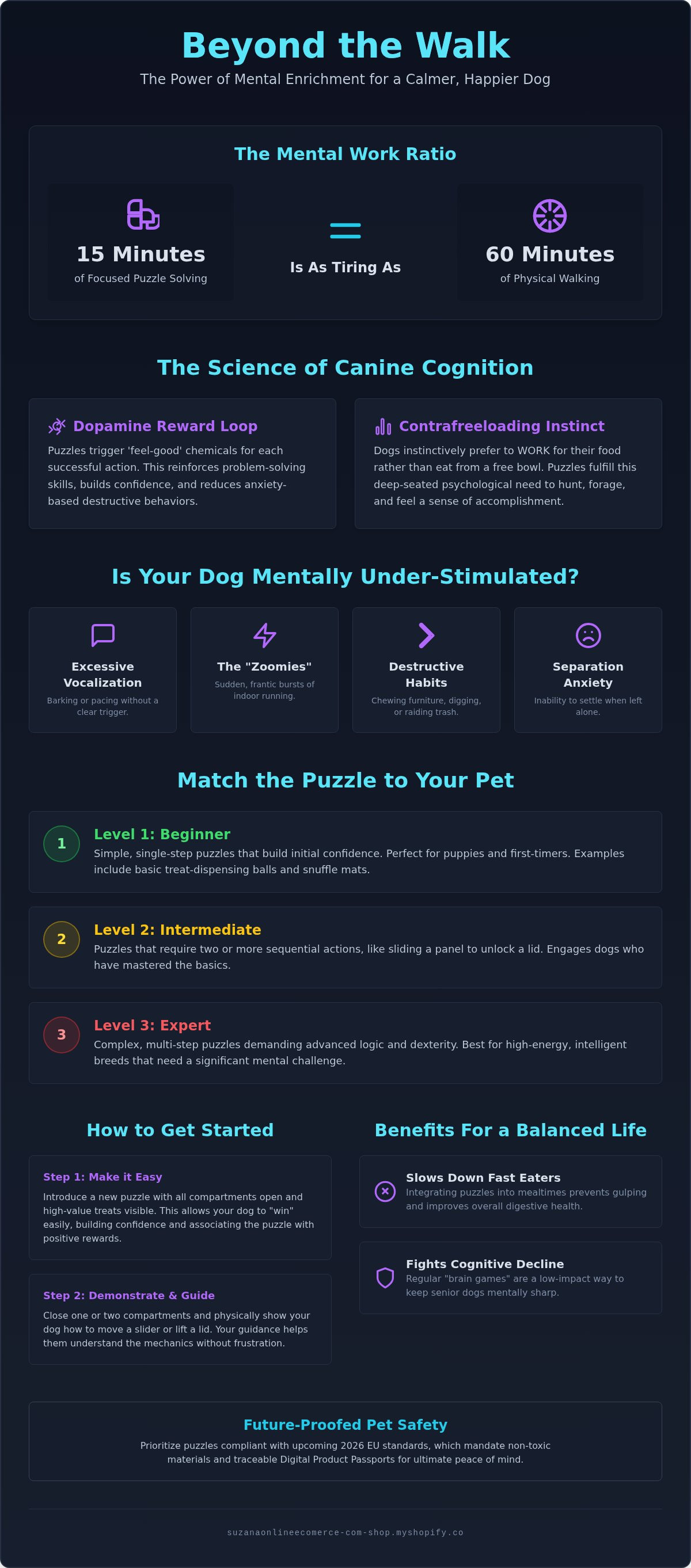
Physical exercise is only half the equation for a healthy pet. While walks provide necessary sensory input and muscle movement, interactive dog puzzles challenge the brain by requiring specific problem-solving actions to access a reward. Experts often cite a practical rule of thumb: fifteen minutes of intense mental work can be as tiring for a dog as a one-hour walk. This isn't just about convenience; it's about biology. Puzzles help lower cortisol levels, the hormone associated with stress, by providing a constructive outlet for energy that would otherwise manifest as anxiety or destructive behavior.
Most animals, including dogs, exhibit a behavior called contrafreeloading. This is the phenomenon where an animal prefers to work for food rather than eat it from a freely available bowl. It taps into their ancestral instincts to forage and hunt, making the meal itself a rewarding success rather than a passive event. When you provide a puzzle, you aren't just feeding your dog; you're giving them a job that fulfills a deep-seated psychological need.
Signs Your Dog Is Mentally Under-Stimulated
Boredom in dogs isn't always quiet. It often presents as nuisance behaviors that owners mistake for a lack of training. If your dog has already been exercised but still exhibits these signs, they likely need mental stimulation:
- Excessive Vocalization: Barking at windows or pacing the hallways without a clear external trigger.
- The Zoomies: Sudden, frantic bursts of running indoors, often occurring in the evening or after a period of inactivity.
- Destructive Habits: Chewing furniture, digging at carpets, or raiding the trash. These are often attempts to self-soothe or create their own work.
- Separation Anxiety: A lack of mental resilience can make it harder for dogs to settle when left alone, leading to panic-based behaviors.
The Role of Enrichment in Modern Pet Care
Modern pet ownership has evolved beyond providing food and shelter. True wellness now includes cognitive health. Passive toys, like a standard tennis ball, rely on repetitive physical motion. In contrast, interactive dog puzzles demand active engagement. They mimic the natural foraging patterns of wild canines, who must navigate obstacles to find sustenance. By integrating these tools into your daily pet supplies strategy, you create a balanced routine that addresses both the body and the mind. Ordering wellness-focused gear online makes it easier than ever to maintain a high standard of care for your companion. This leads to a more predictable, calmer dog who feels satisfied by their daily accomplishments.
The Science of Canine Cognition and Problem-Solving
Dogs perceive and interact with their environment through a sophisticated combination of sensory inputs. While humans rely heavily on sight, a dog's world is defined by scent and tactile manipulation. When a dog engages with interactive dog puzzles, they utilize their nose to locate rewards and their paws or snout to navigate mechanical barriers. This interaction isn't just physical. It triggers a dopamine reward loop in the brain. Each successful movement provides a hit of "feel-good" chemicals, reinforcing the behavior and making the dog feel successful and satisfied.
This biological drive is rooted in a concept known as contrafreeloading. Research shows that many animals, including domesticated dogs, actually prefer to work for their food rather than eat it from a bowl for free. This instinctual need to forage and solve problems is what makes mental enrichment so effective. While a simple treat-dispensing ball relies on random movement and gravity, complex multi-step puzzles require logical sequencing. The dog must learn that they can't reach the reward until they've completed a specific series of actions, such as sliding a panel to unlock a flippable lid.
For senior dogs, this mental stimulation is a vital defense against cognitive decline. Just as humans use puzzles to stay sharp, dogs benefit from regular "brain games" that maintain neural pathways. It's a low-impact way to keep an aging pet engaged when their physical stamina might be decreasing and they can no longer handle long, strenuous walks.
Nose Work vs. Manual Manipulation
Nose-based enrichment taps into a dog's primary sense. Scent puzzles require the dog to sniff out hidden treats, which is naturally calming and lowers the heart rate. Manual manipulation involves using paws or the tongue to move objects. High-drive breeds often excel when these two inputs are combined. To start building your dog's cognitive routine, you can browse professional-grade pet supplies that offer varied difficulty levels.
Building Confidence Through Play
Interactive play helps rescue dogs overcome "learned helplessness" by proving their actions can change their circumstances. For a shy dog, successfully opening a puzzle compartment builds the courage needed to face other daily challenges. Canine cognitive enrichment is the intentional practice of providing mental challenges that stimulate a dog's natural problem-solving abilities to improve their overall psychological well-being.
Choosing the Right Puzzle: A Difficulty Level Framework
Selecting the appropriate challenge level is the most critical step in implementing a successful mental enrichment routine. If a puzzle is too simple, your dog will solve it in seconds and remain under-stimulated. If it's too complex, they may become frustrated and lose interest entirely. A structured progression allows your pet to build the necessary cognitive skills and confidence to tackle increasingly difficult tasks. Most interactive dog puzzles categorized by difficulty follow a four-tier system that mirrors a dog's developing problem-solving abilities.
- Level 1 (Introductory): These focus on one-step actions. The dog only needs to perform a single movement, such as nudging a lid or sliding a basic disc, to reveal a reward. These are ideal for puppies or dogs new to enrichment.
- Level 2 (Intermediate): These require sequential movements. A dog might have to move one piece to clear a path for another. This level introduces the concept that one action leads to the possibility of another.
- Level 3 (Advanced): These interactive dog puzzles feature locking mechanisms. For example, a dog may need to rotate a swivel bone to "unlock" a sliding drawer. This requires significant focus and fine motor control.
- Level 4 (Expert): Designed for highly persistent and food-motivated dogs, these puzzles involve multi-layered challenges. They often combine various mechanical obstacles that must be solved in a specific, non-linear order.
Matching Puzzles to Your Dog’s Breed and Personality
Different breeds interact with objects in unique ways. "Mouth-oriented" breeds like Golden Retrievers often prefer puzzles they can pick up, carry, or manipulate with their teeth. High-stamina herding breeds, such as Border Collies or Australian Shepherds, thrive on repetitive, complex tasks that require intense focus. For toy and miniature breeds, scale is the primary concern. Ensure the puzzle pieces are small enough for their snouts to manipulate but large enough to avoid being a choking hazard. Matching the mechanical style of the toy to your dog's natural instincts ensures longer engagement and better results.
The Danger of Over-Challenging Your Dog
It's a common mistake to buy an expert-level puzzle for a beginner dog, but this often leads to "learned helplessness" where the dog simply stops trying. Watch for signs of frustration, such as aggressive pawing, biting the puzzle's frame, or walking away from the toy entirely. If your dog struggles, "step back" to a lower level or use higher-value treats, like small pieces of dried liver or cheese, to increase their motivation. The goal is to keep them in a state of "flow" where the task is challenging but achievable. Only progress to the next level once your dog can solve their current puzzle consistently and without hesitation.
How to Train Your Dog to Use Interactive Puzzles
Introducing your pet to interactive dog puzzles requires a structured approach to prevent frustration. Most dogs don't instinctively understand how to manipulate sliding panels or rotating discs; they must learn these mechanics through positive reinforcement and modeling. By following a step-by-step training protocol, you ensure your dog remains engaged and builds the cognitive resilience needed for more advanced challenges later on.
- Step 1: Start with "Open" Compartments. Place high-value treats in the puzzle but leave the lids or sliders partially open. This allows your dog to see and smell the reward immediately, establishing a clear connection between the toy and the food.
- Step 2: Demonstrate the Action. Use your finger to slide a panel or flip a lid while your dog is watching. Immediately let them take the treat. This visual modeling helps them understand which parts of the puzzle are mobile.
- Step 3: Reward Any Interaction. In the beginning, praise your dog for any physical contact with the puzzle, such as a nose nudge or a paw tap. Even if they don't successfully open a compartment, you want to reinforce the act of trying.
- Step 4: Gradually Increase Complexity. Once your dog consistently solves the "open" version, begin closing the compartments slightly more each time. Eventually, they'll understand they need to complete the full range of motion to get the reward.
- Step 5: Supervision and Guidance. Stay with your dog during the session. If they get stuck, you can "help" by nudging a piece halfway, but avoid doing the work for them. This maintains the challenge while preventing the dog from giving up.
Common Training Mistakes to Avoid
One of the most frequent errors is leaving a dog alone with a new puzzle too early. Without supervision, a frustrated dog may resort to "brute force" by biting or throwing the toy to get the food. This behavior can damage the puzzle and creates a safety risk. Additionally, using low-value dry kibble for a difficult task often leads to a lack of interest. For new or complex interactive dog puzzles, always use moist treats or small pieces of meat that provide a stronger olfactory lure. To find durable and safe options for your next training session, you can browse our collection of professional pet supplies.
Maintenance and Safety Protocols
Regular maintenance is essential for both hygiene and safety. Plastic puzzles should be cleaned after every use to remove saliva and food residue; most are dishwasher safe on the top rack. Wood-composite puzzles require a more careful approach, usually a wipe-down with a damp cloth and mild soap. Always inspect the toy for sharp edges, cracks, or loose parts that could be swallowed. Store puzzles out of reach when not in use. Keeping them as a special, supervised activity prevents the dog from habituating to them and ensures the toy remains a high-value reward for mental work.
Integrating Puzzles into Your Pet Supplies Strategy
A successful enrichment strategy requires more than just a single toy. It involves a systematic approach to your dog's daily routine. To maintain high engagement levels, you should implement a rotation schedule. Leaving interactive dog puzzles accessible at all times leads to habituation, where the dog loses interest because the challenge is no longer novel. By rotating three to five different puzzles throughout the week, you ensure the cognitive demand remains fresh and exciting for your pet.
Mealtimes offer the perfect opportunity for integration. Many dogs consume their daily kibble in under a minute, which can lead to digestive issues or regurgitation. Replacing a standard bowl with a puzzle feeder forces the dog to work for every bite. This not only slows down consumption for better digestion but also ensures they receive at least two sessions of mental work every day without requiring extra time from your busy schedule. It turns a basic necessity into a rewarding cognitive event.
For a truly comprehensive system, pair these mental challenges with durable dog toys designed for passive chewing. While puzzles provide active mental engagement, chew toys offer a different form of stress relief through repetitive physical motion. SUZANA SHOP serves as a reliable choice for curated pet supplies, allowing you to order wellness-focused gear online with professional support and global shipping capabilities.
The Long-Term Value of Quality Enrichment Gear
Investing in quality enrichment gear is a proactive financial decision. While a professional-grade puzzle has an upfront cost, it's significantly less expensive than replacing furniture, shoes, or carpets damaged by a bored, under-stimulated dog. Modern pet products in 2026 are increasingly focused on sustainability and safety. Following the EU Toy Safety Regulation (EU) 2025/2509, many manufacturers now prioritize non-toxic, BPA-free materials that are free from endocrine disruptors. Building a "brain games" library with these durable, regulated materials ensures your pet stays safe and challenged for years to come.
Final Checklist for Your First Puzzle Purchase
Before selecting a new challenge, assess your dog's specific needs to ensure a successful introduction:
- Problem-Solving Style: Does your dog prefer using their nose for scent-based work or their paws for manual manipulation?
- Appropriate Sizing: Select a size that matches your dog's breed to prevent small parts from becoming choking hazards.
- Material Choice: Decide between easy-to-clean, dishwasher-safe plastics or tactile wood-composite materials.
Check out our full range of pet supplies to find the perfect match for your dog's cognitive level and personality.
Advancing Your Pet’s Mental Wellbeing
Transitioning from passive play to active cognitive engagement is a fundamental shift in modern pet care. By understanding the science of canine problem-solving and selecting the appropriate difficulty level, you can effectively manage common behavioral issues like destructive chewing and separation anxiety. Integrating interactive dog puzzles into daily routines, especially during mealtimes, provides the structured mental stimulation your pet needs to remain calm and satisfied. This approach ensures that your dog's psychological needs are met alongside their physical exercise requirements; for more tips on staying safe during those physical outings, Pet ID Tags Australia provides a helpful guide on quality pet gear.
SUZANA SHOP serves as a reliable partner in this journey, offering a curated selection of everyday essentials designed to support long-term pet wellness. Our platform combines global shipping capabilities with professional customer support to ensure you have access to the best tools for your household. Improving your dog's cognitive health is a practical investment in a more peaceful home environment. Shop the full Pet Supplies collection at SUZANA SHOP to find the perfect enrichment gear for your companion today.
Frequently Asked Questions
Are interactive dog puzzles safe to leave alone with my dog?
No, you should always supervise your dog during puzzle play. Puzzles often contain small moving parts like sliders, lids, or removable pegs that can become choking hazards if a dog decides to chew them off. While modern 2026 models meet strict safety standards, they are not designed as unsupervised chew toys. Always remove the puzzle once the treats are gone to prevent your pet from trying to dismantle the device out of frustration.
How do I clean a dog puzzle toy properly?
Most plastic interactive dog puzzles are dishwasher safe on the top rack, which makes sanitizing them simple. Use a mild, pet-safe detergent and warm water to thoroughly remove saliva and food residue from the compartments. For wood-composite puzzles, avoid soaking them as they may warp. Instead, use a damp cloth and a soft brush to clean out the crevices. Regular cleaning prevents bacterial growth and keeps the enrichment tool hygienic for daily use.
What are the best treats to use in a dog puzzle?
The most effective rewards are those with a strong aroma and high protein content to maintain your dog's interest. Using a high-quality option like Ruff Bar is an excellent choice, as these grain-free bars can be easily broken into smaller, enticing pieces that fit perfectly into most puzzle compartments. High-value treats ensure the dopamine reward loop remains strong during difficult tasks.
Can interactive puzzles help with my dog’s separation anxiety?
Yes, puzzles are a powerful tool for managing separation anxiety by redirecting the dog's focus toward a rewarding task. Providing a puzzle right before you leave creates a positive association with your departure. It keeps their brain occupied during the critical first twenty minutes when anxiety levels are usually at their highest. However, puzzles should be part of a broader behavioral plan and are most effective when the dog is already comfortable with the specific toy.
What if my dog gets frustrated and tries to chew the puzzle?
If your dog resorts to chewing or "brute force," the puzzle is likely too difficult for their current skill level. Immediately stop the session and reset the puzzle to an easier configuration. You can also "help" them by partially opening compartments to demonstrate how the food is accessed. Training should always be a positive experience; frustration is a clear signal that the dog needs more guidance or a simpler challenge to build their confidence.
How often should I give my dog a puzzle toy?
You can provide a puzzle toy every day, ideally during scheduled mealtimes or during periods when your dog needs to settle. Daily use helps maintain cognitive health and provides a reliable outlet for mental energy. To keep interest high, rotate between different types of interactive dog puzzles. This prevents the dog from memorizing a single solution and ensures they continue to actively problem-solve rather than simply going through the motions to get their food.
Are these puzzles suitable for puppies or senior dogs?
Puzzles are excellent for both life stages. For puppies, they help develop early problem-solving skills and prevent boredom-based destructive habits. For senior dogs, puzzles provide vital, low-impact mental stimulation that keeps the brain sharp as physical activity levels naturally decrease. Always choose a size appropriate for the dog's age and jaw strength to ensure the pieces are manageable and safe, especially for seniors with dental issues or puppies with smaller snouts.
Can I use my dog’s regular kibble in these puzzles?
Absolutely. Using regular kibble is a highly effective way to turn a standard meal into an enrichment activity. It significantly slows down fast eaters, which aids in better digestion and prevents bloating. If your dog isn't motivated by kibble alone, try mixing in a few high-value treats to encourage them to start. This strategy makes daily feeding more engaging and ensures your dog gets their mental "workout" without adding excessive calories to their daily diet.