

Lat Pulldown: Your Ultimate Guide to Proper Form and Back Growth

You step up to the machine, grip the bar, and pull... but all you feel is a strain in your biceps and a nagging doubt in your mind. If you're tired of feeling the lat pulldown everywhere except your back, or you’re worried that one wrong move could lead to injury, you've come to the right place. The internet is filled with conflicting advice, leaving you more confused than confident. It's frustrating when a key back-building exercise feels ineffective or, worse, unsafe.
This guide is your new blueprint. We're cutting through the noise to give you a clear, step-by-step path to mastering this powerhouse movement. You'll learn exactly how to set up the machine for your body, execute each rep with perfect form, and finally feel that mind-muscle connection fire up your lats. Say goodbye to uncertainty and get ready to build a wider, stronger back with the confidence of a pro.
What is the Lat Pulldown and What Muscles Does It Work?
Walk into any gym, and you'll find someone performing the lat pulldown. This foundational exercise is a cornerstone of back training for good reason. It’s highly effective for building a strong, broad back, which not only contributes to a powerful V-taper physique but also plays a crucial role in improving your overall posture. The movement itself is straightforward: think of pulling your elbows from an overhead position straight down towards the floor, keeping them close to your sides.
While often compared to the pull-up, the lat pulldown is significantly more accessible. Because you can easily adjust the weight, it's an ideal starting point for beginners who haven't yet developed the strength for pull-ups and a versatile tool for advanced lifters to isolate their back muscles with precision. This machine-based Pulldown exercise effectively targets several key muscle groups in your upper body, making it a highly efficient movement.
Primary Muscle Targeted: The Latissimus Dorsi
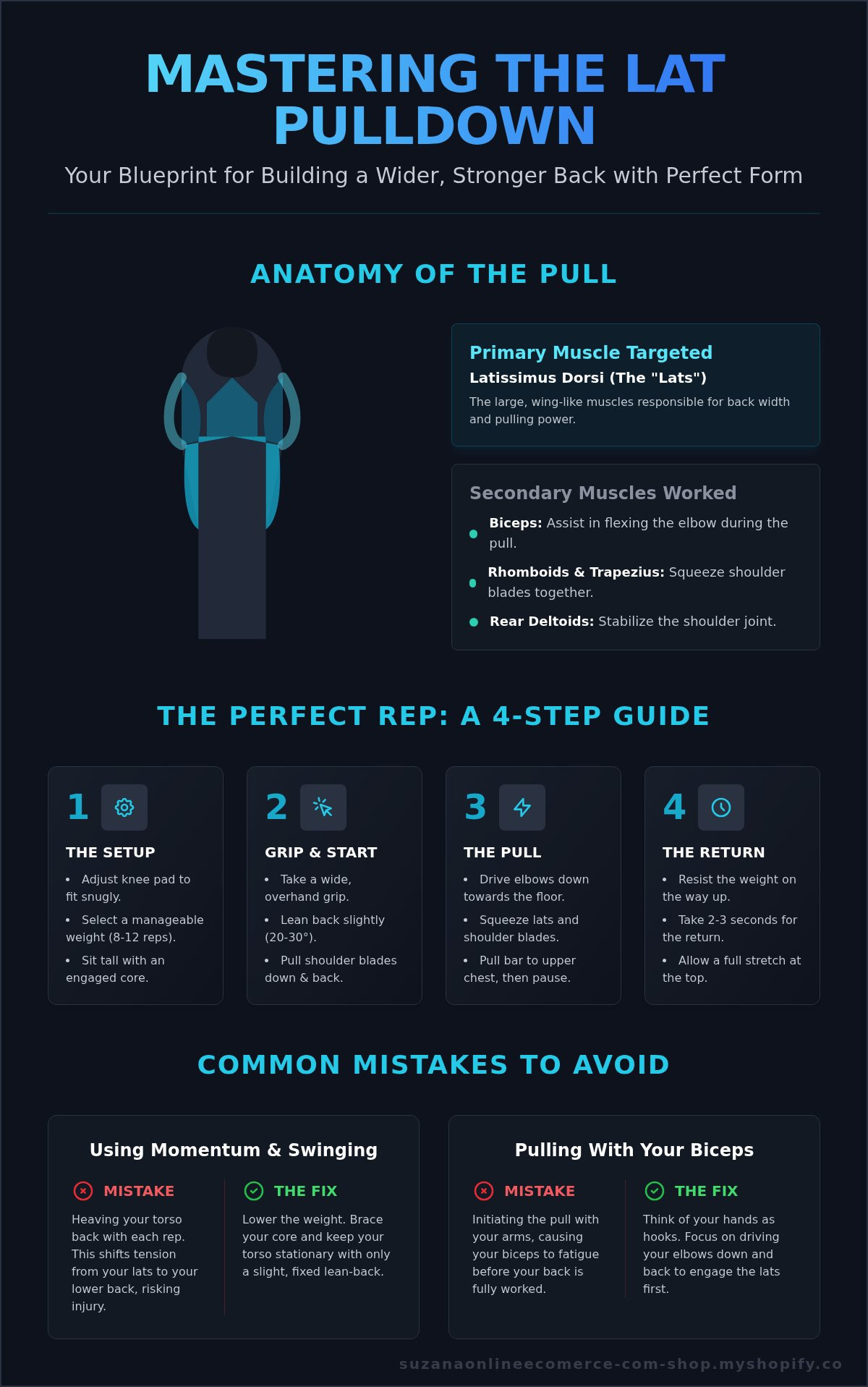
The main star of the show is the latissimus dorsi, or "lats." These are the large, wing-like muscles that span the width of your back. Their primary function is to pull the arms down and in toward the body (adduction). By strengthening your lats, you directly increase the width of your back, creating a more defined and powerful silhouette. This exercise is one of the most direct ways to stimulate and grow these essential muscles.
Secondary Muscles Worked
While the lats do the heavy lifting, several other muscles jump in to assist and stabilize the movement. A well-executed pulldown is a true team effort involving:
- Biceps: As you pull the bar down, your biceps engage to help flex the elbow. They act as a powerful synergist in the pulling motion.
- Rhomboids and Trapezius: Located in your upper-middle back, these muscles are responsible for scapular retraction-the act of squeezing your shoulder blades together as you pull.
- Rear Deltoids: The posterior head of your shoulder muscle (rear delt) works to stabilize the shoulder joint throughout the exercise, ensuring a safe and effective range of motion.
How to Perform the Lat Pulldown: A Step-by-Step Guide
Mastering the lat pulldown isn't about lifting the heaviest weight possible; it's about precision and control. To get the most out of this classic back-builder, you must prioritize form over ego. Before you add plates, focus on mastering the movement with a light, manageable weight. The goal is to establish a strong mind-muscle connection, ensuring your back-not your biceps-is doing the heavy lifting. We'll break the perfect lat pulldown down into four simple phases.
Step 1: The Setup
Your setup is the foundation for a successful and safe lift. Taking a moment to get it right prevents injury and maximizes muscle activation. Follow these key steps:
- Adjust the Knee Pad: Lower the pad until it fits snugly across your thighs. This anchors your body to the seat and prevents you from lifting off as you pull the weight down.
- Select the Weight: Choose a weight you can confidently control for 8-12 repetitions with perfect form. Remember, ego has no place here.
- Sit with Proper Posture: Sit tall on the seat, facing the machine, with your chest held high and your core engaged.
Step 2: The Grip and Starting Position
With your station set, it's time to establish your starting position. Grasp the bar with a wide, overhand grip, typically just outside the width of your shoulders. Once you have a secure grip, lean back slightly-about 20-30 degrees-to create a clear path for the bar. This posture, which is also highlighted in this comprehensive ACE Fitness exercise guide, is crucial. The final, most important step here is to engage your scapula by pulling your shoulder blades down and back. This pre-activates your lats before the pull even begins.
Step 3: The Pull (Concentric Phase)
This is the work phase where you contract your back muscles. Initiate the movement by thinking about driving your elbows down and back towards the floor, not just pulling with your hands. As the bar descends, actively squeeze your shoulder blades together. Pull the bar down smoothly until it reaches your upper chest, just below your collarbone. Pause here for a brief moment, focusing on the intense contraction in your lats.
Step 4: The Controlled Return (Eccentric Phase)
The return journey is just as important as the pull. Instead of letting the weight stack crash down, resist it on the way up. Slowly extend your arms and let the bar return to the starting position over a two to three-second count. This controlled negative enhances muscle growth and reinforces proper form. Allow your lats and shoulder blades to stretch fully at the top before beginning your next powerful repetition.
The 5 Most Common Lat Pulldown Mistakes (And How to Fix Them)
You can perform thousands of reps, but if your form is off, you're leaving muscle growth on the table and opening the door to injury. Nailing your technique is the secret to unlocking the full potential of the lat pulldown. These five common mistakes are often the only things standing between you and a stronger, wider back.
To see if you're guilty of any of these, try filming a set on your phone or ask a knowledgeable friend to watch your form. A quick check can make all the difference.
Mistake #1: Using Momentum and Swinging Your Torso
If you're heaving your body back with every rep, you're using momentum, not muscle. This common ego-lifting error takes the tension directly off your lats and places dangerous shearing force on your lower back. The goal is to move the weight with your back muscles, not by swinging your entire body.
The Fix: Lower the weight immediately. Before you pull, brace your core as if you're about to take a punch. Maintain a slight, stationary lean-back (about 15-20 degrees) throughout the entire set. The only things that should be moving are your arms.
Mistake #2: Pulling with Your Biceps, Not Your Back
Do your biceps and forearms feel like they're on fire while your back feels nothing? You're likely initiating the pull with your arms. This turns a powerhouse back-building exercise into a very inefficient bicep curl, defeating the primary purpose of the movement.
The Fix: Think of your hands as simple hooks. Your goal isn't to pull the bar down with your hands, but to drive your elbows down and back towards your hips. This mental cue helps engage the lats and makes them the prime movers.
Mistake #3: Pulling the Bar Behind Your Neck
This is an outdated and risky technique that offers no additional benefit over the standard lat pulldown. Pulling the bar behind your neck forces your shoulders into an unnatural position of external rotation, placing significant stress on the delicate rotator cuff and your cervical spine.
The Fix: This one is simple and non-negotiable. Always pull the bar down in front of your body, aiming for your upper chest, just below the collarbone.
Mistake #4: Rounding Your Shoulders and Back
As you pull the bar down, it's common to see the shoulders slump and roll forward. This posture immediately disengages your lats and upper back muscles. It not only sabotages your results but also reinforces poor postural habits that can carry over into your daily life.
The Fix: Keep your chest proud and your shoulder blades pulled down and back throughout every single rep. Imagine you are trying to tuck your shoulder blades into your back pockets. This keeps the tension exactly where it belongs: on your lats.
Mistake #5: Not Using a Full Range of Motion
Partial reps yield partial results. Stopping the bar at your chin or only letting your arms extend halfway up cheats your muscles out of crucial time under tension. You miss both the full stretch at the top and the peak contraction at the bottom, which are vital for stimulating growth.
The Fix: Control the bar all the way up until your arms are fully extended, feeling a good stretch in your lats. Then, pull the bar down until it touches, or nearly touches, your upper chest. A full range of motion ensures you work the muscle completely.
Lat Pulldown Variations for a Complete Back Workout
Once you have perfected the standard form, you can introduce variations to your routine to build a truly well-rounded back. Simply changing your grip or the attachment you use can shift the exercise's emphasis, allowing you to target different muscle fibers. This is a powerful strategy for adding variety, stimulating new growth, and breaking through frustrating strength plateaus.
Before exploring these alternatives, ensure your form on the conventional lat pulldown is flawless. Proper technique is the foundation for getting the most out of every variation and, more importantly, for preventing injury.
Wide-Grip Pulldown (Standard)
This is the classic variation we've focused on throughout this guide. It's the cornerstone of back training for a reason. By placing your hands wider than your shoulders with an overhand grip, you maximize the engagement of the latissimus dorsi.
- Primary Muscle Focus: Outer lats (latissimus dorsi).
- Best For: Developing back width and building the iconic 'V-taper' physique.
Close Neutral-Grip Pulldown
For this variation, you'll swap the long bar for a V-bar attachment, allowing you to pull with your palms facing each other. This neutral grip changes the angle of the pull, allowing for a greater range of motion and a deep stretch at the top of the movement. Your biceps will also play a more significant supporting role.
- Primary Muscle Focus: Lower lats, rhomboids, and mid-back.
- Best For: Adding overall thickness and density to your back.
Reverse-Grip (Underhand) Pulldown
Also known as the supinated pulldown, this variation involves gripping the bar at shoulder-width with your palms facing you. This hand position significantly increases bicep activation, turning the exercise into a fantastic two-in-one movement for your back and arms. Many lifters find they can pull more weight with this grip, providing excellent overload for the lower lats.
- Primary Muscle Focus: Lower lats and biceps.
- Best For: A powerful back and bicep combination that adds mass to your lower lats.
Experimenting with these grips can unlock new gains in your back development. To support every lift, make sure you have the right equipment. Explore our collection of quality gym gear and accessories today.
Lat Pulldown Alternatives: No Machine? No Problem.
The lat pulldown machine is a fantastic tool for building a wide, powerful back, but what if you don't have access to one? Don't worry. Whether you're training in a home gym or working with limited equipment, you can still effectively target and strengthen your latissimus dorsi muscles. These alternatives provide a similar stimulus to build the back you want, no machine required.
Pull-Ups / Chin-Ups
Often considered the gold standard of back exercises, the pull-up is the ultimate test of upper body strength. While challenging, it's a goal worth pursuing for its incredible back-building potential. The main difference lies in your grip:
- Pull-Ups: An overhand (pronated) grip, typically wider than your shoulders. This variation places a greater emphasis on the lats.
- Chin-Ups: An underhand (supinated) grip, about shoulder-width apart. This grip increases bicep involvement, which can make the movement slightly easier for beginners.
If you can't perform a full rep, start with assistance bands to support your body weight and build foundational strength.
Resistance Band Pulldowns
This is the most direct and portable alternative to a machine-based lat pulldown. It perfectly mimics the movement pattern and is incredibly easy to set up anywhere. Simply anchor a long-loop resistance band to a high point, like the top of a door or a pull-up bar. Kneel or sit on the floor, grab the band with both hands, and pull down towards your upper chest, focusing on squeezing your shoulder blades together. Find the perfect resistance bands for your home workout to get started.
Dumbbell or Kettlebell Pullovers
A classic bodybuilding movement, the pullover is unique because it effectively targets both the lats and the chest. To perform it, lie with your upper back across a flat bench and your feet firmly on the floor. Hold a single dumbbell or kettlebell with both hands straight above your chest. Keeping a slight bend in your elbows, lower the weight in an arc behind your head until you feel a deep stretch in your lats. Use your back muscles to pull the weight back to the starting position.
Your Journey to a Powerful Back Starts Now
You are now equipped with the knowledge to execute the perfect lat pulldown, avoiding common pitfalls and maximizing every single rep. Remember that mastering the mind-muscle connection and controlling the movement are the true secrets to unlocking significant back growth. Whether you're using a machine, trying new variations, or exploring effective alternatives, the path to a stronger, more defined back is clear and within your reach.
Ready to bring this dedication to your home workouts? We offer a wide selection of fitness and wellness products to help you create your ideal training environment. You can build your home gym with our versatile equipment and enjoy a secure and easy checkout process every time. Take the next step in your fitness journey with the right gear.
Explore our collection of home gym equipment to build your perfect workout space.
Keep pulling, stay consistent, and watch your strength soar!
Frequently Asked Questions About the Lat Pulldown
How much weight should I use on the lat pulldown?
Choose a weight that allows you to complete 8-12 repetitions with perfect form. The last two reps of each set should feel challenging, but not impossible. If you can't control the weight on the way up or have to use momentum, it's too heavy. Start lighter to master the movement, then gradually increase the weight over time as you get stronger. Your form is always the top priority over the amount of weight lifted.
Is a wide grip or close grip better for building my lats?
Both grips are effective but target the back muscles slightly differently. A wide grip (just outside your shoulders) emphasizes the outer lats, which helps create a wider V-taper. A closer, underhand, or neutral grip brings more of your biceps and mid-back muscles into the movement. For balanced development, it's best to incorporate a variety of grip widths into your routine, but a standard overhand, slightly-wider-than-shoulder-width grip is an excellent foundation.
Why do I feel lat pulldowns in my arms and forearms more than my back?
This is a common issue caused by initiating the pull with your biceps instead of your back. To fix this, focus on the mind-muscle connection. Think of your hands as simple hooks and concentrate on driving your elbows down and back towards the floor. Squeeze your shoulder blades together at the bottom of the movement. Reducing the weight and slowing down the tempo can help you feel the correct muscles working and build that crucial connection.
How many sets and reps should I do for muscle growth?
For muscle hypertrophy (growth), a great starting point is 3 to 4 sets of 8 to 12 repetitions. This range provides the ideal combination of mechanical tension and metabolic stress to stimulate muscle development. Make sure you are resting for about 60-90 seconds between sets. This allows for adequate recovery so you can maintain intensity and proper form throughout all of your working sets, leading to better results over time.
Is it safe to pull the bar behind my neck?
No, performing behind-the-neck pulldowns is generally not recommended. This variation places your shoulder joints in an externally rotated and vulnerable position, significantly increasing the risk of rotator cuff impingement and injury. Pulling the bar down to your upper chest is a much safer alternative that is just as, if not more, effective for engaging your lats. Always prioritize joint health and longevity by sticking to the front pulldown.
What's the difference between a lat pulldown and a pull-up?
The primary difference is that a lat pulldown involves pulling a fixed weight down to your body, while a pull-up involves pulling your body up to a fixed bar. Pulldowns are an open-chain exercise, making it easier to isolate the lats and adjust the resistance. Pull-ups are a closed-chain, bodyweight exercise that requires more overall strength and core stability. Both are excellent for building back strength, but pulldowns are more accessible for beginners.
Can I build a big back with just lat pulldowns?
While the lat pulldown is a fantastic exercise for developing back width, it's not enough on its own to build a complete, "big" back. A well-rounded back has both width and thickness. To build thickness, you must incorporate horizontal pulling movements, or rows. Exercises like bent-over barbell rows, T-bar rows, and dumbbell rows are essential for developing the muscles of the mid and upper back. Combine pulldowns with rows for comprehensive back development.