

Leg Extension Machine: The Ultimate Guide to Form, Dos, and Don'ts

That familiar twinge in your knees when you sit down at the leg extension machine-is it just part of the process, or a serious warning sign? You're not alone in wondering. This piece of gym equipment is a powerhouse for isolating and building powerful quads, but it's also one of the most misunderstood. When used incorrectly, it can lead to discomfort and put unnecessary strain on your joints, leaving you feeling frustrated and worried about long-term damage instead of celebrating a great workout.
It’s time to eliminate the guesswork and unlock this machine's true potential safely and effectively. In this ultimate guide, we will show you exactly how to make the leg extension a cornerstone of your leg day. You'll learn how to set up the machine perfectly for your unique body, execute every repetition with flawless form, and finally feel that satisfying burn exclusively in your quads. Get ready to build stronger legs with total confidence, knowing you’re protecting your knees and maximizing every single rep.
What is a Leg Extension Machine and What Muscles Does It Work?
The leg extension is a classic isolation exercise designed to strengthen and define the quadriceps muscles on the front of your thighs. As a single-joint movement, the Leg extension focuses exclusively on knee extension, making it a powerful tool for targeting the quads without engaging the glutes or hamstrings. This makes it an excellent finishing exercise to exhaust the quadriceps after compound movements or a key exercise in rehabilitation programs to rebuild strength around the knee joint.
To see how to perform this exercise with correct form, watch this helpful video:
Anatomy of the Quadriceps
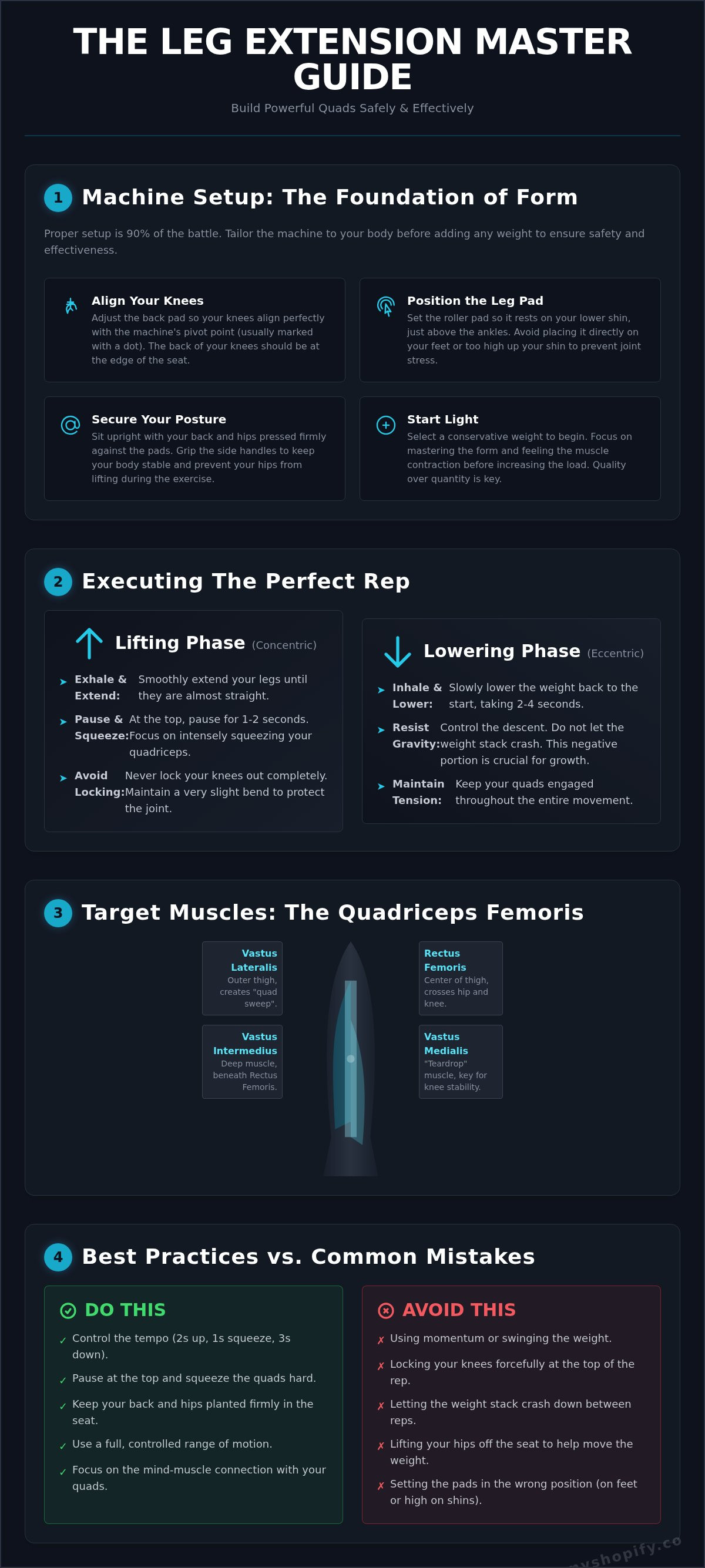
The primary target of the leg extension machine is the quadriceps femoris, a group of four powerful muscles responsible for extending the knee and flexing the hip. Understanding them helps you create a mind-muscle connection for better results.
- Rectus Femoris: The most prominent quad muscle, running down the center of the thigh. It's unique because it crosses both the hip and knee joints.
- Vastus Lateralis: Located on the outer side of the thigh, this muscle contributes to the "quad sweep" and is the largest of the four.
- Vastus Medialis: Often called the "teardrop muscle," it sits on the inner side of the thigh, just above the knee, and is crucial for knee stability.
- Vastus Intermedius: This muscle lies deep beneath the rectus femoris and is not visible, but it works alongside the others to extend the knee.
Types of Leg Extension Machines
While the fundamental movement is the same, you'll encounter a few different types of equipment in commercial and home gyms.
- Seated Selectorized Machine: The most common type, featuring a weight stack with a pin for easy adjustments.
- Plate-Loaded Machine: Requires you to manually add weight plates, often allowing for a higher maximum load.
- Leg Extension / Leg Curl Combo: A space-saving option popular for home gyms that combines two exercises into one unit.
- Bench Attachments: Many adjustable weight benches offer an optional leg developer attachment for performing extensions.
Unlike compound exercises like squats or leg presses that recruit the glutes and hamstrings, the leg extension offers unparalleled isolation. This makes it a strategic choice for pre-exhausting the quads before a heavy lift or for adding targeted volume at the end of your leg day to spur muscle growth.
How to Use the Leg Extension Machine: A Step-by-Step Form Checklist
Mastering the leg extension machine is less about lifting heavy and more about precision and control. Proper setup is 90% of the battle, ensuring you target the quadriceps effectively while protecting your knee joints. When performed with meticulous form, this exercise is a safe and effective way to strengthen the quadriceps. Follow this checklist to set yourself up for success on every single rep.
Step 1: Adjusting the Machine for Your Body
Before you even think about the weight, you must tailor the machine to your body's dimensions. An improper fit is the number one cause of strain and discomfort. Take a moment to make these critical adjustments.
- Set the Back Pad: Adjust the backrest so that the back of your knees fits comfortably against the edge of the seat pad. Your knees should align perfectly with the machine's pivot point or axis of rotation, usually marked with a dot or sticker.
- Position the Leg Pad: Adjust the lower leg pad so it rests on your lower shin, just above the ankles. It should not sit on top of your feet or high up on your shins, which can cause stress on your joints.
- Check Your Posture: Sit down with your back pressed firmly against the back pad. Your hips and spine should be in a stable, neutral position. Avoid slouching or arching your back during the exercise.
- Select a Light Weight: Always start with a light, conservative weight to test your setup. This allows you to check your form and ensure the machine’s path of motion feels smooth and pain-free.
Step 2: Performing the Movement Correctly
With the machine perfectly adjusted, the focus shifts to controlled execution. The goal is to isolate the quads, not to swing the weight with momentum. Each phase of the movement-the lift, the squeeze, and the return-is equally important.
- Grip the Handles: Firmly grip the support handles at your sides. This helps to stabilize your upper body and prevents your hips from lifting off the seat as you extend your legs.
- Exhale and Extend: Take a breath in. As you exhale, smoothly extend your legs to lift the weight until they are nearly straight. Avoid locking your knees at the top; maintain a very slight bend.
- Squeeze the Quads: At the peak of the movement, pause for a second and consciously squeeze your quadriceps muscles. This mind-muscle connection is key to maximizing muscle activation.
- Inhale and Lower Slowly: Inhale as you slowly and deliberately lower the weight back to the starting position. Resist the pull of gravity on the way down-do not let the weight stack crash. This controlled negative portion is crucial for building strength.
The DOs: Best Practices for Maximum Results and Safety
To truly get the most out of the leg extension machine, you need to shift your focus from simply moving the weight to intentionally activating your quadriceps. Proper form isn't just about preventing injury-it's about maximizing every single repetition for better muscle growth. These best practices will help you build stronger, more defined quads safely and effectively.
DO Control the Tempo
Rushing through your reps using momentum is a wasted effort. Instead, make the muscle do the work by controlling the entire movement. This technique, known as increasing time under tension, stimulates muscle fibers more effectively. Try this cadence for each rep:
- Concentric (Lifting): Raise the weight smoothly over a 1-2 second count.
- Peak Contraction: Pause at the top for 1 full second and squeeze your quads hard.
- Eccentric (Lowering): Lower the weight under control over a 2-3 second count. Fight gravity on the way down.
DO Focus on Mind-Muscle Connection
Don't just go through the motions. Actively think about the muscles you're working. Before you even start the lift, consciously engage your quads. As you extend your legs, visualize the muscle fibers shortening and contracting. For a powerful tactile cue, try placing a hand on your quad to feel it working. This mental focus is proven to improve muscle fiber recruitment, leading to better results from your workout.
DO Use a Full Range of Motion
To develop the entire quadriceps muscle, you must work it through its complete range of motion. Start with your knees bent at approximately 90 degrees and extend your legs until they are nearly straight, but be careful not to hyperextend or lock your knees at the top. This controlled, full range of motion is not only for muscle growth but is also a technique physical therapists use, finding it crucial to overcoming knee pain when performed correctly. A partial rep only builds a partial muscle.
The DON'Ts: Common Mistakes That Can Lead to Knee Pain
Let's address the biggest concern surrounding the leg extension machine: knee safety. While this machine is an excellent tool for isolating and strengthening the quadriceps, a few common form errors can quickly turn a productive exercise into a source of joint pain. By understanding and avoiding these key mistakes, you can ensure your workouts are both safe and highly effective.
DON'T Use Too Much Weight
The most frequent cause of injury is simply trying to lift too much, too soon. Ego lifting on this machine places immense shearing force and unnecessary strain on the patellar tendon and the delicate ligaments that stabilize your knee joint. The primary goal is to stimulate the muscle through a full range of controlled motion, not just to move the heaviest weight possible.
A clear indicator of excessive weight is using momentum. If you have to swing your torso or kick your legs aggressively to initiate the lift, the load is too heavy. Start light, master the form, and only then begin to progressively increase the weight.
DON'T Lock Out or Hyperextend Your Knees
At the peak of the extension, it can be tempting to forcefully snap your knees into a fully locked, straight position. This is known as hyperextension, and it's a dangerous habit. When you lock the joint, you transfer the entire load from your hard-working quad muscles directly onto the knee joint's structure-the cartilage, ligaments, and bones.
To protect your knees, always stop just short of full lockout. Maintain a slight, "soft" bend in the knee at the top of the movement. This simple adjustment ensures the tension stays on the muscle, maximizing the exercise's benefit while safeguarding your joints from harmful stress.
DON'T Lift Your Hips Off the Seat
Do you find your hips and glutes rising off the seat pad as you push through a difficult rep? This is a classic compensation pattern and a sure sign the weight is too heavy for your quads to handle alone. When you lift your hips, you're recruiting your lower back and hip flexors to help move the load.
This not only defeats the purpose of isolating the quads but also puts your lower back at risk of strain. To correct this, firmly grip the side handles and make a conscious effort to keep your entire backside planted in the seat throughout the set. This anchors your body, forcing your quads to do all the work. Ready to build your home gym? Shop our fitness equipment collection.
Leg Extension Alternatives and Programming
While the leg extension machine is a fantastic tool for isolating the quadriceps, a well-rounded leg day incorporates variety and strategic programming. Whether you lack access to a machine or want to break through a plateau, understanding alternatives and proper exercise placement is key to building strong, balanced legs.
Effective Alternatives for Quad Isolation
You don't need a dedicated machine to zero in on your quads. These exercises use bodyweight or minimal equipment to achieve a similar muscle-building stimulus:
- Banded Terminal Knee Extensions (TKEs): Anchor a resistance band to a stable post, loop the other end behind your knee, and step back until there's tension. Straighten your leg by flexing your quad. This is excellent for warming up the knee joint and activating the VMO (the teardrop-shaped muscle on the inner thigh).
- Bodyweight Sissy Squats: An advanced movement that puts immense tension on the quads. Rise onto your toes, lean your torso back, and bend your knees forward toward the floor, keeping a straight line from your knees to your head.
- Focused Step-ups: Choose a box or bench where your thigh is parallel to the floor. Drive all your force through the heel of the lead leg to lift your body, minimizing any push-off from the trailing leg.
- Single-Leg Squats: Progressions toward a full pistol squat are phenomenal for building unilateral strength, improving balance, and isolating the working quad and glute.
Where to Place Leg Extensions in Your Workout
Strategic placement of leg extensions can significantly impact your results. Consider these two popular methods:
As a pre-exhaust exercise, you would perform leg extensions before your heavy compound lifts like squats or leg presses. This fatigues the quads first, ensuring they are the limiting factor during your compound set, which can spur new muscle growth.
Alternatively, use them as a finishing exercise. After your main lifts are complete, performing a few high-rep sets (12-15 reps) on the leg extension machine will push the quads to absolute failure, maximizing the metabolic stress needed for hypertrophy.
For balanced development, always pair your quad work with hamstring exercises. A great way to do this is by supersetting leg extensions with seated or lying leg curls. This ensures you train both sides of the upper leg, promoting muscular symmetry and reducing injury risk.
Build Stronger Quads: Final Thoughts on the Leg Extension
You now have a complete roadmap to safely and effectively conquer this powerful quad-building exercise. The most critical takeaways are to prioritize flawless form-aligning your knees with the machine's pivot point and controlling every inch of the movement-to protect your joints. Remember that while it excels at isolation, the leg extension machine delivers its best results when integrated into a balanced leg day routine that also includes compound lifts. By focusing on our dos and avoiding the common don'ts, you are perfectly positioned for serious muscle growth and definition.
Ready to take your leg workouts to the next level from the comfort of your home? Whether you're designing a complete home gym or just looking for that one perfect piece of equipment, we have you covered. We pride ourselves on a wide selection of workout gear and offer solutions for every home gym setup, with convenient worldwide shipping available. Browse our full range of home fitness equipment today!
Keep lifting smart, stay consistent, and get ready to build the powerful, defined quads you've been working towards.
Frequently Asked Questions About the Leg Extension Machine
Is the leg extension machine really bad for your knees?
The leg extension machine isn't inherently bad, but improper use can create issues. It places shear force on the knee, which can stress ligaments like the ACL if you use excessive weight or lock your knees aggressively. For healthy individuals, using controlled form and moderate weight makes it a safe exercise. However, if you have pre-existing knee pain or injuries, it's best to consult a physical therapist before incorporating this movement into your routine.
How much weight should I use on the leg extension machine?
Choose a weight that allows you to complete your desired reps with perfect form, feeling a strong burn in your quads on the final few repetitions. For muscle growth, a weight you can handle for 8-15 reps is a great starting point. For endurance, aim for a lighter weight in the 15-20 rep range. The key is control; if you have to use momentum or feel strain in your knee joint, the weight is too heavy.
Can you build big quads with only leg extensions?
While leg extensions are fantastic for isolating and adding definition to the quads, they are not enough to build significant size on their own. To develop large, powerful quads, you need to prioritize heavy compound exercises like squats, lunges, and leg presses. Use leg extensions as an accessory movement to fully fatigue the muscle and enhance the mind-muscle connection after your main compound lifts are completed for the best results.
Should I do leg extensions before or after squats?
For most lifters, performing leg extensions after squats is the most effective and safest approach. Squats are a complex, heavy compound movement that requires maximum stability and energy. Doing them first ensures you can perform them with optimal strength and form. Using the leg extension machine afterward is a perfect way to isolate and finish off the quads when they are already fatigued, maximizing muscle growth without compromising your primary lift.
What's better for quads: leg extensions or leg press?
Neither is definitively "better" as they serve different primary functions. The leg press is a compound exercise that allows you to move heavy weight, making it superior for building overall mass and strength in the quads and glutes. Leg extensions are an isolation exercise, unparalleled for specifically targeting the four heads of the quadriceps to improve definition and muscular separation. An ideal leg workout will often include both for comprehensive development.
How can I do leg extensions at home without a machine?
You can effectively replicate leg extensions at home using resistance bands or ankle weights. To use a band, secure it to a sturdy anchor (like a heavy couch leg) and loop the other end around your ankle. Sit on a chair and extend your leg against the tension. Alternatively, strap on an ankle weight, sit on a high chair or bench so your feet don't touch the floor, and slowly extend your leg, pausing at the top to squeeze your quad.