

Machines for Weight Training: The Ultimate Beginner's Guide

You walk into the gym, fired up and ready to build strength, but then you see it: a maze of metal, cables, and confusing levers. That feeling of 'gymtimidation' is real, and it can make the most essential machines for weight training feel like an unsolvable puzzle. The fear of using something wrong, choosing the wrong weight, or even just adjusting the seat is enough to make anyone second-guess their fitness goals. But what if you could trade that uncertainty for unshakeable confidence?
This guide is your personal roadmap to mastering the weight room. We’re here to demystify the equipment, turning confusion into competence. We’ll break down the most common machines you’ll find, from the leg press to the lat pulldown, explaining exactly which muscles they target and how to set them up perfectly for your body. You'll learn the fundamental principles for performing each exercise safely and effectively, allowing you to build a solid workout routine without the guesswork. It's time to stop feeling intimidated and start feeling empowered. Let's begin.
Why Use Weight Training Machines? The Machines vs. Free Weights Debate
When you first step into a gym, the sheer variety of equipment can be overwhelming. The most common question beginners ask is: "Should I use machines or free weights?" While both have their place, starting with machines for weight training offers a structured, safe, and effective entry point into strength building. A modern Weight machine is specifically engineered to guide your body through a fixed path of motion, which drastically reduces the learning curve and helps you build a solid foundation.
This guided movement is the key difference and primary advantage over free weights like dumbbells and barbells, which require you to control the weight in three-dimensional space. To see some of these machines in action, take a look at the video below.
This focus on a single plane of movement allows for excellent muscle isolation. For example, a leg extension machine almost exclusively targets your quadriceps, making it easier to feel the muscle working and stimulate growth. Adjusting the resistance is also incredibly simple-just move a pin in a weight stack. This is far quicker and less intimidating than loading and unloading heavy plates on a barbell.
However, it's important to acknowledge the strengths of free weights. They force your body to recruit smaller stabilizer muscles to control the weight, which translates directly to better real-world, functional strength. The "machines vs. free weights" debate isn't about finding a single winner. Instead, it’s about using the right tool for the job.
Key Advantages for Beginners
- Safety: Guided motion paths prevent the most common form errors, significantly lowering the risk of injury as you learn.
- Simplicity: Machines are intuitive to use, and changing weights with a selector pin is fast and straightforward.
- Isolation: They are unparalleled for focusing intense effort on a single muscle group to ensure it's being worked effectively.
- Confidence: The lower barrier to entry helps newcomers feel comfortable and capable in the gym environment from day one.
When to Choose Machines Over Free Weights
- When you are learning a new movement pattern and want to master the basic mechanics safely.
- When you need to target a specific, lagging muscle group that isn't getting enough stimulation from compound exercises.
- When you are recovering from an injury and need controlled, stable movements (always consult a doctor or physical therapist first).
- When you are training alone without a spotter, especially for heavy pressing movements like the chest or shoulder press.
Ultimately, an ideal, well-rounded fitness routine often includes a smart combination of both. Use machines to safely build strength and isolate muscles, and incorporate free weights to improve stability and functional power. By understanding their unique benefits, you can leverage all the tools the gym has to offer for balanced, long-term progress.
The 3 Main Types of Weight Machines Explained
Walking into a gym for the first time can feel overwhelming. You're met with a sea of steel, pulleys, and pads that all seem to do different things. The good news? Nearly all of these machines for weight training can be sorted into three simple categories based on one key difference: how you add resistance. Understanding these types will demystify the gym floor and empower you to build a workout with confidence.
Selectorized (Pin-Loaded) Machines
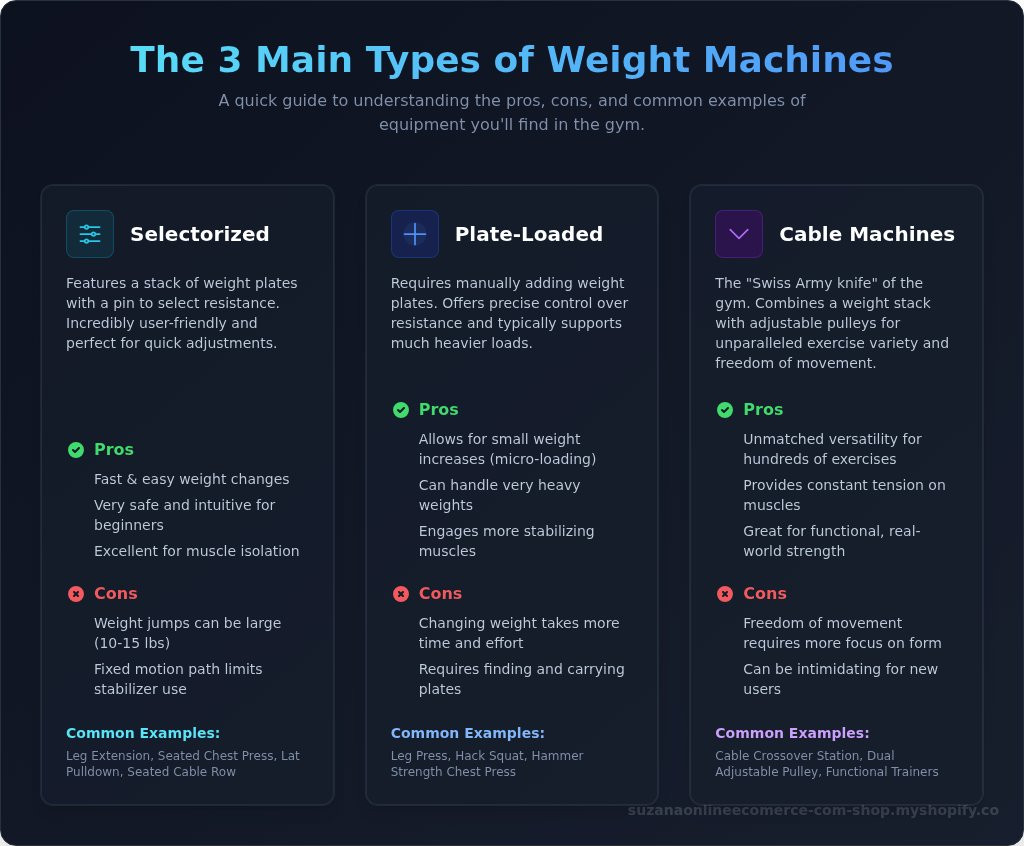
Think of these as the "point-and-click" of the weight room. Selectorized machines feature a built-in stack of rectangular weight plates. To choose your resistance, you simply pull a pin and slide it into the desired slot. This design makes them incredibly user-friendly and perfect for quickly moving between exercises.
- Pros: Extremely fast and easy to change weight; very safe and intuitive for beginners.
- Cons: Weight jumps can be large (e.g., 10-15 lbs), which can make progressive overload challenging.
- Common Examples: Leg Extension, Seated Chest Press, Lat Pulldown, Seated Cable Row.
Plate-Loaded Machines
As the name suggests, these machines require you to manually add round weight plates onto loading posts, just like you would with a barbell. This approach is like packing your own suitcase-you have total control over how much you load, allowing for very small or very large weight increases to perfectly match your strength level.
- Pros: Allows for micro-loading with small plates and can typically handle much heavier weight than selectorized machines.
- Cons: Changing weights takes more time and effort; requires you to find and carry plates.
- Common Examples: Leg Press, Hack Squat, Hammer Strength Iso-Lateral Chest Press.
Cable Machines (Functional Trainers)
Cable machines are the Swiss Army knife of the gym. They combine the convenience of a pin-loaded weight stack with the incredible freedom of adjustable pulleys and various handle attachments. This unique setup allows for movement in virtually any direction, closely mimicking real-world actions and challenging your stabilizing muscles. Learning to control the movement highlights some of the core benefits of using weightlifting machines, like developing stability within a safe, controlled environment.
- Pros: Unmatched versatility for hundreds of exercises, constant tension on the muscle, great for functional strength.
- Cons: The freedom of movement can be intimidating for new users and requires more focus on form.
- Common Examples: Cable Crossover Station, Dual Adjustable Pulley (DAP), Kinesis machines.
A Full-Body Tour of Essential Weight Machines by Muscle Group
Stepping onto the gym floor for the first time can feel like entering a complex maze. This section is your map. By understanding which machines target specific muscle groups, you can navigate with confidence and build a balanced, effective workout. Using these tools correctly allows you to focus on form and safely build a strong foundation, unlocking The Hidden Benefits of Weight Machines, from injury prevention to targeted muscle isolation. Let's start the tour.
Upper Body Machines
From pushing to pulling, these machines cover every major muscle in your chest, back, shoulders, and arms, providing the stability you need to build upper-body strength safely.
- Chest Press Machine: Safely builds your pectoral muscles by mimicking a bench press motion from a supported, seated position.
- Pec Deck/Fly Machine: Isolates the chest muscles for a targeted "squeezing" contraction to enhance definition.
- Lat Pulldown Machine: Strengthens your upper back and lats (the muscles that give your back a 'V' shape) by pulling a bar down towards your chest.
- Seated Cable Row: Targets the muscles of the middle back to improve posture and develop pulling strength.
- Assisted Pull-Up Machine: Helps you build the strength for a full bodyweight pull-up by providing a counter-weight to reduce the load.
- Shoulder Press Machine: Develops your deltoid (shoulder) muscles by pushing weight directly overhead in a controlled path.
- Lateral Raise Machine: Specifically targets the side deltoids to create broader, more rounded shoulders.
- Bicep Curl Machine: Isolates the biceps on the front of your arms with a fixed, guided range of motion.
- Triceps Extension/Pushdown Machine: Focuses on the triceps on the back of your arms by having you push weight down or away.
Lower Body Machines
Your legs are your body's powerhouse. These machines allow you to safely load heavy weight to build strength and muscle in your quads, hamstrings, glutes, and calves.
- Leg Press Machine: Builds overall leg strength by targeting the quads, glutes, and hamstrings in a powerful pushing movement.
- Leg Extension Machine: Directly isolates the quadriceps muscles on the front of your thighs.
- Hack Squat Machine: Offers a supported squat variation that emphasizes quad development while reducing strain on the lower back.
- Leg Curl Machine: Isolates the hamstring muscles on the back of your thighs through a controlled curling motion.
- Glute Kickback/Hip Thrust Machine: Specifically targets the gluteal muscles for powerful hip extension and shaping.
- Calf Raise Machine (Seated or Standing): Strengthens the calf muscles by having you press weight up with your ankles.
Core & Abdominal Machines
While many core exercises use bodyweight, these specific machines for weight training can add valuable resistance to strengthen your entire midsection, from your abs to your lower back.
- Ab Crunch Machine: Adds weighted resistance to the standard crunch, helping to build stronger abdominal muscles.
- Captain's Chair Leg Raise: Targets the lower abs and hip flexors by requiring you to lift your legs while your upper body is supported.
- Back Extension Machine (Hyperextension): Strengthens the lower back muscles (erector spinae), which are crucial for good posture and overall stability.
- Torso Rotation Machine: Isolates the oblique muscles along the sides of your core through a controlled twisting motion.
How to Use Any Weight Machine Correctly: A 5-Step Checklist
Walking into a gym filled with complex-looking equipment can be intimidating. The fear of "doing it wrong" or "looking silly" stops many people before they even start. But here’s the secret: every experienced lifter was once a beginner. The key is to build a safe, effective setup habit from day one. This five-step checklist is your universal guide to approaching any new weight machine with confidence. Remember, taking a minute to set up isn’t a sign of a novice; it’s the mark of a smart lifter.
Step 1-2: Adjust the Machine & Select Your Weight
Proper setup ensures the machine fits your body, preventing injury and maximizing results. Before you lift a single pound, make the machine an extension of your own frame.
- Find the Adjustments: Look for yellow or red pins and levers. These control seat height, back pads, and handle positions. Your goal is to create a comfortable and stable starting position.
- Align Your Joints: This is the most critical step for safety. On a leg extension machine, for example, your knee should align perfectly with the machine's pivot point. For a chest press, adjust the seat so the handles are at mid-chest level.
- Start Light: Select a weight that feels almost too easy for your first set. This set is for learning the movement pattern, not for building muscle. A good rule of thumb for most machines for weight training is to choose a weight you can control for 10-12 smooth repetitions.
Step 3-4: Focus on Form & Control
Once the machine is set, the focus shifts to quality movement. Good form is more important than heavy weight, every single time. It's how you get strong, not injured.
- Read the Placard: Most machines have a diagram showing proper form, the start/end positions, and the muscles being worked. Take 10 seconds to study it.
- Move Deliberately: Avoid using momentum to swing the weight. Each movement should be slow and intentional. Focus on feeling the target muscle contract as you push or pull.
- Control the Negative: The "negative" (or eccentric phase) is when you return the weight to the start. Don't just let it drop! Actively resist gravity, taking 2-3 seconds to lower the weight. This is where significant strength and muscle growth happens.
Step 5: Breathe and Practice Gym Etiquette
The final touches separate beginners from seasoned gym-goers. Proper breathing fuels your muscles, and good etiquette ensures a positive environment for everyone.
- Breathe Correctly: A simple and effective pattern is to exhale on the exertion (the pushing or pulling phase) and inhale as you return to the starting position.
- Wipe It Down: Always use a towel and the gym's cleaning spray to wipe down any surfaces you touched, including the seat, back pad, and handles.
- Be Considerate: Don't rest on the equipment for long periods between sets. If the gym is busy, let others "work in" with you. This simple courtesy is appreciated by everyone.
Building Your First Machine-Based Workout Routine
You've learned the what and why; now it's time for the how. Creating your first workout is less about complexity and more about consistency. The key is to start with a manageable plan that works your entire body, allowing you to build a solid foundation and learn proper form on the various machines.
Understanding Reps, Sets, and Rest
These three terms are the building blocks of any strength program. Here's what they mean for a beginner:
- Reps (Repetitions): This is one complete motion of an exercise. Aim for a weight that you can lift for 8-15 reps with good form. The last couple of reps should feel challenging but not impossible.
- Sets: A set is a group of consecutive repetitions. To start, perform 2-3 sets of each exercise.
- Rest: This is the recovery time between sets. Take 60-90 seconds of rest to let your muscles briefly recover before the next set.
Your long-term goal is progressive overload-gradually increasing the demand on your muscles over time by adding more weight, reps, or sets. This is how you get stronger.
Sample Beginner Full-Body Routine (3 Days/Week)
This routine is perfect for performing on non-consecutive days (e.g., Monday, Wednesday, Friday). It targets all major muscle groups, making it an efficient way to get started with machines for weight training.
- Leg Press: 3 sets of 10-12 reps
- Lat Pulldown: 3 sets of 10-12 reps
- Chest Press Machine: 3 sets of 10-12 reps
- Ab Crunch Machine: 3 sets of 12-15 reps
Remember to focus on controlled movements and proper form above all else. This simple but effective routine provides a fantastic introduction to using machines for weight training to build strength.
Consistency will always beat short-term intensity. Stick with your plan, listen to your body, and celebrate the small victories along the way. Ready to build your own setup? Explore our home gym equipment.
Your Strength Journey Starts Here
You now have the foundational knowledge to approach the weight room with confidence. This guide has shown that weight machines are an excellent starting point, providing the stability and guided motion necessary to build strength safely and effectively. By understanding how to use the equipment for each muscle group and structuring your first routine, you've already conquered the biggest hurdle: getting started the right way.
Creating a consistent habit with the right machines for weight training is your ticket to achieving your fitness goals. Now, it's time to put that knowledge into action. If you're inspired to build your dream home gym, we have everything you need. We offer a wide selection of equipment for all fitness levels, with free shipping available on select items to help you get set up.
Ready to start your fitness journey? Explore our collection of home workout equipment today!
Embrace the process, trust in your new skills, and get ready to unlock a stronger, healthier you. You've got this!
Frequently Asked Questions About Weight Training Machines
Can you build serious muscle using only machines for weight training?
Absolutely. Weight machines are excellent for building muscle because they isolate specific muscle groups and provide constant tension throughout the movement. This controlled environment is ideal for hypertrophy (muscle growth). While free weights have their benefits, a well-structured routine using only machines like the leg press, chest press, and lat pulldown can lead to significant strength and size gains, making them a powerful tool for any fitness level.
Are weight machines effective for weight loss?
Yes, they are a highly effective tool for weight loss. Using machines for weight training builds lean muscle mass, which increases your resting metabolic rate, meaning you burn more calories even when you're not working out. This, combined with the calories burned during your actual training sessions, creates a powerful fat-burning effect. For the best results, combine your machine workouts with a balanced diet and consistent cardiovascular exercise.
How often should a beginner use weight machines per week?
A beginner should aim for two to three non-consecutive days per week. This schedule provides your muscles with crucial time to recover and grow stronger between sessions. A full-body routine on Monday, Wednesday, and Friday is a popular and effective starting point. Listening to your body is key; if you feel overly fatigued, an extra rest day is always a good idea. Consistency is more important than frequency when you're just starting out.
What's better for a home gym: machines or free weights?
The best choice depends on your space, budget, and goals. Free weights like dumbbells are versatile and space-efficient. However, machines offer a guided range of motion, which can be safer for beginners or those training alone. A single multi-station home gym machine can provide a full-body workout with built-in safety features, making it a fantastic, albeit larger, investment for a dedicated home gym space.
How do I know if I'm lifting the right amount of weight?
The ideal weight is one where the last two or three repetitions of a set are challenging but can be completed with proper form. If you finish your set feeling like you could easily do several more reps, it's time to increase the weight. Conversely, if your form breaks down halfway through the set, the weight is too heavy. Aim for a weight that allows you to fail within your target rep range, such as 8-12 reps for muscle growth.
Is it normal to be sore after using weight machines for the first time?
Yes, it's completely normal and even expected. This feeling is known as Delayed Onset Muscle Soreness (DOMS), and it's a sign that you've effectively challenged your muscles. The soreness usually peaks 24 to 48 hours after your workout and will diminish as your body adapts to the new stimulus. To help manage it, stay hydrated, get enough sleep, and perform some light stretching or active recovery.