

Smith Machine: The Ultimate Buyer's Guide for Your Home Gym

Dreaming of building the perfect home gym but feeling overwhelmed by the options? The thought of lifting heavy free weights alone can be daunting, and the endless debate over whether a smith machine is as effective as a traditional squat rack can cause serious analysis paralysis. You want a safe, effective workout without the risk of injury, but choosing the right centerpiece for your space feels like a massive hurdle.
We get it. That’s why we created this ultimate buyer's guide. We’re here to cut through the noise and give you the clear, straightforward information you need. In this article, you'll discover the real pros and cons of this popular equipment, learn how it can provide a killer full-body workout, and explore some of the best exercises to get you started safely and effectively.
By the end, you’ll feel confident and empowered to decide if a Smith machine is the perfect investment for your long-term fitness goals. Let's find the right fit for your dream gym.
What is a Smith Machine and How Does It Work?
A Smith machine is a versatile piece of weight training equipment designed for strength and resistance training. Its core components are a barbell permanently fixed within two vertical steel rails. This design constrains the barbell's movement to a single, guided path-straight up and down. This fixed motion is the machine's defining feature, offering a unique alternative to traditional free weights.
The primary purpose of this apparatus is to enhance safety, especially for those training alone. The barbell has integrated hooks that can be rotated to catch onto a series of slots or pegs along the frame, allowing you to rack the weight at any point during a lift. For a complete overview of its history and design, the Wikipedia entry on What is a Smith Machine? is an excellent resource.
To see exactly how these components work together, take a look at this short video:
The Core Mechanics: Fixed Path vs. Free Motion
The rigid guide rods force the barbell to travel in a single plane of motion. This is a stark contrast to free weights like barbells and dumbbells, which demand you control the weight's path in three-dimensional space. By removing the need to balance the bar, the machine significantly reduces the engagement of smaller stabilizer muscles. This mechanic allows you to focus purely on pushing the weight. Furthermore, the built-in locking points act as a reliable safety net, enabling you to end a set safely if you reach muscle failure.
Who is a Smith Machine Best For?
The unique design of this equipment makes it an ideal choice for specific lifters and fitness goals. It is particularly well-suited for:
- Beginners: It helps newcomers learn the fundamental movement patterns of major lifts, like squats and bench presses, with a lower risk of poor form.
- Individuals Who Train Alone: The integrated safety catches serve as a virtual spotter, providing the confidence to push your limits without a partner.
- Lifters Focusing on Muscle Hypertrophy: By minimizing the stabilization required, you can better isolate and fatigue a target muscle, a key factor in building muscle size.
- Those Recovering from Injuries: The controlled, predictable range of motion can be beneficial for safely rebuilding strength during rehabilitation under professional guidance.
The Great Debate: Smith Machine vs. Free Weight Squat Rack
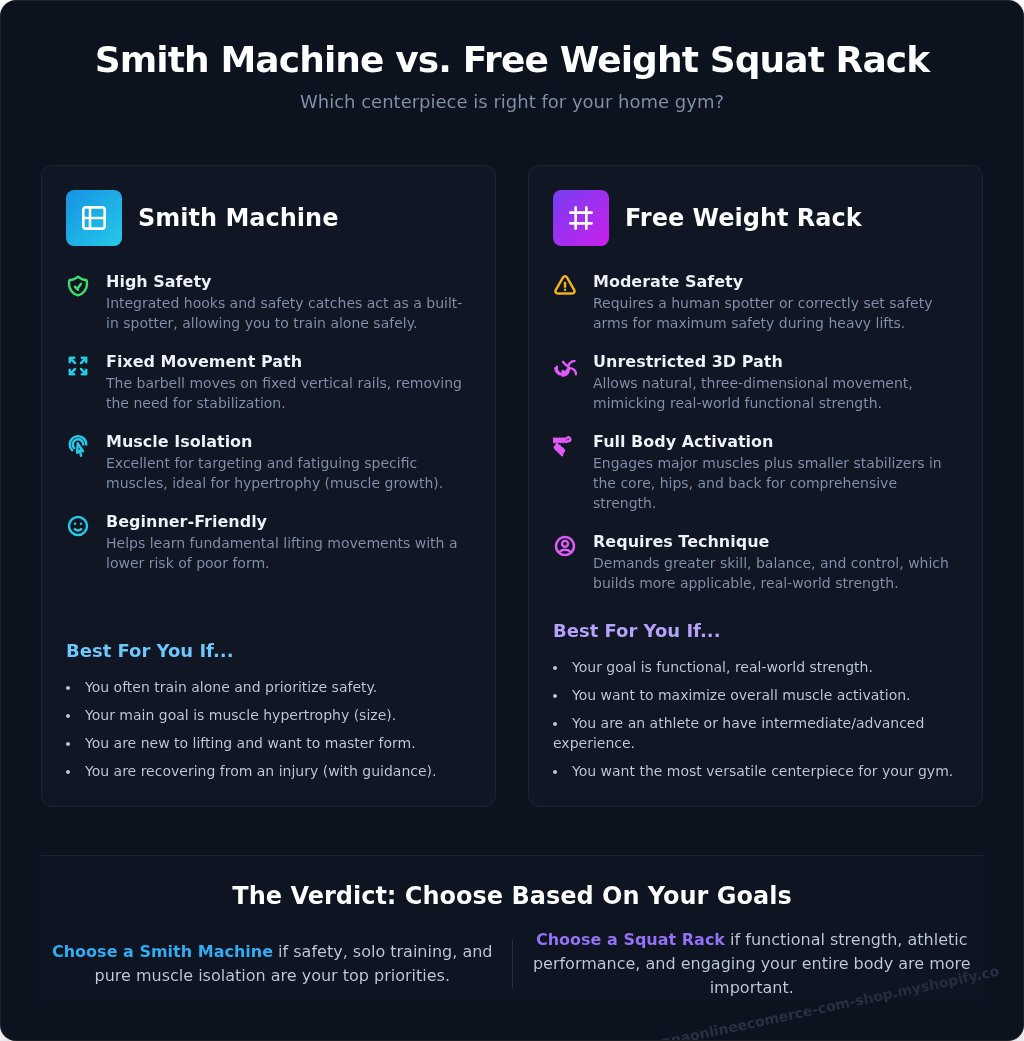
When designing a home gym, the centerpiece is often the rack. This leads to the ultimate question: should you get a Smith machine or a free weight squat rack? The truth is, there's no single "better" option. The right choice depends entirely on your fitness level, goals, and training preferences. Instead of asking which is superior, ask which is superior for you.
To help you decide, here is a quick comparison of the two powerhouses:
| Feature | Smith Machine | Free Weight Squat Rack |
|---|---|---|
| Safety | High (built-in spotters, easy racking) | Moderate (requires safety arms or a spotter) |
| Movement Path | Fixed, linear path | Unrestricted, natural 3D path |
| Muscle Activation | Excellent for isolating target muscles | Engages more stabilizer muscles |
| Skill Level | Beginner-friendly | Requires more technique and balance |
Advantages of the Smith Machine: Safety, Stability, and Isolation
The primary draw of a smith machine is its unparalleled safety. The barbell is fixed on guide rods, allowing you to simply twist your wrists to rack the weight at any point. This makes it ideal for training alone without a spotter. This fixed path also provides stability, removing the need to balance the weight so you can focus entirely on isolating and pushing a specific muscle group, like your quads during a squat or chest during a bench press.
Advantages of the Squat Rack: Functional Strength and Versatility
A free weight squat rack is the cornerstone of building functional, real-world strength. Because you must control and stabilize the barbell through a natural range of motion, you engage countless small stabilizer muscles in your core, hips, and back. In fact, a Smith machine vs. free weight squat study from the NIH found that free weight squats activated significantly more musculature overall. This freedom of movement is crucial for athletic performance and mimicking everyday activities.
The Verdict: Making the Right Choice for Your Goals
So, which one belongs in your home gym? The answer lies in your priorities.
- Choose a Smith machine if: You prioritize safety above all, often train alone, or want to focus on isolating specific muscles for hypertrophy (growth) with maximum stability.
- Choose a squat rack if: Your goal is to build functional strength, improve athletic performance, and master compound movements with a natural bar path.
For those who want the best of both worlds, hybrid "all-in-one" trainers combine a Smith machine, squat rack, and cable system into a single footprint. Whatever your path, the right equipment is waiting. Explore our range of home gym equipment to find your fit.
Unlocking Your Workout: The Best Smith Machine Exercises
One of the greatest strengths of adding a smith machine to your home gym is its incredible versatility. The guided barbell path creates a stable and secure environment, allowing you to focus purely on muscle contraction and push your limits without worrying about balance. This makes it an ideal platform for a complete, full-body workout, from heavy compound lifts to targeted isolation movements. For those looking to explore even more creative movements, publications like BarBend offer comprehensive lists of the Best Smith Machine Exercises that can keep your routine fresh and challenging.
Compound Lifts for Building Mass
These foundational, multi-joint movements are the cornerstone of any strength-building program. The stability of the machine allows you to safely handle heavier loads than you might with free weights, especially when training alone, stimulating maximum muscle growth.
- Smith Machine Squats: The fixed path helps you maintain an upright posture and experiment with foot placement to target different muscles. Focus on sitting back, keeping your chest up, and driving through your heels to a comfortable depth.
- Smith Machine Bench Press: This is a game-changer for solo lifters. The built-in safety catches allow you to confidently press to failure without a spotter. Control the bar on the descent and explode up powerfully.
- Smith Machine Rows: A fantastic back builder. Brace your core and pull the bar towards your lower chest or upper abdomen. The guided motion helps isolate your lats and rhomboids for a thicker, stronger back.
- Smith Machine Overhead Press: Whether seated or standing, the stability removes the balance component, letting you focus entirely on contracting your deltoids for powerful, well-defined shoulders.
Isolation Exercises for Muscle Definition
After building your foundation with compound lifts, isolation exercises help sculpt and define individual muscles. The Smith machine offers unique advantages for these targeted movements, ensuring strict form and maximum tension on the target muscle.
- Split Squats & Lunges: Unilateral training is crucial for correcting strength imbalances. The machine provides the balance support needed to go deep into the movement and focus on driving through the front leg.
- Calf Raises: Stand on a small block or plate to get a full stretch and contraction. The machine lets you safely load up the heavy weight needed to truly stimulate stubborn calf muscles.
- Hip Thrusts: Setting up hip thrusts with a free barbell can be awkward. The fixed bar path makes the movement incredibly stable and simple to set up, allowing you to focus solely on squeezing your glutes at the top.
- Inverted Rows: An excellent bodyweight back exercise. Lie under the bar, grab it with an overhand grip, and pull your chest towards it while keeping your body rigid like a plank. Adjusting your foot position changes the difficulty.
How to Choose the Right Smith Machine: A Buyer's Checklist
Once you've decided that a Smith machine is the right centerpiece for your home gym, the next step is choosing the perfect model. With a wide range of features and price points, making an informed decision is key to long-term satisfaction. This checklist will guide you through the essential factors to consider, ensuring you invest in equipment that aligns with your fitness goals, space, and budget.
Core Features: Bearings, Angle, and Build Quality
The performance of any smith machine hinges on its fundamental components. Pay close attention to these details, as they directly impact your user experience and safety.
- Linear Bearings vs. Bushings: Linear bearings provide an exceptionally smooth, near-frictionless glide, ideal for serious lifters. Bushings are a more cost-effective alternative that offers a reliable but less fluid motion.
- Angled vs. Vertical Path: Many modern machines feature a slight 7-degree angle. This more closely mimics the body's natural movement path for squats and presses, offering a more ergonomic feel than a purely vertical track.
- Frame and Capacity: Check the steel gauge (lower is thicker) and the machine’s maximum weight capacity. Ensure it can safely support your current and future lifting ambitions. Don't forget to inspect the safety hooks for solid construction and an easy-to-use locking mechanism.
All-in-One Systems vs. Basic Models
Do you need a dedicated machine for compound lifts, or a complete home gym solution? A basic model provides the core barbell rack for squats, presses, and rows. In contrast, all-in-one systems integrate functional trainers, cable crossovers, lat pulldown stations, and more. While these comprehensive units offer incredible versatility and can save space compared to buying individual pieces, be realistic about which attachments you will consistently use. Sometimes, a high-quality basic machine paired with select equipment is a more effective investment.
Measuring Your Space and Budget
Before you fall in love with a particular model, grab a tape measure. Carefully measure the height, width, and depth of your designated gym area. Crucially, account for extra clearance. You'll need space on the sides to load weight plates and enough room in front and behind for safe movement. Finally, establish a clear budget that includes potential shipping and installation costs. With your measurements and budget in hand, you’re ready to make a confident choice.
Find a Smith Machine that fits your space and budget today.
Ready to Elevate Your Home Gym?
Choosing the right equipment is the most critical step in building a home gym that you'll actually use. As we've explored, the smith machine offers a powerful combination of safety, versatility, and muscle-building potential, making it a cornerstone for beginners and seasoned lifters alike. By understanding the key differences between models and knowing which features align with your fitness goals, you are now equipped to make a confident and informed decision.
The perfect setup is within your reach. We are dedicated to helping you build your complete home gym from one convenient store. With a wide selection of fitness equipment for every budget and expert guides to help you choose the right gear, you'll find everything you need to transform your space and your workouts.
Take the next step on your fitness journey today. Shop our collection of Smith machines and home gym equipment and start building the workout space you've always dreamed of. Your goals are waiting.
Frequently Asked Questions
Can you actually build serious muscle with a Smith machine?
Absolutely. Muscle growth is driven by progressive overload, and a Smith machine is an excellent tool for this. It allows you to safely increase the weight on major compound lifts like squats, bench presses, and rows. The guided motion helps isolate target muscles, which is a highly effective technique for stimulating hypertrophy. While it uses fewer stabilizer muscles than free weights, it's more than capable of helping you build serious size and strength.
Is the fixed bar path on a Smith machine bad for your joints?
The fixed bar path can potentially strain joints if your body isn't positioned correctly, as it doesn't allow for natural movement arcs. To prevent this, it's crucial to adjust your foot and body placement to align with the machine's path. For example, placing your feet slightly forward during squats can create a more comfortable angle for your knees and back. Always prioritize proper form and listen to your body to ensure a safe and effective workout.
What is the difference between a Smith machine and a power rack or squat rack?
The key difference is barbell movement. A Smith machine features a barbell fixed on guide rails, restricting it to a vertical or near-vertical path. In contrast, a power rack is a frame that holds a free-weight barbell, allowing for unrestricted, three-dimensional movement. The Smith machine offers built-in safety and stability, while a power rack is superior for developing stabilizer muscles and mimicking real-world functional strength with free weights.
How much space do I need to fit a Smith machine in my home?
Plan for a footprint of roughly 5-6 feet in width and 4-5 feet in depth. The most critical measurement, however, is ceiling height. Most machines stand between 7 and 7.5 feet tall, so you will need a ceiling of at least 8 feet to provide adequate clearance for movement and loading weight plates. Always measure your available space and compare it to the specific dimensions of the model you intend to buy before making a purchase.
Are all-in-one Smith machine gyms worth the extra money?
For those seeking maximum versatility in a limited space, they are often a fantastic investment. These systems combine a Smith machine with other equipment like a functional trainer with cable pulleys, a power rack, and various attachments. While the upfront cost is higher, it is typically more affordable and space-efficient than purchasing each component separately. This consolidation provides a complete gym solution in a single footprint, offering incredible workout variety.
Do I need to buy special weight plates for a Smith machine?
No, you do not need special plates. The vast majority of modern Smith machines are designed to be used with standard Olympic weight plates, which have a 2-inch diameter center hole. These are the same plates used with Olympic barbells in any commercial or home gym. It's always wise to double-check the product specifications to confirm the sleeve diameter, but it is almost always the 2-inch Olympic standard.