

The 9 Best Shoulder Exercises for Mass and Definition

Are you spending hours in the gym, pressing and raising until your arms burn, only to see the same narrow shoulders in the mirror? It's a common frustration, and the answer isn't always just lifting heavier. Building those broad, "3D" delts that command respect comes from lifting smarter-understanding how to train the entire muscle group for balanced, powerful growth. If you're tired of guesswork and ready for a clear path forward, you've come to the right place. We've cut through the noise to bring you the definitive guide to the best shoulder exercises for building serious mass and definition.
In this article, we'll do more than just list exercises. We’ll break down the three heads of the deltoid and show you exactly which movements target each one for complete development. You'll learn the proper form to maximize gains while minimizing the risk of injury, a crucial step for long-term progress. Get ready to trade your frustration for a concrete plan and build the strong, well-rounded shoulders you’ve been working for.
Anatomy 101: Understanding the Three Heads of Your Shoulder
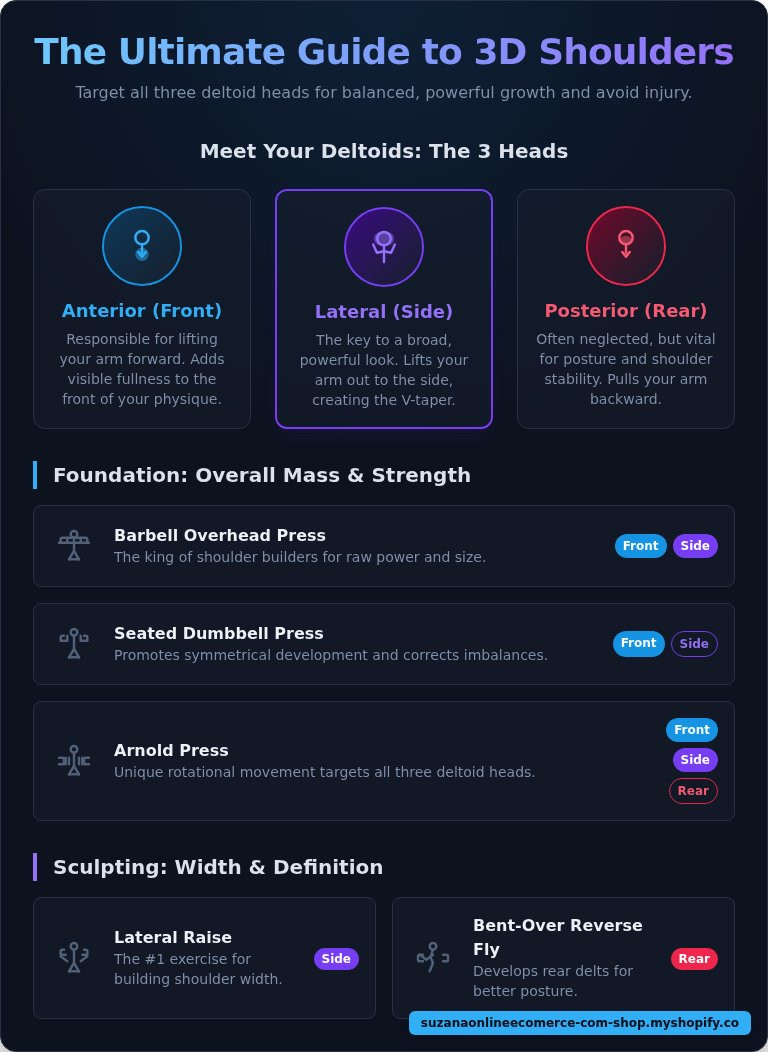
Before you can build impressive, three-dimensional shoulders, you need to understand what you're working with. The primary muscle you see is the deltoid, a thick, triangular muscle that essentially acts as a "cap" over your shoulder joint. Think of it like a coconut shell with three distinct sections. To achieve that powerful, rounded look and ensure long-term joint health, you must train all three parts equally. A lopsided approach not only looks strange but can also lead to injury and poor posture.
The deltoid is responsible for the incredible range of motion in your upper arm. A deeper look into the anatomy of the shoulder joint reveals a complex system of muscles and tendons, but for our purposes, focusing on the three heads of the deltoid is the key. Truly the best shoulder exercises are those that form a complete program, hitting each head with intention.
For a quick visual breakdown of how to train these muscles, check out this excellent video from ATHLEAN-X™:
Anterior Deltoid (Front)
Located at the front of your shoulder, the anterior deltoid is responsible for shoulder flexion-the motion of lifting your arm straight out in front of you. This muscle gets a lot of indirect work from chest-focused movements like the bench press and push-ups. However, to add that prominent fullness to the front of your physique, including direct exercises like front raises is essential for well-rounded development.
Lateral Deltoid (Side)
This is the money-maker for creating a broad, powerful look. The lateral (or medial) deltoid sits on the side of your shoulder and is primarily responsible for shoulder abduction-lifting your arm out to the side. Developing this head is the secret to creating the illusion of a smaller waist and a more pronounced V-taper. It responds best to specific isolation exercises, as it receives less stimulation from compound pressing movements.
Posterior Deltoid (Rear)
Often the most neglected of the three, the posterior (or rear) deltoid is on the back of your shoulder. Its main functions include pulling your arm backward and rotating your shoulder externally. Strong rear delts are absolutely crucial for maintaining good posture, preventing a hunched-forward look, and ensuring overall shoulder joint stability. Neglecting them is a common mistake that leads to muscular imbalances and potential injury down the road.
The Foundation: Best Compound Exercises for Overall Shoulder Mass
To build a truly impressive set of shoulders, you need to start with a strong foundation. This is where compound exercises come in. Unlike isolation movements that target a single muscle, compound exercises engage multiple joints and muscle groups simultaneously, making them incredibly efficient for building overall mass and strength. For this reason, they should be the first exercises you perform in your shoulder workout when your energy levels are highest.
The key to growth is progressive overload-gradually increasing the weight, reps, or sets over time. A well-rounded approach also includes mobility and stability, as outlined in this comprehensive shoulder conditioning program from the American Academy of Orthopaedic Surgeons, to ensure your joints stay healthy and strong.
1. Barbell Overhead Press (Military Press)
Often called the "king" of shoulder exercises, the Barbell Overhead Press (OHP) is unrivaled for building raw power and size in the deltoids. It heavily engages the anterior and medial delts, with support from the triceps and upper chest. For proper standing form:
- Stand with your feet shoulder-width apart and engage your core.
- Grip the barbell slightly wider than your shoulders, resting it on your upper chest.
- Press the bar straight overhead until your arms are fully extended, keeping your head neutral.
- Lower the bar back to the starting position under full control.
Avoid excessively arching your lower back to lift the weight; keep your glutes and abs tight. For a home-friendly alternative, the Dumbbell Overhead Press offers similar benefits.
2. Seated Dumbbell Shoulder Press
The Seated Dumbbell Shoulder Press is one of the best shoulder exercises for promoting symmetrical development. Using dumbbells forces each shoulder to work independently, which helps correct strength imbalances. The seated position with back support allows you to focus purely on the press without using leg drive. To perform it safely, keep your elbows slightly in front of your body rather than flared out to the sides, which reduces stress on the shoulder joint.
3. Arnold Press
Named after Arnold Schwarzenegger, this unique press variation targets all three heads of the deltoid through its rotational movement. You begin with palms facing you at the bottom of the movement, rotate them to face forward as you press up, and then reverse the motion on the way down. This extended time under tension is fantastic for hypertrophy. However, the complex movement requires precise control, so always start with a lighter weight to master the form before trying to go heavy.
Building Width: Top Isolation Exercises for Your Lateral Delts
While heavy pressing builds overall mass, isolation exercises are what truly sculpt the shoulders and create that coveted V-taper. These movements target the medial (or lateral) head of the deltoid specifically, which is responsible for making your shoulders look wider. Understanding the biomechanics behind shoulder muscle activity and function is key to selecting the right movements for targeted growth. For these exercises, the goal isn't to lift as heavy as possible.
Instead, focus on control, tempo, and feeling the muscle work through every inch of the repetition. Lighter weights with perfect form will always be more effective for building shoulder width than heavy, sloppy reps that recruit other muscles like the traps and back. This is where the mind-muscle connection becomes paramount.
4. Dumbbell Lateral Raise
Often considered the single most effective movement for the lateral delts, the dumbbell lateral raise is a non-negotiable part of the best shoulder exercises for width. The key is flawless execution.
- Stand with dumbbells at your sides, feet shoulder-width apart, and a slight bend in your knees and elbows.
- Keeping your torso stationary, raise the dumbbells out to your sides. Lead with your elbows, keeping them slightly higher than your wrists, as if you're pouring a jug of water.
- Raise the weights until your arms are parallel to the floor. Pause briefly at the top to squeeze the muscle, then slowly lower the dumbbells with control.
- Avoid this: Do not use momentum to swing the weight up or shrug your shoulders. This takes the tension off the delts and places it on your traps.
Home Variation: If you don't have dumbbells, the Resistance Band Lateral Raise is an excellent and joint-friendly alternative.
5. Cable Lateral Raise
The cable lateral raise offers a unique advantage over its dumbbell counterpart: constant tension. Because the cable pulls from the side, your medial delt is under load throughout the entire range of motion, even at the bottom. To perform it, set a D-handle on a cable pulley at its lowest setting. Stand sideways to the machine, grab the handle with your outside hand, and perform the raise across your body, focusing on a controlled and smooth movement.
6. Barbell/Dumbbell Upright Row
This is a powerful compound movement that heavily targets both the lateral delts and the upper traps. Using a barbell or two dumbbells, take a shoulder-width or slightly wider grip. Lead with your elbows and pull the weight straight up towards your chin, keeping it close to your body. The wider grip helps emphasize the medial delts over the traps.
Important Caution: To avoid potential shoulder impingement, do not pull the bar higher than your lower chest. If you feel any pinching or pain, lower the weight or choose a different exercise.
For a 3D Look: Essential Exercises for Your Rear Delts
Many lifters focus heavily on pressing movements, developing their front and side delts while neglecting the back. The posterior (rear) deltoids are the secret to achieving that coveted "3D" shoulder look. More importantly, strong rear delts are crucial for balanced shoulder health and good posture, pulling your shoulders back and preventing the rounded, "hunched forward" posture common among avid gym-goers.
To truly isolate them, focus on the mind-muscle connection-feel the contraction rather than just moving weight. These muscles respond best to lighter weight and higher repetitions, so leave your ego at the door and prioritize perfect form.
7. Face Pull
This movement is a powerhouse for shoulder health, targeting not just the rear delts but also the rotator cuff muscles and upper back. It's an excellent corrective exercise that directly counteracts the effects of sitting and heavy pressing.
- Setup: Attach a rope to a cable pulley set at chest height. Grasp the ends of the rope with an overhand grip.
- Execution: Step back to create tension. Pull the rope towards your face, aiming to get your hands on either side of your head. As you pull, focus on driving your elbows back and high while externally rotating your shoulders-think about pulling the rope handles apart.
- Focus: Squeeze for a second at the peak contraction before slowly returning to the start.
8. Bent-Over Dumbbell Reverse Fly
A classic for a reason, this free-weight exercise allows you to completely isolate the posterior delts. Hinge at your hips, keeping your back straight and nearly parallel to the floor. Let the dumbbells hang with a neutral grip, palms facing each other.
With a slight bend in your elbows, raise the weights out to your sides in a wide arc, squeezing your shoulder blades together at the top. This is one of the best shoulder exercises for pure rear delt isolation. If you struggle with form, the Pec Deck machine's reverse fly setting is a fantastic, stable alternative.
9. Barbell High Row
This exercise hits the rear delts and upper back muscles like the traps and rhomboids from a unique angle. Take a wide, overhand grip on a barbell-wider than you would for a traditional bent-over row. Hinge at the hips with a straight back. Instead of pulling to your waist (which targets the lats), pull the barbell high towards your upper chest or collarbone, flaring your elbows out to the sides. This subtle change in pull path shifts the emphasis directly onto your rear delts.
Putting It All Together: Sample Shoulder Workouts
Knowing the individual movements is only half the battle. To truly build impressive, well-rounded shoulders, you need a structured plan that combines the best shoulder exercises into a cohesive workout. We've designed three distinct routines based on your experience level and equipment access. Choose the one that fits your goals and get ready to work.
Important: Always perform a proper warm-up before starting. This should include 5-10 minutes of light cardio and dynamic stretches like arm circles to increase blood flow and prepare your muscles and joints for the work ahead.
Beginner Shoulder Workout (Focus on Form)
If you're new to shoulder training, your primary goal is mastering perfect form and building a solid foundation. This routine focuses on the fundamentals, helping you establish a strong mind-muscle connection without overwhelming your joints. Focus on controlled movements and choose a weight that challenges you by the final reps. Rest 60-90 seconds between sets.
- Seated Dumbbell Press: 3 sets of 8-12 reps
- Dumbbell Lateral Raise: 3 sets of 10-15 reps
- Face Pulls: 3 sets of 12-15 reps
Advanced Shoulder Workout (Mass Building)
Ready to pack on serious mass? This high-volume routine is designed for maximum muscle hypertrophy for the experienced lifter. It starts with a heavy compound lift to build raw strength and follows with targeted isolation work to sculpt every angle of the deltoids. Rest 90-120 seconds on heavy presses and 60 seconds on isolation exercises to maximize intensity.
- Barbell Overhead Press: 4 sets of 6-8 reps
- Seated Dumbbell Press: 3 sets of 8-10 reps
- Cable Lateral Raise: 4 sets of 12-15 reps (each arm)
- Bent-Over Dumbbell Reverse Fly: 4 sets of 12-15 reps
At-Home Dumbbell-Only Shoulder Workout
No gym? No problem. You can build powerful shoulders with just a pair of dumbbells. This comprehensive routine is perfect for a home setting and proves you don't need a lot of equipment to perform some of the best shoulder exercises. It targets all three heads of the deltoid for balanced development. Rest 60-90 seconds between sets.
- Seated Dumbbell Press: 4 sets of 8-12 reps
- Arnold Press: 3 sets of 10-12 reps
- Dumbbell Lateral Raise: 4 sets of 12-15 reps
- Bent-Over Dumbbell Reverse Fly: 4 sets of 12-15 reps
To get the most out of your training, make sure you have the right tools for the job. Find the gear for your home workouts in our fitness equipment collection.
Your Blueprint for Building Bolder Shoulders
Building a powerful, well-rounded set of shoulders isn't about luck; it's about smart, strategic training. The most crucial takeaway is that you must train all three deltoid heads-front, side, and rear-to achieve that coveted 3D look. A truly effective routine combines heavy compound lifts for overall mass with targeted isolation work to carve out detail and width. By integrating the best shoulder exercises from this guide, you create a balanced plan for sustainable growth and impressive definition.
Now, it's time to equip yourself for success. You can build your ideal physique right from home with our wide selection of quality home workout gear, designed for every fitness level. We have everything you need to get the job done. Ready to build your home gym? Shop our fitness equipment today!
Stay consistent, push your limits, and be proud of the strength you're building. Your journey to powerful, sculpted shoulders starts now.
Frequently Asked Questions About Shoulder Training
How many times a week should I train shoulders?
For optimal muscle growth, training shoulders two to three times per week is ideal for most people. This frequency allows for sufficient stimulus and recovery. Instead of one long, grueling session, consider splitting your volume across the week. For example, you could have one day focused on heavy overhead presses and another later in the week dedicated to higher-repetition lateral and rear delt exercises. Always listen to your body and ensure you're fully recovered between sessions.
Can I build big shoulders with just dumbbells?
Absolutely. Dumbbells are one of the most effective tools for building impressive shoulders. They allow for a greater range of motion and force each arm to work independently, engaging more stabilizer muscles. Exercises like the dumbbell overhead press, Arnold press, lateral raises, and bent-over reverse flyes are staples for a reason. In fact, many of the best shoulder exercises can be performed effectively with just a set of dumbbells, making them perfect for home or gym workouts.
How do I warm up my shoulders before a workout?
A proper warm-up is crucial to prevent injury and improve performance. Start with 5 minutes of light cardio, like an arm bike or rowing, to increase blood flow. Follow this with dynamic stretches such as arm circles (both forward and backward), band pull-aparts to activate your rear delts, and shoulder dislocations with a resistance band or PVC pipe. Finish with a few very light sets of your first exercise to prime the specific movement pattern you're about to perform.
Why do my shoulders hurt when I bench press?
Shoulder pain during a bench press often stems from improper form or muscle imbalances. A common mistake is flaring your elbows out to 90 degrees, which places excessive stress on the shoulder joint. Instead, tuck your elbows to a 45-75 degree angle. Also, ensure you are retracting your scapula (pinching your shoulder blades together) to create a stable base. If pain persists, it could indicate a rotator cuff issue, so it's wise to consult a physical therapist.
Should I train shoulders on the same day as chest?
Training shoulders and chest together is a very common and effective strategy, often called a "push day." Since your front deltoids are heavily involved in pressing movements like the bench press, it's efficient to train them together. However, your shoulders might be pre-fatigued, limiting your performance on overhead presses. An alternative is to pair shoulders with legs or give them their own dedicated day if they are a primary focus for you. The best split depends on your goals and recovery.
How long does it take to see results from shoulder exercises?
Consistency is key. If you are training progressively 2-3 times per week and following a proper nutrition plan, you can expect to feel stronger within 4 to 6 weeks. Visible changes in muscle size and definition typically take a bit longer, with most people noticing initial results within 8 to 12 weeks. Remember that genetics, diet, and sleep quality all play a significant role in your rate of progress, so be patient and stick with your routine for the long term.