

The Ultimate Guide to Workout Equipment for Your Home Gym

Dreaming of building a home gym but feeling stuck staring at a sea of treadmills, kettlebells, and complicated machines? The sheer number of options can be overwhelming, leaving you wondering where to even begin-and where you’d possibly put it all. But creating an effective fitness space doesn't have to be a confusing or expensive ordeal. The secret isn't about buying the biggest, priciest machine; it's about choosing the right workout equipment for your specific goals, budget, and living area.
That's exactly why we created this ultimate guide. We're here to cut through the noise and help you build your perfect fitness sanctuary, one smart choice at a time. From versatile resistance bands that fit in a drawer to the perfect set of dumbbells for building strength, we'll walk you through the essential pieces you need. Get ready to discover affordable, space-saving solutions, understand which tools align with your personal goals, and feel confident in creating the convenient home gym you've always wanted.
The Foundation: 3 Must-Have Pieces of Workout Equipment for Everyone
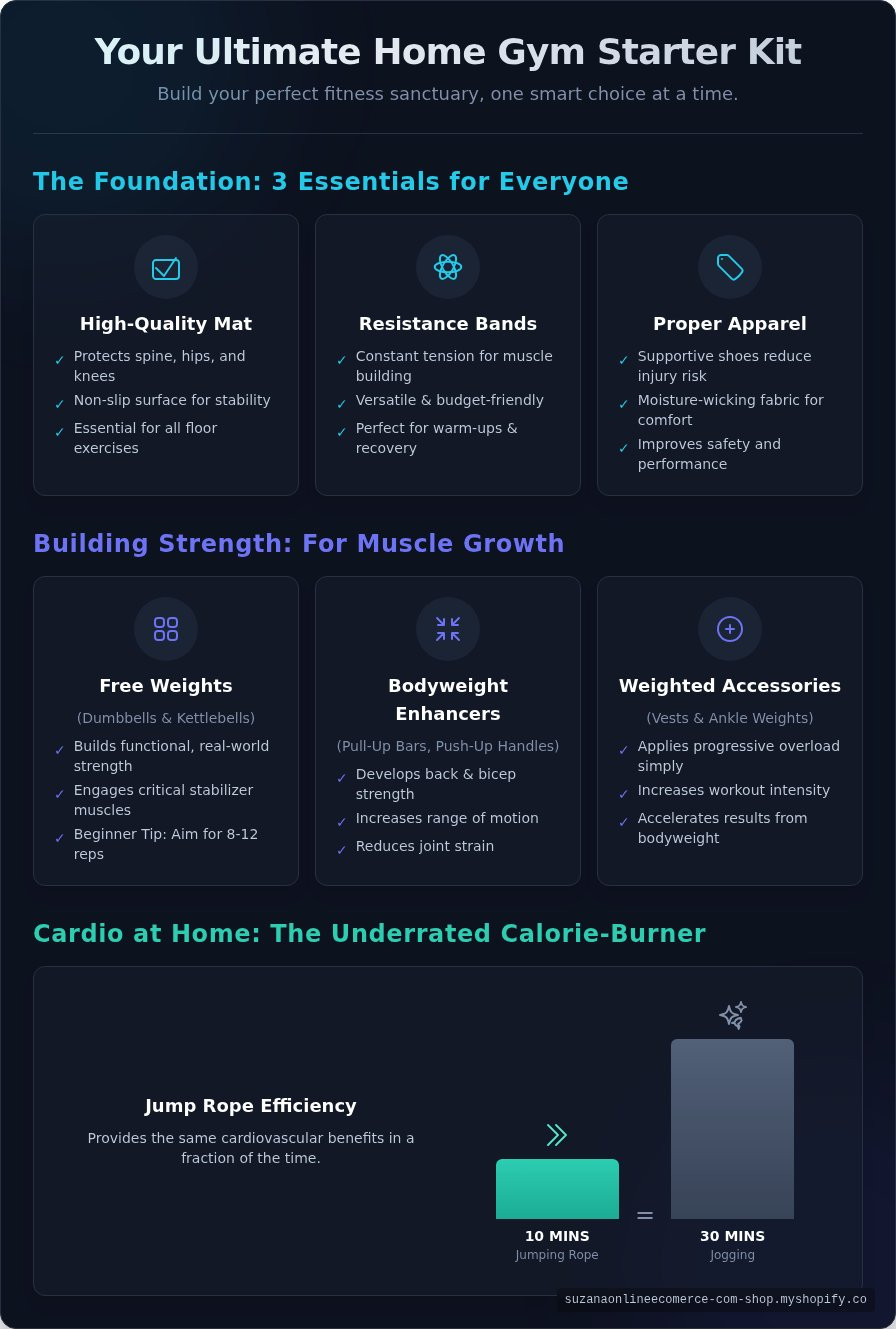
Before you even think about dumbbells or treadmills, every successful at-home fitness journey begins with a solid foundation. These three essentials prioritize safety, comfort, and versatility, ensuring you get the most out of every movement. Skipping these basics can lead to unnecessary discomfort, poor form, or even injury, turning your motivation into frustration. The world of Exercise equipment is vast, but these multi-purpose items offer the best value for anyone starting out.
To see how these foundational pieces can create a powerful home workout, watch this helpful video:
1. A High-Quality Exercise Mat
An exercise mat is your personal workout space. It's not just for yoga; it’s crucial for floor exercises like planks, push-ups, stretching, and any core work. While a thin yoga mat is designed for grip, a thicker fitness mat (1/2 inch or more) provides the necessary cushioning to protect your spine, hips, and knees from a hard floor. When choosing one, look for key features like a non-slip surface for stability, adequate padding for comfort, and a material that’s easy to wipe clean after a sweaty session.
2. A Set of Resistance Bands
Resistance bands are arguably the most versatile and budget-friendly piece of workout equipment you can own. They come in several forms, including loop bands for lower-body work, tube bands with handles for mimicking gym machine movements, and lighter therapy bands for rehabilitation. Unlike free weights, bands provide constant tension throughout an exercise, effectively building muscle and improving stability. They are perfect for warm-ups, full-body strength training, and assisting with recovery.
3. Proper Workout Apparel and Footwear
What you wear is a critical piece of equipment for success. The right gear goes beyond style-it’s about performance and safety. Moisture-wicking fabrics pull sweat away from your skin, keeping you cool, dry, and comfortable. Most importantly, supportive athletic shoes designed for your activity absorb impact and stabilize your feet, significantly reducing the risk of injuries like shin splints or twisted ankles. This is a small investment that dramatically improves the quality and safety of every workout.
Building Strength: Essential Equipment for Muscle Growth
While bodyweight exercises are a fantastic starting point, true muscle growth relies on a principle called progressive overload-gradually increasing the demand on your muscles over time. This is where strategic at-home workout equipment comes in, allowing you to consistently challenge yourself. Before investing, it's wise to understand the fundamentals of Selecting Home Exercise Equipment to ensure your choices are safe and effective for your fitness level. We'll explore three key categories designed for various budgets and spaces.
Free Weights: Dumbbells and Kettlebells
Free weights are the cornerstone of strength training. Unlike machines, they force your stabilizer muscles to engage, building functional strength and coordination. Dumbbells are ideal for isolating specific muscles in exercises like bicep curls or chest presses. Kettlebells, on the other hand, excel at dynamic, full-body movements like swings and goblet squats that build power and cardiovascular endurance. For those tight on space, adjustable dumbbells are a premium solution, offering an entire rack's worth of weights in one compact design. As a beginner, choose a weight you can lift for 8-12 reps with good form.
Bodyweight Enhancers: Pull-Up Bars and More
This category of workout equipment makes foundational bodyweight exercises significantly more effective. A simple doorway pull-up bar is one of the best investments for developing back and bicep strength. Push-up handles can increase your range of motion and reduce wrist strain, allowing for a deeper, more comfortable push-up. For a more advanced and versatile option, a suspension trainer uses your body weight and gravity to create adjustable resistance for hundreds of exercises, firing up your core with every move.
Weighted Accessories: Vests and Ankle Weights
The simplest way to apply progressive overload to bodyweight movements is by adding direct weight. A weighted vest instantly increases the intensity of squats, lunges, push-ups, and even cardio, accelerating your results without changing your routine. Ankle and wrist weights are excellent for adding a small but meaningful amount of resistance to leg lifts, glute bridges, and other targeted toning exercises. Crucially, always prioritize proper form when using these accessories to avoid placing undue stress on your joints.
Cardio at Home: Equipment to Boost Your Heart Health
When you think of cardio, a bulky treadmill or elliptical might come to mind. But getting your heart rate up and improving your cardiovascular health doesn't require a huge machine or a massive budget. A well-rounded fitness plan is crucial, and the American Heart Association Recommendations emphasize the importance of consistent aerobic activity for heart health. The right compact workout equipment can help you meet these goals by turning any small space into a high-intensity training zone. These tools are effective, affordable, and easy to store, making consistent cardio more accessible than ever.
The Jump Rope: An Underrated Calorie-Burner
Don't underestimate this classic playground toy. A jump rope is one of the most efficient calorie-burning tools available. In fact, just 10 minutes of jumping can provide the same cardiovascular benefits as 30 minutes of jogging. From basic speed ropes for quick footwork to weighted ropes that engage your upper body, there's an option for every fitness level. Beginner's Tip: To find the right size, stand on the middle of the rope; the handles should reach your armpits. Find the perfect jump rope in our fitness collection!
Aerobic Steps and Plyo Boxes
An aerobic step or plyometric box is a versatile platform for torching calories and building explosive strength. It’s a cornerstone for high-intensity interval training (HIIT), allowing for dynamic movements that get your heart pounding. Use it for:
- Box jumps and step-ups to build leg power.
- Incline or decline push-ups to challenge your upper body.
- High-energy step aerobics routines.
Many models feature adjustable heights, so you can increase the challenge as your fitness improves. They slide easily under a bed or into a closet when your workout is done.
Sliders and Gliding Discs
For a low-impact workout that delivers a major core challenge, look no further than sliders. These small, simple discs create an unstable surface under your hands or feet, forcing your stabilizing muscles-especially your core-to work overtime. They are perfect for fluid, controlled movements like gliding lunges, pikes, mountain climbers, and hamstring curls. As some of the most portable and affordable workout equipment on the market, they easily slip into a gym bag or store away in a drawer.
Flexibility & Recovery: Tools Your Body Will Thank You For
Peak fitness isn't just about pushing your limits during a workout; it's about how effectively you recover afterward. Neglecting recovery can lead to soreness, burnout, and injury. The secret weapon to a sustainable, long-term fitness routine is dedicating time to flexibility and muscle release. This specialized workout equipment is designed to reduce muscle soreness, improve your range of motion, and help you come back to your next session stronger than before.
Foam Rollers for Self-Myofascial Release
Think of a foam roller as a deep-tissue massage you can give yourself. By applying pressure to specific points on your body, you can release tightness and adhesions in your muscles and fascia. This process, known as self-myofascial release, helps restore healthy muscle function. When choosing a roller, consider its density:
- Low-density rollers are softer and ideal for beginners or those who are particularly sore.
- High-density rollers are much firmer, providing a more intense and deeper massage.
For the best results, roll slowly over areas like your quads, hamstrings, calves, and upper back. When you find a tender spot, pause for 20-30 seconds to allow the muscle to release.
Stretching Aids: Yoga Blocks and Straps
You don't have to be a yogi to benefit from these simple yet powerful tools. Yoga blocks and stretching straps are fantastic for anyone looking to safely improve their flexibility. A block can "bring the floor closer to you," providing support in lunges or forward folds. A stretching strap acts as an extension of your arms, allowing you to gently deepen a hamstring or quad stretch without compromising your form.
Targeted Relief: Massage Balls and Sticks
Sometimes, you need to target a small, stubborn muscle knot that a foam roller can't quite reach. This is where massage balls and roller sticks shine. A lacrosse or spiky massage ball is perfect for digging into the arches of your feet, your glutes, or the muscles around your shoulder blades. A muscle roller stick gives you precise control to massage your legs and arms, flushing out lactic acid and easing soreness after a tough session.
Investing in these recovery tools is an investment in your overall performance and well-being. Explore our curated collection of recovery and flexibility workout equipment to find the perfect additions to your routine.
How to Build Your Home Gym: Putting It All Together
You’ve seen the best accessories on the market, but how do you select the right ones for your routine? Turning your home into a functional fitness space is easier than you think. This practical framework will help you cut through the noise and choose the perfect workout equipment by focusing on three key factors: your goals, your space, and your budget.
Step 1: Define Your Primary Fitness Goal
The most effective home gym is one built with a purpose. Aligning your gear with your primary fitness goal ensures every piece you buy serves your journey. Don't know where to start? Use this simple guide to match your ambition with the right tools.
- To Build Muscle: Focus on resistance. Your go-to items will be Dumbbells, Kettlebells, a Pull-Up Bar, and Resistance Bands.
- To Lose Weight: Prioritize cardiovascular and full-body movements. A Jump Rope, Kettlebells, and Resistance Bands are excellent for high-intensity, calorie-burning circuits.
- To Improve Flexibility: Support your body through deeper stretches and recovery. A high-quality Yoga Mat, Foam Roller, Yoga Blocks, and Stretching Straps are essential.
Step 2: Assess Your Available Space
You don’t need a dedicated room to get a great workout. For a ‘closet gym,’ prioritize items you can easily store, like resistance bands, a yoga mat, and a jump rope. If you have a free corner, you can create a ‘corner-of-the-room gym’ with slightly larger items like a set of adjustable dumbbells or an aerobic step. For those with a garage or spare room, the possibilities expand, but starting with a versatile, compact collection of workout equipment is always a smart first move.
Step 3: Choose a Budget-Friendly Starter Kit
Building your home gym doesn't require a huge investment. You can assemble a powerful and versatile kit for less than the price of a couple of fitness classes. Here are two starter bundles to get you moving without breaking the bank.
- The 'Under $50' Kit: A perfect foundation for any routine. Includes a comfortable Yoga Mat, a set of Loop Resistance Bands, and a quality Jump Rope.
- The 'Under $150' Kit: Everything from the kit above, plus a versatile Kettlebell (or a set of light Dumbbells) and a Foam Roller for recovery.
Ready to create a space that inspires you to move? Build your custom starter kit at SUZANA SHOP today!
Your Home Gym Awaits: Take the Next Step
Creating your ideal home gym is a journey, not a destination. As we've explored, you can start effectively with just a few foundational pieces and gradually build a setup that perfectly matches your goals-whether that's gaining strength, boosting cardio, or prioritizing recovery. The key is choosing the right workout equipment that inspires you to move and stay consistent. You now have the roadmap to build a space where you can achieve incredible results on your own terms.
Now it's time to bring your vision to life. Our expertly curated selection is designed specifically for at-home fitness, ensuring you get high-quality gear without the guesswork. With secure and easy checkout and worldwide shipping on all orders, getting started has never been simpler. Ready to start your fitness journey? Shop our full collection of workout equipment!
Your best workout is just one step away. Here's to building the strength, health, and confidence you deserve!
Frequently Asked Questions About At-Home Workout Equipment
What is the single most important piece of workout equipment for a beginner?
For most beginners, the single most important item is a high-quality exercise mat. It provides a comfortable, stable, and clean surface for a huge range of activities, from yoga and pilates to bodyweight strength exercises like push-ups and planks. A good mat protects your joints from a hard floor, defines your workout space, and is incredibly versatile. It’s the foundation upon which you can build almost any at-home fitness routine before investing in other gear.
Can I build muscle effectively at home with minimal equipment?
Absolutely. Building muscle relies on the principle of progressive overload-consistently challenging your muscles to do more. This can be achieved effectively using resistance bands, which offer variable tension, or a set of adjustable dumbbells. Even bodyweight exercises can be modified to increase difficulty over time. Consistency, proper form, and adequate nutrition are far more crucial for muscle growth than having access to a wide variety of machines or a full gym setup.
How do I choose the right weight for dumbbells or kettlebells to start?
A great rule of thumb is to choose a weight you can lift for 10-15 repetitions with proper form, where the last two reps feel challenging but are still possible to complete. If you can easily do more, the weight is too light. If you struggle to maintain form before 8 reps, it's too heavy. It is always better to start lighter to master the movement and prevent injury before gradually increasing the weight as you get stronger.
Is expensive workout equipment better than cheaper alternatives?
Not always. Price often reflects brand recognition, advanced features, or premium materials, but it doesn't always equate to a better workout. For fundamental items like resistance bands, jump ropes, or basic dumbbells, affordable options are often just as effective. Focus on durability, safety, and user reviews rather than price alone. The best workout equipment is the gear you'll use safely and consistently, regardless of its cost.
How often should I clean my workout equipment like mats and bands?
For high-contact items like your exercise mat, it's best to wipe it down with a gentle cleaning solution after every use to prevent bacteria and odor buildup. For other equipment like dumbbells, kettlebells, and resistance bands, a thorough cleaning once a week is generally sufficient unless they become visibly dirty. Always allow your gear to air dry completely before storing it to maintain its quality and hygiene.
What's the difference between workout equipment for men and women?
Functionally, there is no difference. Fitness gear is inherently unisex, and its effectiveness depends on your individual strength, size, and goals-not your gender. Marketing that labels workout equipment "for men" or "for women" typically just refers to aesthetic choices like color or slight variations in default weight ranges or grip sizes. You should always choose equipment that feels comfortable and appropriately challenges you, regardless of the label.