

The Ultimate Kettlebell Guide: How to Choose The Perfect Weight & Type

Standing in front of a rack of kettlebells can feel a bit intimidating. That simple cannonball with a handle promises a powerful, full-body workout, but it also brings a flood of questions. What weight is right for a beginner? Will I waste money on one that's too light, or risk injury with one that's too heavy? With so many different types, materials, and prices, just getting started can feel like the first workout. The fear of choosing the wrong kettlebell is real, and it’s enough to stop many people before they even lift.
Well, consider that confusion over. This guide is your personal roadmap to kettlebell confidence. We're going to demystify the entire selection process, from pinpointing your ideal starting weight to understanding the crucial differences between cast iron and competition styles. You'll learn exactly what to look for in a quality bell and how to choose the one that aligns perfectly with your unique fitness goals. Get ready to leave the guesswork behind and confidently purchase the single most versatile piece of equipment for your home gym.
Why Every Home Gym Needs a Kettlebell
If you could only choose one piece of equipment for your home gym, the kettlebell would be a top contender. Far more than just a cannonball with a handle, its unique design creates an offset center of gravity. This simple but brilliant feature forces your stabilizer muscles to work overtime, engaging your core and improving your balance with every single repetition. This is not a new fitness trend; in fact, the History of the Kettlebell shows its long-standing effectiveness as a foundational strength tool originating in Russia centuries ago.
To see how this versatile tool can fit into your routine, this video offers a great primer on selecting the right one.
One of its most celebrated advantages is its incredible efficiency. It’s a space-saving powerhouse, capable of replacing an entire rack of dumbbells or bulky isolation machines. For anyone building a home gym with limited space or a modest budget, this single piece of equipment unlocks a world of powerful, functional workout possibilities.
Full-Body Workouts with a Single Tool
Unlike isolation exercises like bicep curls, kettlebell movements are masters of integration. A single fluid motion, such as a Turkish Get-Up or a Goblet Squat, recruits major muscle groups from your legs, core, back, and shoulders all at once. This holistic approach builds functional, real-world strength that translates directly into everyday activities, from lifting groceries to carrying a child. Your core, in particular, gets a constant, intense workout as it fights to stabilize the dynamic, shifting weight.
The Ultimate Combination of Strength and Cardio
Forget splitting your time between the treadmill and the weight rack. Ballistic exercises like the swing are famous for their metabolic impact, skyrocketing your heart rate to provide a high-intensity cardio session while simultaneously building explosive power in your hips, glutes, and hamstrings. This dual-benefit training is the key to burning fat, building lean muscle, and improving your cardiovascular endurance all at once, making your workouts drastically shorter and more effective.
Decoding Kettlebell Types: Cast Iron vs. Competition vs. Adjustable
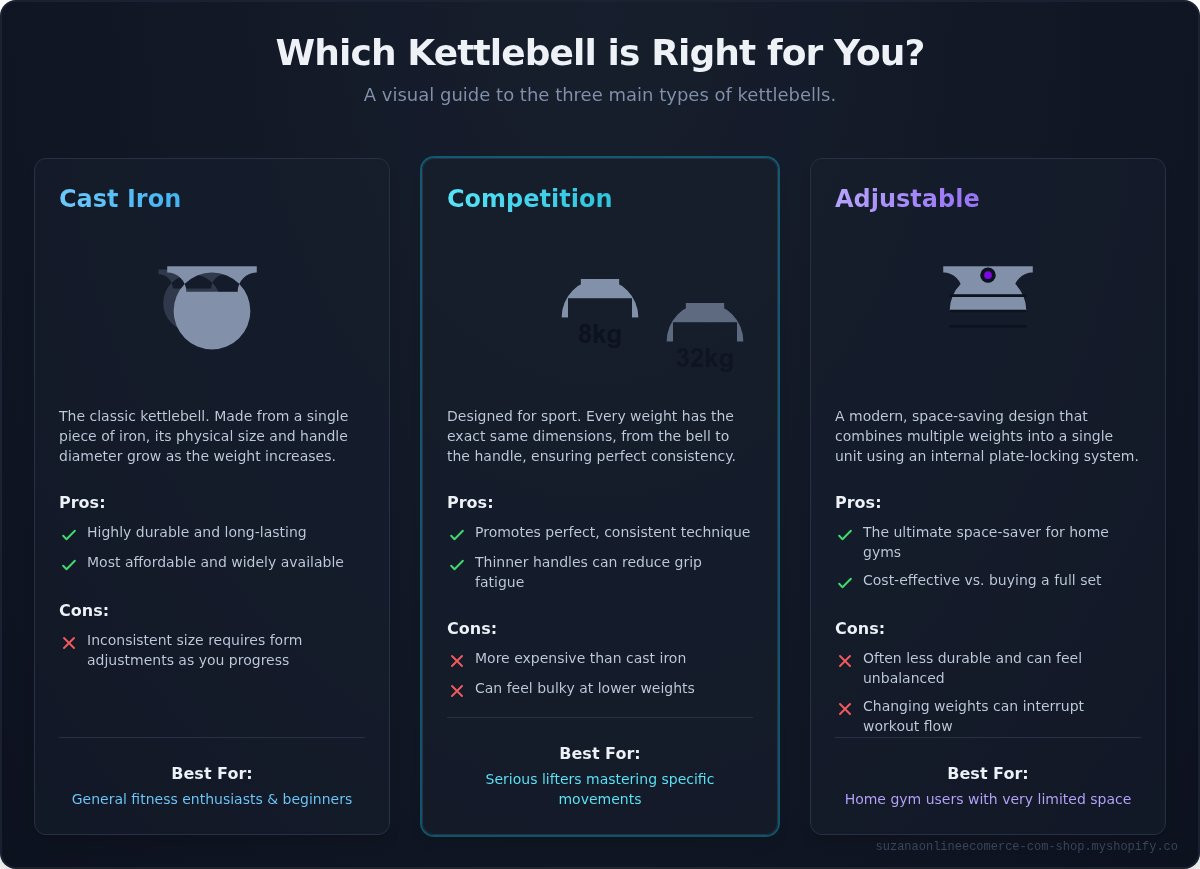
When you first decide to buy a kettlebell, you’ll quickly realize they aren't all created equal. The type you choose impacts your training, technique, and budget. Choosing the right tool is the first step to unlocking the powerful results that various studies on kettlebell benefits have documented, from building explosive strength to improving cardiovascular health. The main difference between the three most common types-cast iron, competition, and adjustable-comes down to size consistency.
Classic Cast Iron Kettlebells
This is the iconic, traditional kettlebell. Made from a single piece of cast iron, its physical size increases as the weight goes up. A 12 kg bell will be noticeably smaller than a 24 kg bell. This is the most common type you'll find in commercial gyms and home setups.
- Pros: Highly durable, generally the most affordable option, and widely available from numerous brands.
- Cons: The handle diameter and bell size change with the weight, which can require slight adjustments to your form and grip as you progress.
Best for: General fitness enthusiasts and beginners looking for the best balance of value and function.
Competition Style Kettlebells
As the name suggests, these are designed for kettlebell sport. The key feature is that every weight, from a light 8 kg to a heavy 48 kg, has the exact same dimensions-the same bell size, height, and handle diameter. The weight difference comes from the density of the metal inside the hollow steel shell.
- Pros: Promotes perfect, consistent technique for every lift, regardless of weight. The thinner handles can reduce grip fatigue.
- Cons: More expensive than cast iron and can feel awkwardly large and bulky at lower weights.
Best for: Serious lifters focusing on mastering specific lifts like the snatch, clean, and jerk.
Adjustable Kettlebells
Adjustable kettlebells are the modern solution for saving space. They combine multiple weights into a single unit, typically using a pin, dial, or locking mechanism to add or remove weighted plates inside the shell. This allows you to have a range of weights in the footprint of a single bell.
- Pros: The ultimate space-saver and can be more cost-effective than buying a full set of individual bells.
- Cons: Often less durable, can feel less balanced, and changing weights takes time, which can interrupt workout flow.
Best for: Home gym users with very limited space and a budget to invest in a quality, all-in-one solution.
How to Choose Your Perfect Starting Kettlebell Weight
"What weight should I start with?" is the single most important question for anyone new to kettlebells. The key is finding your "Goldilocks" weight: heavy enough to challenge you, but light enough to master the technique. Unlike dumbbells often used for isolated exercises, your starting kettlebell is chosen for powerful, full-body movements like swings and goblet squats. A common mistake is starting too light; ballistic exercises require sufficient load to engage your hips and generate momentum correctly. Research backs this up, with a comprehensive review of kettlebell training from the NIH confirming how these compound lifts are uniquely effective for building total-body strength and power.
General Weight Recommendations for Women
For women, we generally recommend starting in the 8-16 kg range depending on your current fitness background. Use these guidelines as your starting point, but always listen to your body.
| Fitness Level | Recommended Starting Weight |
|---|---|
| Beginner (New to strength training) | 8-12 kg (18-26 lb) |
| Active (Some experience with weights) | 12-16 kg (26-35 lb) |
| Advanced (Confident with strength training) | 16 kg+ (35 lb+) |
General Weight Recommendations for Men
For men, the starting weights are typically higher due to differences in average muscle mass. Find your recommended starting weight below.
| Fitness Level | Recommended Starting Weight |
|---|---|
| Beginner (New to strength training) | 12-16 kg (26-35 lb) |
| Active (Some experience with weights) | 16-24 kg (35-53 lb) |
| Advanced (Confident with strength training) | 24 kg+ (53 lb+) |
When and How to Progress to a Heavier Weight
Knowing when to level up is crucial for continuous progress. Before grabbing a heavier bell, ensure you have completely mastered the form on foundational lifts. Rushing this step can lead to bad habits and increase injury risk. You are likely ready to progress when:
- Your current weight feels too easy for the target number of reps.
- You can maintain perfect, crisp form throughout every single set.
- You feel confident and in complete control of the bell during the entire movement.
When you meet this criteria, the next logical step is usually a 4 kg (approx. 9 lb) jump, which is the standard increment for most kettlebell lines.
Not All Cannonballs are Equal: Key Features of a Quality Kettlebell
When you're ready to invest in your fitness, it's tempting to grab the cheapest option available. However, with a tool like a kettlebell, build quality is not just about longevity-it's about your safety, comfort, and the effectiveness of your workout. A well-made bell feels balanced and becomes an extension of your body, while a poorly made one is an awkward, and potentially dangerous, liability. Understanding the key differences is what separates a smart purchase from a future garage sale item.
The Handle: Grip, Texture, and 'Window' Space
Your primary point of contact with the bell is the handle, and its design is crucial. Look for a single-piece cast iron bell with a smooth, seamless handle. Any seams, burrs, or casting imperfections will tear up your hands, leading to blisters and missed workouts. The handle diameter should be Goldilocks-perfect: not so thick that it exhausts your grip, and not so thin that it digs into your palms during heavy lifts. Finally, inspect the 'window'-the space between the handle and the body of the bell. It must be large enough to comfortably fit both hands for foundational movements like the two-handed swing.
The Finish: Powder Coat vs. Vinyl vs. Bare Iron
The coating on a kettlebell does more than just add color; it dictates grip and durability. Here’s a quick breakdown of the most common types:
- Powder Coat: Considered the gold standard by many. This textured finish provides excellent grip, holds chalk well, and is extremely durable. It offers a secure feel without being overly abrasive.
- Vinyl Coat: Often found on budget bells, this plastic coating protects floors from scuffs. However, it can become very slippery when your hands get sweaty, creating a safety hazard. The vinyl can also crack and peel over time.
- Bare/E-Coat Iron: This offers a classic, raw feel and incredible durability. The downside is that bare iron is susceptible to rust and requires regular maintenance (like oiling) to stay in top condition.
For most users, a powder-coated finish provides the best combination of grip, feel, and low maintenance.
The Base: Look for a Flat, Stable Bottom
This is a simple but non-negotiable feature. A quality kettlebell will have a wide, flat, machined base. This ensures it remains stable and won't wobble when placed on the floor. Stability is essential for exercises like renegade rows, kettlebell push-ups, or even just setting the bell down safely between sets. A rounded or uneven bottom is a clear indicator of a low-quality casting process. For a reliable tool that supports your entire fitness journey, explore our collection of high-quality kettlebells.
Your First Workout: 5 Foundational Kettlebell Exercises
You've chosen your weight, and now the real fun begins. This simple, full-body workout is designed to build confidence and help you master the fundamental movements. Focus on controlling the weight and maintaining proper form before increasing speed or reps. For a complete workout, perform 8-12 reps of each exercise for 3 rounds, resting 60-90 seconds between rounds.
The Kettlebell Deadlift
Before you swing, you must hinge. The deadlift is the blueprint for the powerful hip-hinge pattern. It teaches you to engage your glutes and hamstrings to lift the weight, protecting your back and building a strong foundation.
- Muscles Worked: Glutes, hamstrings, core, and the entire posterior chain.
The Two-Handed Swing
The cornerstone of kettlebell training, the swing is an explosive exercise that builds power, burns calories, and improves cardiovascular health. Remember, the power comes from a sharp hip thrust-it is not an arm lift or a squat. Your arms are just there to guide the bell.
- Muscles Worked: Glutes, hamstrings, hips, core, and back.
The Goblet Squat
Holding the weight against your chest acts as a counterbalance, making it easier to keep your torso upright and sink deep into a squat with perfect form. It’s one of the best ways to learn and reinforce proper squat mechanics while building serious leg strength.
- Muscles Worked: Quads, glutes, hamstrings, core, and upper back.
The Overhead Press
A classic strength builder, the strict overhead press develops strong, stable shoulders. The offset weight of the kettlebell forces your core to work overtime to prevent your torso from twisting or leaning, making it a fantastic stability challenge.
- Muscles Worked: Shoulders (deltoids), triceps, and core.
The Halo
The perfect move to warm up or cool down. The halo improves shoulder mobility and thoracic spine rotation. Move the bell smoothly and deliberately around your head in a "halo" motion, keeping your core tight and your head still.
- Muscles Worked: Shoulders, upper back (traps), and core stabilizers.
Mastering these five movements will give you a powerful and effective full-body workout. Ready to get started? Find the perfect kettlebell for your first workout in our shop today.
Swing Into Action: Your Kettlebell Journey Begins Now
You're now equipped with the essential knowledge to transform your fitness. From decoding kettlebell types to choosing the perfect starting weight, you have the roadmap to success. Remember, mastering those foundational exercises is your first step toward unlocking the incredible full-body power of this single piece of equipment.
The right gear makes all the difference. As your one-stop shop for health and wellness, we provide a wide selection of fitness equipment, all quality-tested for durable and effective home use. Investing in a high-quality kettlebell is an investment in your results. Ready to get started?
Find the perfect kettlebell for your home gym in our collection! The strength and confidence you're searching for are just one swing away. Embrace the challenge and begin building a stronger you today.
Frequently Asked Questions
Is one kettlebell enough to get a good workout?
Absolutely. A single kettlebell is a fantastic tool for a full-body workout, especially for beginners. Exercises like the kettlebell swing, goblet squat, and Turkish get-up are compound movements that engage multiple muscle groups simultaneously. This allows you to build strength, improve cardiovascular health, and increase mobility with just one piece of equipment, making it a highly efficient and effective option for home fitness.
What's the difference between kettlebells and dumbbells?
The primary difference lies in their center of gravity. A dumbbell's weight is evenly distributed on either side of the handle, making it ideal for isolation exercises like bicep curls. A kettlebell has an offset center of gravity, with the weight sitting below the handle. This unique design is perfect for ballistic, dynamic movements like swings, cleans, and snatches, which build explosive power and functional strength in a way dumbbells cannot.
How do I know when I'm ready to buy a second or heavier kettlebell?
You're ready to advance when your current weight no longer feels challenging for your target repetition range. For example, if you can easily perform 20 goblet squats with perfect form and feel you could do more, it's time to level up. Progress requires new stimulus, and moving to a heavier kettlebell will challenge your muscles to adapt and grow stronger, helping you break through plateaus and continue making gains.
Are kettlebell workouts good for weight loss?
Yes, kettlebell training is excellent for weight loss. It uniquely blends strength training with high-intensity cardio. Dynamic exercises like swings and snatches elevate your heart rate, burning a significant number of calories in a short amount of time. This process not only burns fat during the workout but also boosts your metabolism for hours afterward, helping you achieve your weight loss goals more effectively than steady-state cardio alone.
Can you build significant muscle with only kettlebells?
Definitely. You can build substantial muscle by applying the principle of progressive overload. This means consistently increasing the challenge, either by using a heavier kettlebell, performing more reps, or reducing rest time. Compound exercises like double kettlebell front squats, presses, and rows place significant tension on your muscles, stimulating hypertrophy (muscle growth). With the right programming and intensity, kettlebells are a powerful tool for building a strong, muscular physique.
How do I take care of my cast iron kettlebell to prevent rust?
Proper care is simple. Always wipe your kettlebell down with a dry cloth after each use to remove sweat and chalk, as moisture causes rust. Store it in a dry, indoor location-avoid damp basements or garages. If you notice small rust spots, you can gently scrub them with steel wool or fine-grit sandpaper. To provide extra protection, you can occasionally apply a very thin coat of mineral oil or even just keep it well-chalked.