

2026 Guide: Choosing a Barbell Set for Home Gyms

If you believe a barbell is just a piece of cold steel, you're overlooking the most critical engineering decision in your home gym. Choosing the wrong barbell set for home use doesn't just hinder your progress; it can lead to damaged flooring and safety risks that are easily avoidable with the right technical knowledge.
It's true that the market is flooded with confusing options, from standard one-inch bars to professional Olympic variants with varying tensile strengths. You want a setup that allows for years of strength progression without needing an upgrade in six months. This guide helps you master the technical specifications and selection criteria required to build a professional-grade strength training station in your own residence. We'll examine why a 150,000 PSI rating is the baseline for durability, how to distinguish between plate materials like rubber and cast iron, and the specific maintenance steps needed to keep your gear in peak condition. By the end, you'll have the confidence to select equipment that fits your space and protects your investment for the long term.
Key Takeaways
- Understand the mechanical differences between Olympic and standard systems to ensure your barbell set for home supports long-term weight progression.
- Learn how to evaluate technical specifications like tensile strength and knurling to select a bar that balances grip comfort with professional-grade durability.
- Identify the critical safety requirements for solo training, including the use of spotter arms and high-density flooring to protect your residence.
- Avoid common purchasing mistakes by recognizing why entry-level "starter sets" often fail to meet the needs of serious strength training.
- Master the concept of micro-loading to maintain consistent progress and maximize the return on your equipment investment.
The Foundation of Strength: Why a Barbell Set for Home is Your Best Investment
A barbell set for home is a modular system consisting of a central bar, weighted plates, and secure collars. Unlike machines that dictate a fixed path of motion, a barbell requires the lifter to stabilize the weight through space. This engagement of secondary stabilizer muscles leads to superior functional strength and better carryover to daily activities. Looking at the History of the Barbell, it's clear this tool has remained the gold standard for athletes because it facilitates progressive overload more effectively than any other equipment. By adding small increments of weight over time, you force the central nervous system and muscular structure to adapt. A professional-grade barbell set for home acts as the centerpiece of a functional home gym.
The Economic Value of Home Strength Training
Choosing to train at home offers a clear financial advantage over traditional gym models. While a commercial membership involves recurring monthly fees and hidden costs like fuel and locker rentals, a barbell set is a one-time capital investment. High-quality steel equipment is exceptionally durable. Unlike the plastic components found in many modern fitness trends, a steel bar and iron or rubber plates can withstand decades of use. You also save a significant amount of time by removing the commute to a facility. This efficiency often leads to better workout adherence, as the barrier to starting a session is significantly lowered when the equipment is only a few steps away.
Versatility Across Fitness Levels
The scalability of a barbell system makes it suitable for everyone from beginners starting their fitness journey to competitive powerlifters. A single 20kg bar can be used for technique work or loaded with hundreds of pounds for maximal effort lifts. This versatility centers on the four primary compound movements: the squat, bench press, deadlift, and overhead press. These exercises provide the most efficient path to total-body transformation because they utilize multiple muscle groups simultaneously. If you're looking to expand your setup beyond the basics, our home gym equipment guide provides a roadmap for building a comprehensive training station that aligns with a broader wellness lifestyle.
Navigating Barbell Anatomy: Weights, Knurling, and Sleeve Types
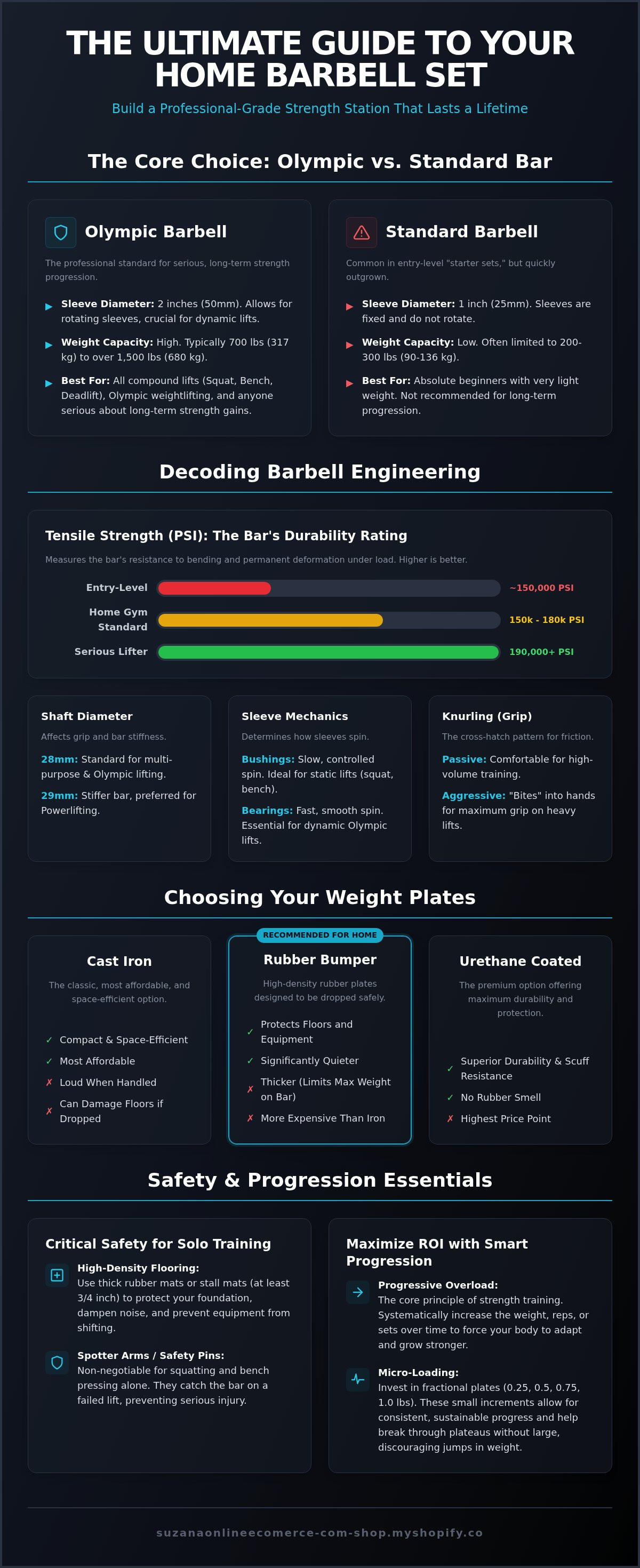
Selecting a barbell set for home requires looking beyond the aesthetics to the engineering of the bar itself. The tensile strength, measured in PSI, determines how much load the bar can handle before it permanently deforms. For most residential users, a rating between 150,000 and 180,000 PSI provides a reliable mid-range option. Serious lifters should aim for 190,000 PSI or higher to ensure long-term durability under heavy loads. The shaft diameter also matters; a 28mm bar is standard for multi-purpose use, while a 29mm bar offers the stiffness preferred for powerlifting.
The internal mechanics of the sleeves dictate how the bar behaves under load. Bushings, usually made of bronze or brass, provide a slow and controlled spin. These are ideal for static lifts like the squat or deadlift. In contrast, needle bearings allow the sleeves to spin rapidly, which is essential for protecting the wrists during dynamic Olympic movements. Regardless of the internal mechanism, secure collars are a non-negotiable safety component. They prevent plates from shifting, which could otherwise create an asymmetrical load and lead to injury.
Weight Plate Materials: Iron vs. Rubber Bumper Plates
- Cast Iron: These are the most compact and affordable plates. They allow you to fit more weight on the bar, but they're loud and can damage unprotected floors.
- Rubber Bumper Plates: Constructed from high-density rubber, these plates are designed to be dropped. They're much quieter and safer for home use, though their thickness limits the total weight you can load.
- Urethane Coating: This is a premium material that doesn't smell like rubber and offers superior resistance to scuffs and floor damage.
Understanding Knurling Marks and Grip
Knurling is the cross-hatch pattern etched into the steel to provide friction. A passive knurl is comfortable for high-volume training, whereas an aggressive knurl is designed to "bite" for maximum security during heavy singles. Most high-quality bars feature dual knurl marks, which are standardized rings that help you consistently place your hands for different lifting styles. To keep your grip consistent, use a stiff plastic brush to remove chalk and debris from the grooves regularly. If you're starting to assemble your station, you can explore professional fitness equipment to find a bar that matches your specific training goals.
Olympic vs. Standard Barbell Sets: A Comparative Analysis
The choice between Olympic and standard systems is the most significant technical decision you'll face when purchasing a barbell set for home. Olympic bars are the industry standard for professional training. They feature 50mm (2-inch) diameter sleeves and typically measure 2.2 meters (7.2 feet) in length. A standard men's Olympic bar weighs 20kg (44 lbs) with a 28mm shaft, while the women's version weighs 15kg, measures 2.01 meters, and has a thinner 25mm shaft. These bars are engineered for high-capacity lifting, with many rated for 1,000 lbs or more. Standard barbells use 1-inch diameter sleeves and are often only 5 or 6 feet long. They're significantly lighter and have much lower weight capacities, usually capping out around 200 to 300 lbs.
It's vital to understand that weight plates are not interchangeable between these two systems. An Olympic plate will slide around dangerously on a standard bar, and a standard plate won't fit over an Olympic sleeve at all. When building a barbell set for home, you should make your selection based on your 5-year strength goals. If you intend to progress to heavy compound lifts, investing in an Olympic system now prevents the need to replace your entire plate inventory when you eventually outgrow standard equipment.
When to Choose an Olympic Set
The Case for Standard Barbell Sets
Standard sets offer practical benefits for specific residential environments. They're excellent for small apartments where a full 7-foot Olympic bar cannot be safely maneuvered or stored. Since they're less material-intensive, they're also a budget-friendly option for users focused on general fitness, toning, or high-repetition endurance work. The lighter starting weight of a standard bar, often between 15 and 25 lbs, is an approachable entry point for seniors or teenagers who find the 44-lb Olympic starting weight too heavy for initial technique development.
Safety and Maintenance: Protecting Your Floors and Your Body
A residential environment presents unique challenges compared to a commercial facility. When setting up a barbell set for home use, you must identify a dedicated "Drop Zone." Contrary to common misconceptions, using rubber bumper plates does not eliminate the need for protective flooring. Even high-density rubber can transmit enough force to crack a concrete subfloor over time if the impact isn't properly dispersed. You should also verify your spatial clearance. A standard 7-foot Olympic bar requires at least 9 feet of horizontal space to allow for plate loading and safe movement. Ceiling height is equally critical; ensure you have enough overhead room to fully lockout an overhead press without hitting light fixtures or rafters.
Solo training is the norm for home lifters, making spotter arms an essential safety requirement. These adjustable steel brackets catch the bar if you fail a lift, preventing it from pinning you. Perform a Home Gym Safety Check as a non-negotiable pre-workout routine to ensure all equipment is secure and the path is clear. Maintaining a barbell set for home isn't just about safety; it's about protecting your financial investment from the corrosive effects of a home environment.
The 3-Step Barbell Maintenance Routine
Maintaining your gear preserves its performance and prevents the buildup of rust. Follow these steps to keep your equipment in professional condition:
- Step 1: Wipe down the shaft after every session. Sweat and skin oils are corrosive; a quick pass with a dry cloth prevents oxidation in the knurling.
- Step 2: Perform monthly light oiling. Apply a small amount of 3-in-1 oil to the sleeves and knurling, then brush it in to maintain the steel's integrity.
- Step 3: Check the mechanical components. Regularly inspect sleeve bolts and collar clips to ensure nothing has loosened from repeated drops or vibrations.
Floor Protection Strategies
Effective flooring reduces noise and protects your home's structural integrity. For general training with weights up to 75 pounds, a rubber flooring thickness of 8mm (3/8-inch) is the industry standard. However, for heavier lifting or dropping weights, you should opt for thicknesses of 20-25mm to ensure adequate shock absorption. A dedicated lifting platform, which uses a plywood center and rubber sides, provides the best balance of stability and protection. Proper workout equipment placement is also vital; avoid placing heavy racks on upper floors without verifying the floor's load-bearing capacity. To ensure you have the right safety gear for your space, you can browse our professional fitness accessories to complete your setup.
Choosing Your Progression: How to Scale Your Home Barbell System
Many first-time buyers fall into the "starter set" trap by purchasing a pre-bundled 100lb or 120lb barbell set for home use. While these seem cost-effective, a consistent strength program will see you outgrow these weights on compound movements like the deadlift or squat in as little as eight to twelve weeks. Investing in a high-capacity bar from the start allows you to add plates incrementally as your strength develops. SUZANA SHOP provides professional-grade fitness equipment designed to grow with you, ensuring your initial purchase remains the foundation of your gym for years to come. Planning your equipment ceiling now prevents frustration later.
To maintain steady progress once the initial "newbie gains" slow down, consider micro-loading. Using fractional plates of 0.5lb or 1lb allows you to increase the total load even when a standard 5lb jump feels impossible. As your training matures, you might expand your collection with specialized bars. An EZ-curl bar reduces strain on the wrists during bicep and tricep work, while a trap bar offers a more neutral grip that's often safer for those with lower back concerns. These additions complement your primary barbell and help target specific muscle groups more effectively.
Planning for the Next 24 Months
A functional beginner setup, including a 7-foot Olympic bar and approximately 300 pounds of plates, is generally sufficient for 12 to 18 months of training. When selecting your bar, ensure it's compatible with a standard power rack. Most racks require bars with at least 52 inches between the sleeves to sit securely on the J-cups. Integrating your strength training with other wellness products and high-performance gear from REP Store creates a holistic approach to health. You don't want to sell and replace underpowered gear by your second year. Choosing a bar with a 150,000+ PSI rating ensures you won't exceed the equipment's safety limits as you get stronger. Precision matters here.
Before finalizing your order, verify these technical and logistical details to ensure a seamless setup:
- Compatibility: Double-check that your plate hole diameter (2-inch for Olympic, 1-inch for Standard) matches your bar's sleeve diameter.
- Shipping Logistics: Review the shipping policies for heavy freight. Barbells and plates are heavy items; confirm if there are specific delivery requirements for your residence.
- Warranty: Look for a warranty that covers the bar's structural integrity and sleeve rotation to protect against manufacturing defects.
- Weight Ceiling: Confirm the bar's maximum weight capacity exceeds your 24-month strength goals.
Build Your Professional Training Foundation Today
Investing in a barbell set for home is a commitment to long-term physical progression. You now understand the critical role of tensile strength, the mechanical advantages of Olympic systems, and the necessity of proper flooring for residential safety. These technical details ensure your equipment outlasts your initial goals and adapts as you grow stronger. Don't settle for entry-level bundles that you'll outgrow in a few months. Selecting gear based on a five-year outlook prevents unnecessary replacement costs and keeps your training momentum high.
SUZANA SHOP offers a curated selection of high-durability fitness equipment designed for the specific needs of home gym enthusiasts. We provide global shipping and professional support across all wellness and fitness categories to help you build a station that meets commercial standards. Consistency in training starts with having gear you can trust to perform safely under every load. Take the next step in your strength journey by choosing equipment that matches your dedication to a healthier lifestyle.
Browse Professional Barbell Sets at SUZANA SHOP to start building your station with confidence. Your home gym is a long-term investment in your health and wellness.
Frequently Asked Questions
How much space do I really need for a 7ft barbell set?
You need a minimum of 9 feet of horizontal space for a 7ft bar. This allows for one foot of clearance on either side to safely load and unload plates without hitting walls or storage racks. Vertical space is also vital; verify that your ceiling is high enough to accommodate a full overhead press lockout. Always measure your specific room dimensions before purchasing a barbell set for home to avoid spatial constraints during your workout.
Is a 300lb barbell set enough for a beginner?
A 300lb set is typically sufficient for the first 12 to 18 months of consistent strength training for most beginners. This weight range allows for significant progression in foundational compound lifts like the squat and deadlift. However, as you develop technical proficiency and strength, you may eventually need to purchase additional individual plates. Starting with this capacity ensures you have enough resistance to trigger muscle adaptation without overinvesting too early.
Can I use iron plates on a second-story floor?
Using iron plates on a second-story floor requires careful consideration of structural load-bearing limits and impact protection. While the static weight may be safe, the dynamic force of dropping iron weights can cause structural damage or excessive noise. You should use high-density rubber mats of at least 20mm thickness or a dedicated lifting platform to disperse the force. Consulting a structural engineer is recommended if you plan on lifting heavy loads in residential upper-story rooms.
What is the difference between a bushing and a bearing barbell?
The primary difference lies in the rotation speed and intended use of the bar. Bushings use solid sleeves to provide a slow, stable spin, making them the standard choice for powerlifting movements like the bench press. Bearings utilize small needles to allow for high-speed rotation, which is essential for protecting the wrists during dynamic Olympic lifts. Most users building a barbell set for home benefit from a multi-purpose bushing bar for general strength training.
Do I need a power rack to use a barbell set at home?
You don't strictly need a power rack for all exercises, but it's essential for safely performing heavy squats and bench presses at home. Without a rack, you're limited to movements that start from the floor, such as deadlifts, rows, and cleans. For solo training, a power rack with adjustable spotter arms provides a critical safety net that prevents the bar from pinning you during a failed repetition. It's a foundational safety investment.
How do I stop my barbell from rusting in a garage gym?
Humidity control and regular maintenance are the best defenses against oxidation in a garage environment. Wipe down the bar shaft after every session to remove sweat and skin oils, which are highly corrosive to steel. Apply a light coat of 3-in-1 oil to the knurling and sleeves once a month, then use a stiff brush to work it into the grooves. Using a dehumidifier in your garage gym can also significantly extend the life of your equipment.
Are rubber-coated plates better than solid rubber bumper plates?
Rubber-coated plates are typically iron plates with a thin protective layer, whereas bumper plates are made of thick, high-density rubber. Bumper plates are designed to be dropped from overhead and are much quieter, making them ideal for home use. Rubber-coated plates are more compact, allowing you to fit more weight on the bar, but they aren't designed for high-impact drops. Choose based on whether your training style involves dynamic movements or static lifts.
Can I use a barbell set for cardio and high-intensity interval training?
Yes, a barbell set for home is an excellent tool for high-intensity interval training and metabolic conditioning. Using lower weights with higher repetitions through movements like thrusters, power cleans, or barbell complexes can significantly elevate your heart rate and improve cardiovascular endurance. This versatility allows you to integrate strength and conditioning into a single session. Ensure you maintain strict form as fatigue sets in during high-intensity intervals to prevent injury.