

Best Indoor Cycling Bike for Home Use: 2026 Buyer’s Guide

Did you know the global indoor cycling market is projected to reach 2.3 billion dollars by the end of 2026? As more people trade crowded gyms for home setups, the primary question remains: which machine provides a professional workout without breaking the bank or taking up too much room? Finding the best indoor cycling bike for home use shouldn't involve guesswork. It's frustrating to worry about noisy flywheels disturbing your neighbors or feeling confused by complex resistance types. You want a smooth, quiet experience that integrates with your favorite apps and fits your specific floor plan.
We understand that choosing the right equipment can feel overwhelming with so many technical specs to compare. You need a reliable bike that offers long-term durability and a whisper-quiet ride. This guide simplifies your search by highlighting the top-performing models for 2026. We'll show you how to match resistance types to your fitness goals and identify which features actually matter for your daily routine. From high-tech immersive screens to space-saving designs, you're about to discover the perfect fit for your home gym.
Key Takeaways
- Understand how drive systems and flywheel weights dictate your ride's smoothness and noise levels to ensure a gym-quality experience at home.
- Learn how to identify the best indoor cycling bike for home use by matching frame materials and resistance types to your specific space constraints and fitness goals.
- Evaluate the differences between "Connected Fitness" platforms and tablet-based freestyle riding to avoid paying for expensive subscriptions you don't need.
- Discover the essential maintenance requirements and construction features, such as steel versus aluminum frames, that guarantee long-term equipment durability.
- Identify the critical accessories, like high-density equipment mats from SUZANA SHOP, required to protect your floors and complete your professional home studio.
Why Indoor Cycling is the Ultimate Home Cardio Solution
Choosing the best indoor cycling bike for home use involves more than just looking at prices. It's about finding a tool that supports your long-term health and longevity. Cycling is a low-impact activity, which means it protects your joints while you push for peak performance. Unlike running on hard pavement, the modern stationary bicycle allows for high-intensity training without the repetitive orthopedic stress. You can achieve a significant caloric burn in a quick 30 to 45-minute window, making it a highly efficient solution for busy professionals.
The convenience of a home setup is unmatched. You don't have to deal with gym memberships, crowded locker rooms, or the "commute to the gym" barrier. Instead, you have 24/7 access to a workout environment tailored to your preferences. Training in the privacy of your home also means you can focus entirely on your metrics and progress without any external distractions or self-consciousness.
To better understand how different models compare and function in a home environment, watch this helpful video overview:
Spinning vs. Upright vs. Recumbent Bikes
Identifying the right bike category is the first step in your journey. Spin bikes are the gold standard for high-intensity interval training (HIIT) and standing climbs. They mimic the aggressive geometry of a road bike. Upright bikes provide a more traditional feel; they are excellent for steady-state cardio and are generally more approachable for beginners. If you require maximum lumbar support due to back issues or limited mobility, recumbent bikes offer a reclined position that prioritizes comfort and safety.
The Mental and Physical Benefits of At-Home Cycling
Consistency is the foundation of any fitness transformation. By removing the stress of traffic or unpredictable weather, you make it easier to maintain a daily habit. Cycling triggers a powerful endorphin release that improves mood and reduces anxiety. Because you can customize the resistance and intensity on the best indoor cycling bike for home use, the equipment scales with your fitness level. This accessibility ensures that you stay motivated and see tangible results over time.
Decoding the Tech: Resistance, Flywheels, and Drive Systems
Understanding the internal mechanics of your equipment is vital when searching for the best indoor cycling bike for home use. The technical specifications aren't just numbers; they dictate how the machine feels under your feet and how long it will last. While many focus solely on the frame, the drive system and flywheel are the components that truly define the quality of your ride.
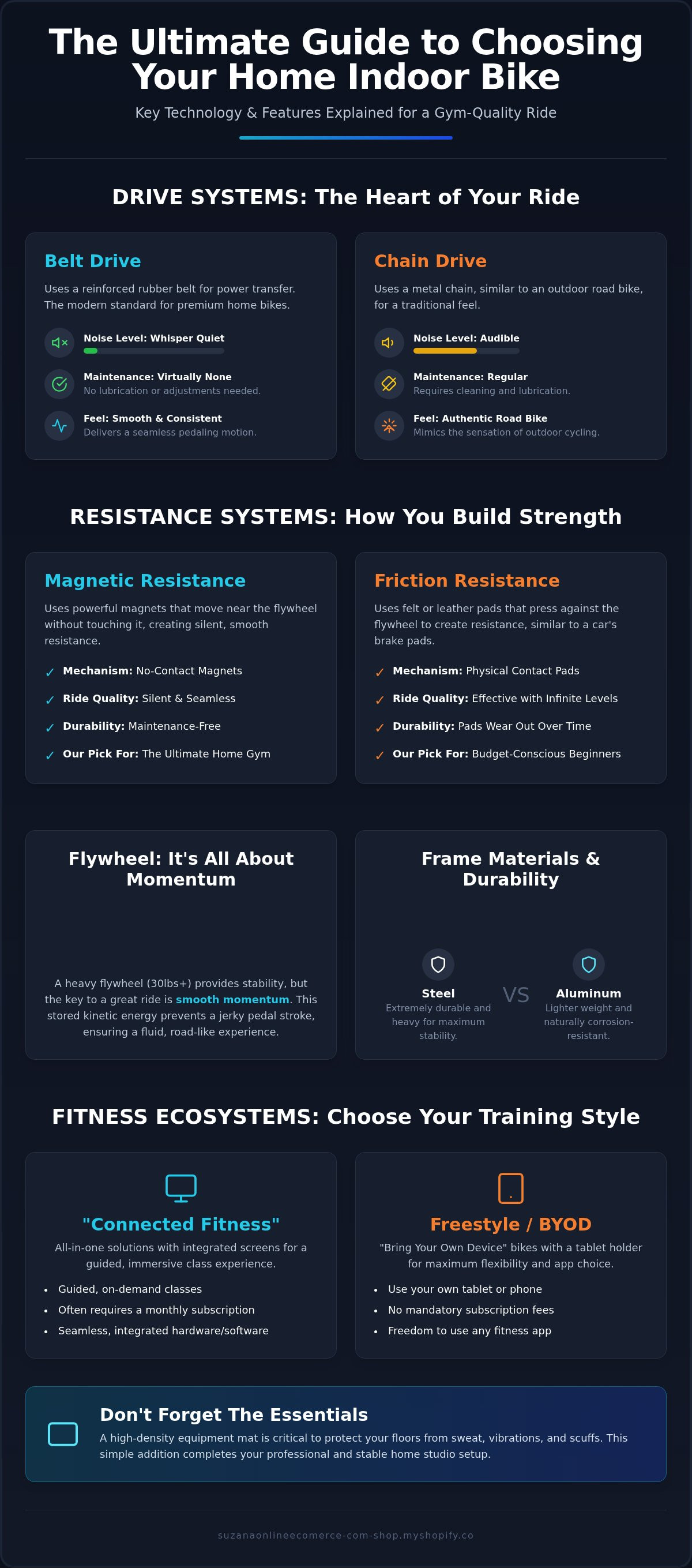
The drive system connects the pedals to the flywheel, and your choice here impacts both noise levels and maintenance requirements. Chain drives provide a feel similar to a traditional road bike, but they require regular lubrication and can be quite noisy. In contrast, belt drives use a reinforced rubber belt. These systems are virtually silent and require almost no maintenance, making them the superior choice for shared living spaces or apartments.
Flywheel Momentum is the kinetic energy stored in the rotating disk that ensures a smooth, non-jerky pedal stroke during your workout.
Magnetic vs. Friction Resistance
The method of applying resistance determines how the bike challenges your muscles. Magnetic resistance is the professional standard for high-end home equipment. It uses powerful magnets that move closer to or further from the flywheel. Because the magnets never actually touch the wheel, the system is silent and maintenance-free. Friction resistance uses felt or leather pads that physically grip the flywheel. While friction systems are cost-effective and offer infinite resistance levels, the pads eventually wear out and require replacement. If your budget allows, magnetic systems provide a more seamless experience for the best indoor cycling bike for home use.
Understanding Flywheel Weight and Momentum
Flywheel weight has traditionally been a primary indicator of stability. Heavy flywheels, often weighing 30lb or more, use physical mass to create consistent momentum. This weight prevents the "choppy" feeling sometimes found in cheaper equipment. However, modern engineering has challenged the myth that heavier is always better. High-tech magnetic bikes, like those used in boutique studios, often utilize lighter flywheels paired with high-speed gearing to simulate the same inertia. This approach reduces the overall weight of the machine without sacrificing the road feel. To keep your high-tech setup performing its best, consider adding professional fitness accessories that protect your equipment and your floors.
Essential Features for a Quiet and Durable Home Setup
Noise control is often the deciding factor for apartment dwellers and early-morning exercisers. Even the most advanced resistance system won't help if the bike's mechanical operation wakes up your neighbors or family. When looking for the best indoor cycling bike for home use, prioritize a frame built from high-tensile steel. Steel provides the necessary weight to keep the machine stable during high-intensity sprints, preventing the "rocking" motion common in lighter, lower-quality frames. While aluminum frames are lighter and resistant to corrosion, they often lack the "planted" feel required for out-of-the-saddle climbing.
Durability also depends on ergonomics. You should look for a bike that offers four-way adjustability: seat height, seat fore/aft, handlebar height, and handlebar fore/aft. This level of customization allows you to maintain a neutral spine and prevents long-term joint strain. Pay attention to the Q-factor, which is the distance between the pedal attachment points. A narrower Q-factor more closely mimics the feel of a professional road bike and reduces lateral stress on your knees and hips during long sessions.
Belt Drive vs. Chain Drive Systems
Chain drives use a metal chain and sprockets, just like a standard outdoor bicycle. While they offer a tactile feel that some outdoor cyclists prefer, they generate significant noise and require regular oiling to prevent rust and mechanical grinding. Belt drives use a carbon-fiber or reinforced rubber belt that glides silently over the pulleys. Because they don't require grease, they won't stain your carpet or gym flooring. This silence and cleanliness have made belt drives the industry standard for modern home fitness equipment, ensuring your workout doesn't disturb the rest of your household.
Space-Saving Designs and Portability
Before purchasing, it's essential to measure your intended workout area. There is a clear difference between a bike's "workout footprint" and its "storage footprint." If you use a multi-purpose room, look for models with large, front-mounted transport wheels. These allow you to tilt the machine and roll it into a corner or closet when your session ends. For more advice on optimizing your workout layout, check out our guide on Home Gym Equipment: The Ultimate Buyer's Guide. This ensures your home studio remains functional and organized without cluttering your daily living space.
How to Choose the Right Bike for Your Fitness Level
Selecting the best indoor cycling bike for home use requires a realistic assessment of your long-term commitment. It's easy to be swayed by high-end technology, but you don't always need a massive touchscreen to reach your fitness goals. Your choice should balance your current physical needs with your budget and the type of motivation you require. Stability is also a safety factor; high-quality models like the NordicTrack S22i offer a 350 lb weight capacity, which ensures the frame remains steady during intense sprints.
Budget tiers in 2026 generally fall into three categories. Entry-level bikes like the YOSUDA cost around $340 and offer a solid, friction-based workout without digital bells and whistles. Mid-range options, such as the Schwinn IC4 or Bowflex C6, typically sit near the $999 mark and provide magnetic resistance with Bluetooth connectivity. Premium models, including the Peloton Bike+ at $2,695, include integrated HD touchscreens and automated resistance features. Matching your investment to your frequency of use prevents overspending on features you might not use daily.
Entry-Level vs. Premium Performance Models
As you evaluate your options, it is helpful to explore Direct-to-consumer retail sales of bicycles and cycling equipment to compare different price points and feature sets across various reputable brands.
Entry-level models focus on the fundamentals: a sturdy frame and manual resistance. These are perfect for beginners who want to test their consistency without a major financial hurdle. Premium models offer an immersive experience with rotating screens and AI-powered coaching. However, the secret value play of 2026 is pairing a high-quality "dumb" bike with a "smart" app on your own tablet. This allows you to access professional-grade telemetry and classes without the proprietary hardware lock-in or the $2,000 plus price tag. You can find the best indoor cycling bike for home use accessories to complete this hybrid setup in our fitness collection.
The Role of Connectivity and Fitness Apps
Connectivity determines how you interact with your data. Most modern bikes use Bluetooth or ANT+ to sync with heart rate monitors and cycling apps. If you enjoy a community feel, subscription-based platforms like Peloton or Zwift offer live leaderboards and virtual worlds; for easy access to these international services, many users rely on پینگول for their gift card needs. If you prefer a self-guided routine, look for a bike that is "app-agnostic." This means it can connect to various platforms like JRNY or YouTube workouts. Using your own tablet or smartphone is often more cost-effective because it avoids the mandatory, high-cost monthly memberships required by many integrated-screen bikes.
Simply placing the best indoor cycling bike for home use in a corner isn't enough to sustain a long-term fitness habit. You need a dedicated environment that minimizes friction and maximizes your psychological drive to train. A professional home studio protects your investment and your property. For instance, high-density equipment mats are non-negotiable. They dampen vibrations that might disturb neighbors and prevent heavy steel frames from leaving permanent indentations in your flooring. These mats also trap sweat, which is highly corrosive to both your bike's finish and your subfloor.
Beyond the mechanical setup, you should integrate wellness products to handle post-ride recovery. Recovery is where the actual physiological gains happen. Without proper stretching and hydration, even the most expensive equipment becomes a glorified clothes hanger within months. For a deeper look at organizing your space and selecting the right tools, explore The Ultimate Guide to Workout Equipment for Your Home Gym.
Must-Have Accessories for Your Cycling Space
A complete setup includes tools for cross-training and hygiene. Yoga mats provide a stable surface for off-bike core work and flexibility sessions. These are essential for counteracting the forward-leaning posture inherent in cycling. Adding a pair of dumbbells allows you to participate in integrated upper-body classes found on many modern streaming platforms. Don't overlook hydration essentials; a high-capacity water bottle and specialized sweat towels are mandatory for high-intensity interval training (HIIT) sessions where body temperatures rise quickly. Having these items within arm's reach ensures you don't have to break your rhythm once the ride begins.
Starting Your Journey with Professional Equipment
SUZANA SHOP supports your fitness journey by providing a curated selection of professional-grade wellness items and accessories. We focus on objective quality so you don't have to guess which gear will withstand the rigors of daily use. As you begin your first 30 days with the best indoor cycling bike for home use, follow this checklist to ensure success:
- Verify Ergonomics: Re-check your seat height and handlebar reach after the first week to ensure no joint strain.
- Floor Integrity: Inspect your equipment mat to ensure it is properly centered and catching all moisture.
- Consistency over Intensity: Focus on showing up for 20 minutes a day rather than one grueling two-hour session.
- Maintenance Routine: Wipe down the frame and flywheel after every session to prevent salt buildup and rust.
Investing in quality equipment from the start ensures that your home gym remains a functional sanctuary for years to come.
Transform Your Daily Routine with the Right Setup
Your journey toward better health doesn't require a gym membership or a complex commute. It starts with selecting a machine that fits your lifestyle. By prioritizing silent belt drives and maintenance-free magnetic resistance, you ensure your workouts remain consistent without disturbing your household. Remember that the best indoor cycling bike for home use is only as effective as the environment you create around it. High-density mats and recovery tools are just as important as the flywheel itself for long-term success.
As global e-commerce experts, we specialize in providing professional-grade workout accessories and curated wellness items designed for durability. Whether you're a beginner starting with manual resistance or an athlete seeking advanced connectivity, the right tools bridge the gap between your current level and your fitness goals. Don't let indecision stall your progress. You can browse professional fitness equipment at SUZANA SHOP today to complete your home studio with high-quality gear. Your future self will thank you for the investment you make in your wellness today. Start your first ride with confidence.
Frequently Asked Questions
What is the best type of indoor cycling bike for a beginner?
An upright bike or a basic spin bike with manual resistance is often the ideal choice for those just starting. These models provide a stable platform and a straightforward interface that doesn't require complex software setup. Beginners should prioritize a comfortable, adjustable seat and a sturdy frame over high-end digital features. Starting with a reliable, manual machine allows you to build a consistent habit before committing to more expensive, tech-heavy equipment.
Is magnetic resistance better than friction resistance for home use?
Magnetic resistance is generally superior for home environments because it's virtually silent and requires zero maintenance. Since the magnets never touch the flywheel, there's no friction noise or mechanical wear. Friction resistance is more budget-friendly but uses pads that eventually wear down and need replacement. For apartment dwellers or those who exercise early in the morning, the silent operation of a magnetic system makes it the best indoor cycling bike for home use.
How much space do I really need for an indoor bike?
Most indoor bikes have a physical footprint of approximately 4 feet by 2 feet. However, you should plan for a workout zone of at least 6 feet by 4 feet to allow for safe mounting, dismounting, and upper-body movements. Ensure there's adequate ventilation and enough vertical clearance if you plan on standing during climbs. Using a high-density equipment mat can help define this space while protecting your flooring from sweat and mechanical vibrations.
Do I need special shoes (cleats) to use a home cycling bike?
You don't need special cycling shoes if your bike is equipped with toe cages, which allow you to ride in standard athletic sneakers. However, using dedicated cycling shoes with SPD or Delta cleats provides a more secure connection to the pedals. This connection improves your power transfer and reduces the risk of your foot slipping during high-intensity intervals. Many mid-range bikes come with dual-sided pedals to accommodate both sneakers and professional cycling cleats.
Can I use a tablet or phone instead of a bike with a built-in screen?
Using your own tablet or smartphone is a highly effective way to access premium content without the high cost of integrated hardware. Many riders prefer app-agnostic bikes that feature a built-in tablet holder and Bluetooth connectivity. This setup allows you to switch between different fitness platforms as your interests change. It also eliminates the risk of your bike's built-in screen becoming technologically obsolete or requiring a mandatory, high-cost monthly membership to function.
How often should I perform maintenance on my home bike?
You should perform basic maintenance after every session by wiping down the frame, handlebars, and flywheel to remove corrosive sweat. On a monthly basis, check that all bolts are tight and ensure the pedals are securely attached. If you have a chain-drive system, it will require lubrication every three to six months. Belt-drive systems are lower maintenance but still benefit from a quick visual inspection of the belt's tension and integrity twice a year.
Is an indoor bike better than a treadmill for weight loss?
Neither machine is inherently better, as weight loss depends on your total caloric deficit and consistency. However, an indoor bike offers a low-impact alternative that is much easier on the joints than a treadmill. This makes it a sustainable choice for long-term use, especially if you're recovering from an injury or have orthopedic concerns. Because cycling is less taxing on the skeletal system, many users find they can work out more frequently compared to running.
What weight flywheel should I look for in a mid-range bike?
In a mid-range bike using traditional resistance, a flywheel weighing between 30 and 40 pounds is the standard for a smooth ride. This mass creates the necessary inertia to prevent a choppy pedal stroke. However, if you are looking at modern magnetic bikes, the flywheel weight matters less. These advanced systems use high-speed gear ratios and magnetic induction to simulate the feel of a heavy wheel without the added physical bulk or weight.