

Foam Roller Exercises: The Complete Guide to Muscle Recovery in 2026

Did you know that over 1.71 billion people worldwide currently struggle with musculoskeletal disorders? Most of us accept chronic muscle tightness as an inevitable byproduct of a desk job or a heavy gym session. You've likely felt that familiar ache in your hamstrings or the stubborn knot between your shoulder blades and wondered if pushing a hard cylinder into your muscles is actually helping or just causing unnecessary pain. It's common to feel hesitant when you aren't sure which movements are safe or how much discomfort is normal during a recovery session.
This guide provides clarity by showing you how to master foam roller exercises to eliminate tension and safely improve your flexibility from the comfort of your home. You don't have to guess about the effectiveness of your recovery anymore. We will break down professional techniques, explain how to gauge the right intensity, and help you build a simple ritual that turns your daily recovery into a professional grade wellness experience. By the end of this guide, you'll have a repeatable home routine that reduces soreness and restores your range of motion effectively.
Key Takeaways
- Understand the technical mechanics of Self-Myofascial Release (SMR) and how it helps release restrictions within the muscle fascia.
- Master specific foam roller exercises for the quadriceps, hamstrings, and upper back to restore mobility and reduce chronic tightness.
- Learn to identify and correct common safety mistakes, such as rolling too quickly or applying direct pressure to joints and bones.
- Discover the optimal timing for recovery by using light rolling for pre-workout activation and deep pressure for post-workout repair.
- Establish a repeatable home wellness ritual that bridges the gap between professional-grade recovery and your daily fitness routine.
What is Foam Rolling? Understanding Self-Myofascial Release
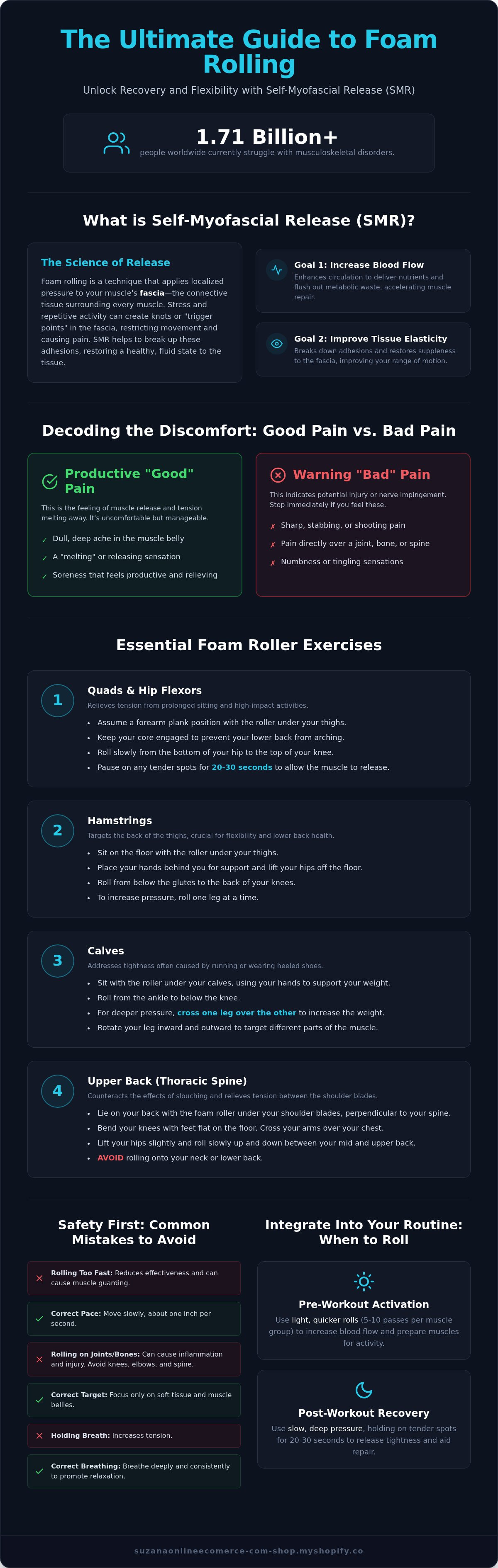
Foam rolling is a technical recovery method formally known as Self-Myofascial Release (SMR). It functions by applying localized pressure to specific points in your body to alleviate tension. The primary target of this technique is the fascia, which is a thin, tough layer of connective tissue that wraps around every muscle and organ. When you experience stress or engage in repetitive physical activity, this tissue can become thick or sticky. This creates "trigger points" or knots that restrict your natural movement. By performing foam roller exercises, you manually manipulate these tissues to break up adhesions and restore their fluid state.
The primary goals of SMR are twofold: increasing blood flow to the targeted area and improving tissue elasticity. Enhanced circulation delivers essential nutrients to the muscles while helping to flush out metabolic waste. However, the process requires a precise understanding of physical feedback. "Good pain" typically feels like a dull ache or a productive "melting" sensation as the muscle relaxes. In contrast, "bad pain" is sharp, stabbing, or located directly over a joint or bone. If you feel numbness or tingling, stop immediately; these are signs of nerve compression rather than muscular release.
The Benefits of Daily Foam Rolling
Consistency is the most critical factor for seeing results. Integrating these movements into your schedule provides accelerated recovery, especially after using machines for weight training. Heavy lifting often leads to microscopic tears in the muscle fibers, resulting in Delayed Onset Muscle Soreness (DOMS). Daily rolling helps mitigate this discomfort by maintaining the suppleness of the surrounding fascia. You'll also notice a measurable improvement in your joint range of motion. This increased flexibility ensures that your body can handle more complex movements without risking strain or compensation injuries.
How Foam Rolling Complements Your Wellness Routine
Self-massage is a foundational element of a comprehensive health and wellness plan. Beyond the physical repair, many people find that foam roller exercises serve as a powerful mental reset. After a long workday spent at a desk, the physical act of rolling out the back or shoulders signals to the nervous system that it's time to transition from a high-stress state to a recovery state. This physical release is directly connected to stress reduction. When your body isn't holding onto physical tension, your mind often follows suit. This makes recovery tools essential wellness products for anyone looking to maintain a balanced lifestyle in a high-demand environment.
Essential Foam Roller Exercises for Lower Body Recovery
Lower body tension often originates from prolonged sitting or high-impact training. Using foam roller exercises effectively requires a focus on the large muscle groups that support the pelvis and knees. When you address these areas, you don't just fix local soreness; you often resolve referred pain in the lower back and ankles. Precision is key during these movements to ensure you're targeting soft tissue rather than bone or connective ligaments.
Targeting the Quads and Hip Flexors
To begin, assume a forearm plank position with the roller placed under your thighs. It's vital to stay between the top of the knee and the bottom of the hip bone. You should never roll directly over the kneecap. Move at a slow, incremental rate of approximately one inch per second. If you encounter a particularly sensitive "sweet spot," pause and hold for 20 to 30 seconds. This sustained pressure allows the nervous system to signal the muscle to relax. Maintaining a strong core during this exercise prevents your lower back from arching, which protects your spine while you work.
For the hamstrings and calves, the approach shifts to using your body weight for leverage. Sit on the floor with the roller under your thighs and use your hands to lift your hips. For the calves, which are often chronically tight in runners or those wearing high-heeled shoes, cross one leg over the other to increase the downward pressure. This added weight helps reach deeper layers of the gastrocnemius muscle. Investing in high-quality fitness equipment ensures your recovery tools provide the right density for these technical movements.
Addressing the glutes and piriformis is also essential, as these muscles are frequently the root cause of lower back issues. Sit directly on the roller and cross one ankle over the opposite knee. Lean slightly toward the side of the crossed leg to access the deep rotators. This helps release the piriformis, which can otherwise compress the sciatic nerve and cause significant discomfort during daily activities.
The Correct Way to Roll the IT Band
Many athletes mistakenly believe they should roll the iliotibial (IT) band directly. However, the IT band is a thick piece of connective tissue that cannot be "stretched" or "released" through direct pressure. Rolling it directly often causes unnecessary inflammation. Instead, focus on the surrounding muscles that pull on the band. These include the Tensor Fasciae Latae (TFL) at the hip and the Vastus Lateralis on the outer quad. Use a side-lying posture to manage intensity, supporting your weight with your opposite leg and forearm. This indirect approach provides the relief you need without the sharp, unproductive pain of rolling the band itself.
Relieving Upper Body Tension: Exercises for Back and Shoulders
Chronic upper body tension is a frequent complaint for desk workers and athletes alike. Hours spent leaning over a keyboard or performing repetitive overhead movements can lead to "tech neck" and restricted shoulder mobility. Implementing targeted foam roller exercises for the upper back and shoulders helps reverse these postural compensations. Unlike the lower body, the upper body requires a more nuanced approach to avoid putting undue pressure on the spine and ribs. By focusing on the thoracic spine and the muscles surrounding the shoulder blades, you can effectively release the knots that accumulate from daily stress.
Thoracic Extension for Posture Correction
To address a rounded upper back, place the roller horizontally across your mid-back, specifically around the bottom of your shoulder blades. It's vital to support your head with your hands to avoid straining the neck muscles. Keep your feet flat on the floor and your knees bent. As you inhale, gently lean back over the roller to encourage spinal extension. Don't force the movement; let gravity and your breath do the work. Exhale as you return to the starting position. This specific movement helps open the chest and improves the mobility of the thoracic vertebrae, which is often the most restricted area of the spine for office professionals.
Releasing the Lats and Rotator Cuff
The latissimus dorsi (lats) are large muscles that, when tight, significantly limit your ability to reach overhead. To release them, lie on your side with the roller tucked into your armpit. Extend your bottom arm straight out in a "superman" position. You'll likely find a sensitive trigger point just behind the armpit. Instead of long, sweeping movements, use small oscillating motions or a side-to-side rocking technique to break up adhesions. This precision helps target the rotator cuff muscles that stabilize the shoulder joint. Improving the suppleness of these tissues is essential for maintaining a full range of motion during both exercise and daily activities.
When working on the upper back, you can also target the area between your shoulder blades. Cross your arms over your chest as if giving yourself a hug. This action pulls the scapulae apart, exposing the rhomboids and mid-trapezius muscles underneath. Gently roll up and down for 30 seconds to address the deep-seated tension often found in this region. However, you must adhere to strict safety boundaries. Never roll your lower back (lumbar spine) or your neck vertebrae. The lumbar spine lacks the protective cage of the ribs, and the neck is too delicate for the pressure of a standard roller. If you find these foam roller exercises aren't reaching specific small knots, you might consider using smaller wellness products like massage balls for more localized pressure.
Safety First: Common Foam Rolling Mistakes and How to Avoid Them
While foam roller exercises are highly effective for recovery, improper technique can lead to bruising or increased inflammation. One of the most frequent errors is rolling too quickly. Rapid movements trigger a protective reflex in the muscle spindles, causing the tissue to contract rather than relax. To see results, you must move slowly. Another critical mistake is applying direct pressure to joints or bones. As established in previous sections, you should stay on the "meaty" part of the muscle. Putting weight on the kneecap or the side of the elbow can cause joint capsule irritation that takes weeks to resolve.
Duration also matters. Don't spend several minutes grinding into a single knot. Research suggests that 30 to 90 seconds per muscle group is the optimal range for release. Exceeding this limit increases the risk of damaging the skin or underlying capillaries. Furthermore, many people unconsciously hold their breath when they hit a sensitive spot. This inhibits the parasympathetic nervous system, making it impossible for the muscle to let go. Focus on deep, rhythmic exhales to facilitate the release of tension.
Understanding the Pain Threshold
Effective rolling shouldn't be a test of endurance. Use a pain scale from 1 to 10 to monitor your intensity. You're aiming for a "productive discomfort" that sits at a 6 or 7. If the pain feels sharp, stabbing, or radiates down your limb, stop immediately. These are signs of nerve compression or acute tissue damage rather than a muscular knot. Remember that your fascia requires hydration to remain elastic. Squeezing the tissue with a roller displaces fluid, so it's essential to drink water immediately after your session to help the tissues rehydrate and recover. For those looking to further support their body's recovery through nutrition, Biora.hu offers a range of vitamins and supplements designed to maintain muscle and joint health.
There are times when you should avoid foam roller exercises entirely. If you have an acute injury like a muscle tear, a bone fracture, or severe localized swelling, rolling will only aggravate the condition. Individuals with chronic health issues, such as osteoporosis or deep vein thrombosis, must consult a medical professional before starting a routine. If a high-density roller feels too aggressive for your current physical state, you can find gentler alternatives in other workout equipment categories, such as soft mats or low-density rollers. To ensure you have the right tools for a safe recovery, explore our professional-grade fitness equipment today.
How to Integrate Foam Rolling into Your Daily Wellness Routine
The effectiveness of foam roller exercises depends largely on timing and intent. When you use a roller as a pre-workout tool, your goal is neural activation. Use fast, light strokes for 10 to 20 seconds per area to increase local blood flow and "wake up" the nervous system. Conversely, post-workout sessions require deep, slow movements to facilitate waste removal and downregulate the nervous system after intense exertion. This slower pace helps transition your body into a state of recovery more efficiently than stretching alone. By shifting your approach based on your activity level, you ensure that your recovery tools work with your body's natural rhythms.
For those spending long hours at a desk, a "Desk Reset" is essential for long-term health. A 5-minute routine focusing on the thoracic spine and hip flexors can counteract the structural collapse caused by prolonged sitting. To maximize your results, always pair rolling with static stretching. Rolling desensitizes the muscle and breaks up adhesions; this allows you to achieve a deeper, more effective stretch immediately afterward. It's a simple combination that significantly improves overall flexibility and reduces the risk of repetitive strain injuries.
Choosing the Right Foam Roller for Your Needs
Selecting the correct tool is just as important as the technique itself. Low-density rollers are made of softer foam and are ideal for beginners or those with high sensitivity. High-density rollers are firmer and provide the intense pressure needed for deep tissue release in larger muscle groups like the quads. You might also consider textured or grid rollers, which feature ridges designed to mimic a massage therapist’s fingers or palms. These are particularly effective for stubborn trigger points. While full-length rollers are staples for home gyms, travel-sized versions are excellent wellness products that ensure you never miss a recovery session while on the road.
A Sample 10-Minute Full-Body Routine
Consistency beats intensity every time. Use this 10-minute protocol three to four times a week to maintain tissue health. Spend approximately 2 minutes on each of the "Big Three" muscle groups:
- Quadriceps: Focus on the front of the thighs to release hip and knee tension.
- Latissimus Dorsi: Roll the sides of the mid-back to improve shoulder mobility.
- Thoracic Spine: Perform the extension movements described in section 3 to correct posture.
Dedicate the final 4 minutes to transition between these areas and focus on deep, diaphragmatic breathing. This signals your brain to release any remaining muscular guarding. By integrating these foam roller exercises into a repeatable ritual, you create a sustainable foundation for long-term physical well-being and peak performance. For those looking to support their body from the inside out, check out Nuradiant for expert advice on the best multivitamins for active adults over 40.
Adopting a consistent recovery strategy is the most effective way to maintain long-term physical performance and comfort. By mastering these specific foam roller exercises, you've moved beyond simple stretching into the technical field of Self-Myofascial Release. Success in your wellness journey relies on moving slowly, respecting your pain threshold, and choosing tools that match your specific muscle density needs. Whether you're correcting posture after a long day at a desk or repairing tissue after a heavy lifting session, the right technique ensures you stay mobile and injury-free.
To get the most out of your routine, you need reliable equipment that stands up to daily use. Upgrade your home gym with professional recovery gear at SUZANA SHOP. We offer a curated selection of high-quality wellness products and provide global shipping on all fitness equipment to support your health goals wherever you are. Start your next session today and feel the immediate difference that professional-grade recovery makes in your daily life.
Frequently Asked Questions
Is it okay to foam roll every day?
Yes, you can perform foam roller exercises every day as part of a maintenance routine. Daily rolling for 10 to 15 minutes helps prevent the buildup of new adhesions and maintains fascia elasticity. However, you should avoid rolling the same sore spot for several days in a row if you notice bruising or excessive tenderness. Consistency is more important than intensity, so aim for a sustainable daily ritual rather than one long, aggressive session.
Why does foam rolling hurt so much at first?
Initial discomfort occurs because the roller is compressing trigger points or knots where the fascia has become thick and restricted. Your nervous system isn't used to this level of localized pressure, which leads to a heightened pain response. As your tissue quality improves and the adhesions break down, the sensitivity will decrease. If you stay within the recommended 6 to 7 pain threshold, the process will become significantly more comfortable over time.
Can foam rolling help with cellulite?
Foam rolling cannot permanently eliminate cellulite, as it doesn't remove the underlying fat cells. However, it can temporarily improve the appearance of the skin by increasing local blood circulation and encouraging lymphatic drainage. This reduces fluid retention and makes the skin look smoother for a short period. For long-term results, you should combine recovery tools with a balanced diet and regular strength training rather than relying solely on myofascial release techniques.
How long should I roll each muscle group?
You should spend between 30 and 90 seconds on each specific muscle group. Research indicates that this is the optimal window for the nervous system to signal the muscle to relax. Rolling for less than 30 seconds may not provide enough stimulus for release, while exceeding 90 seconds increases the risk of tissue inflammation or bruising. If you have multiple tight spots, move between them rather than lingering too long on one area.
Should I foam roll before or after a workout?
You can use foam roller exercises both before and after your training sessions for different reasons. Pre-workout rolling should be fast and light to increase blood flow and activate the muscles for movement. Post-workout rolling should be slow and deliberate to help flush out metabolic waste and transition your body into a recovery state. Integrating both phases into your fitness routine provides a comprehensive approach to muscle health and performance.
Can I foam roll my lower back?
You should avoid rolling your lower back directly. Unlike the upper back, the lumbar spine lacks the structural protection of a rib cage, making the vertebrae and internal organs vulnerable to excessive pressure. Rolling this area can also cause the surrounding muscles to spasm as a protective mechanism. If you experience lower back tightness, focus on rolling your glutes, hip flexors, and hamstrings, as these areas are often the actual source of the tension.
What is the difference between a smooth and a textured foam roller?
Smooth rollers provide even pressure across the entire muscle surface, making them ideal for beginners or those with sensitive tissues. Textured rollers feature ridges or bumps designed to mimic a massage therapist’s fingers and palms. These patterns allow for more localized pressure on deep trigger points. While a smooth surface is better for general recovery, a textured grid is more effective for athletes who need to penetrate deeper layers of dense muscle tissue.
How do I know if I am foam rolling correctly?
You are rolling correctly if you feel a productive discomfort that stays around a 6 or 7 on a 10-point scale. After a session, the targeted muscle should feel more mobile and less restricted. You should not experience sharp, stabbing pain or radiating numbness during the movement. If you can maintain deep, steady breathing while applying pressure, it's a good sign that your nervous system is accepting the release rather than fighting against it.