

Home Gym Ideas for a Basement with Low Ceilings: Maximizing Your Space

You reach the peak of a heavy overhead press only to have your knuckles collide with a cold, low-hanging floor joist. It's a common frustration for fitness enthusiasts trying to transform a cramped cellar into a functional workout zone. Standard equipment often ignores the reality of older homes with limited headroom. Finding effective home gym ideas for a basement with low ceilings requires moving away from vertical stacks and toward a horizontal strategy. You shouldn't have to compromise your safety or your gains just because your ceiling sits at seven feet or less.
It's frustrating when pull-up bars are unusable and ellipticals are simply too tall for your space. You deserve a training environment that feels open and professional, even if it's below ground level. This guide shows you exactly how to design a high-performance gym using specialized equipment and smart layout hacks. We will explore low-profile benches, compact gear, and lighting techniques that make any cramped room feel spacious and bright. By the end, you'll know how to select equipment that fits perfectly without needing custom modifications.
Key Takeaways
- Learn why your standing reach is a more critical measurement than the actual ceiling height when planning your layout and equipment selection.
- Discover effective home gym ideas for a basement with low ceilings, including the use of 72-inch "shorty" power racks and compact adjustable dumbbells.
- Implement the "joist hack" to gain extra clearance for barbell movements and choose the optimal flooring thickness to save vertical space.
- Master exercise modifications like seated overhead presses and kneeling lat pulldowns to maintain a high-performance routine despite height constraints.
- Use strategic color theory and large mirrors to transform a cramped cellar into a bright, professional-grade training environment.
Assessing Your Vertical Clearance: How Low is Too Low?
Building a functional workout space starts with a tape measure; not a catalog. In the fitness industry, a standard ceiling height is typically 8 feet. Anything under 7 feet (84 inches) is considered a low-ceiling environment. According to the 2024 International Residential Code, existing habitable basements can have a ceiling height as low as 6 feet 8 inches, with beams or ducts projecting down to 6 feet 4 inches. Finding effective home gym ideas for a basement with low ceilings begins with a brutal assessment of these specific dimensions.
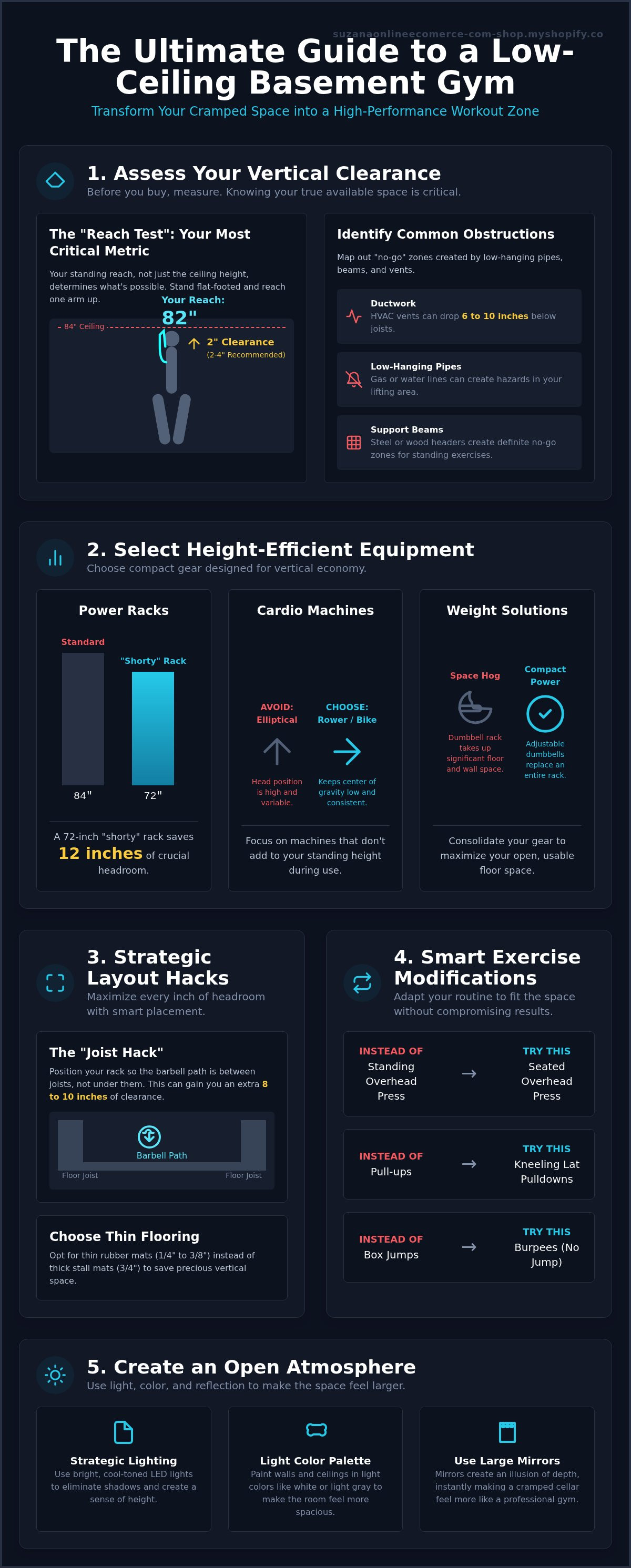
Your standing reach is a more critical metric than the raw ceiling height. To find this, stand flat-footed and reach one arm as high as possible. If your reach is 82 inches and your ceiling is 84 inches, you only have two inches of clearance for overhead movements. This "Reach Test" determines which exercises are physically possible. You must also account for a safety margin. Aim for at least 2 to 4 inches of "air" above your tallest piece of equipment or the peak of your range of motion. This gap prevents you from smashing your knuckles or damaging the ceiling during intense sets.
Identifying obstructions is the next step. Look for the following common basement hurdles:
- Ductwork: HVAC vents often drop 6 to 10 inches below the joists.
- Low-hanging pipes: Gas or water lines may run across your intended lifting area.
- Support beams: Steel or wood headers often create "no-go" zones for standing exercises.
Measuring for Overhead Movements
Calculating clearance for a barbell isn't just about the bar's height. You have to account for the plates. A standard Olympic plate has a diameter of 17.7 inches, meaning it extends nearly 9 inches above the bar. If you're performing dynamic movements like burpees or box jumps, you must also account for the "jump" factor. Your head height increases by several inches at the apex of a hop; measure your height while standing on your toes to simulate this vertical shift.
Identifying the Best 'Zones' in Your Basement
When brainstorming home gym ideas for a basement with low ceilings, remember that the center of the room isn't always the best spot. The highest points in a basement are usually the pockets between the floor joists. Positioning a power rack so the barbell path travels between these beams can "buy" you an extra 8 to 10 inches of clearance. Always map out your zones based on where the pipes are lowest. These are your "danger zones" where you should only place low-profile benches or floor-based stretching mats.
Selecting the Best Equipment for Low Ceiling Basements
Equipment shopping for a basement is an exercise in vertical economy. While standard commercial racks frequently reach 90 inches, specialized "shorty" models stop at 72 inches. These racks are the foundation for most home gym ideas for a basement with low ceilings because they provide safety without scraping the floor joists. Integrating compact home gym equipment like adjustable dumbbells further reduces the footprint, replacing an entire wall of fixed weights with a single, height-efficient pair.
For strength training, look for specialized machines for weight training that feature side-mounted pulleys rather than top-mounted ones. This design keeps the total height of the machine under seven feet. Additionally, be mindful of your bench choice. A high-back incline bench can add significant height when fully upright, potentially pushing your head into a duct or pipe. A standard flat bench provides more clearance and is often more versatile in a tight space.
Short Power Racks and Squat Stands
A 72-inch rack fits under almost any residential beam. When choosing one, you'll need to decide between bolt-down and flat-foot models. Bolt-down racks offer maximum stability but require drilling into your concrete floor. Flat-foot models are more portable but often have a slightly larger base to maintain balance. Many basement-ready racks omit the top pull-up bar or offer a side-mounted version. This prevents your head from hitting the ceiling at the top of a rep. Comparing a 72-inch model to a standard 84-inch rack shows a 12-inch difference that is often the deciding factor for safety.
Compact Cardio Solutions
Ellipticals are often the enemy in low-clearance spaces. The elliptical motion creates a peak where your head rises significantly higher than your standing height. Instead, focus on spin bikes or rowers. These machines keep your center of gravity low and consistent throughout the workout. If you prefer a treadmill, check the "step-up height" on the specification sheet. Some treadmills sit 10 inches off the floor, while low-profile models might only be 5 inches. This 5-inch difference determines whether you can run comfortably or if you'll be forced to duck. If you need to supplement your space with versatile tools, you can explore compact fitness accessories to finish your setup.
Strategic Layout: Maximizing Every Inch of Headroom
Layout strategy in a low-clearance basement is a game of millimeters. Success depends on aligning your equipment with the architectural quirks of the room rather than fighting against them. The "Joist Hack" is the most effective technique for tall lifters. By positioning your power rack so the barbell's vertical path travels between the floor joists, you can gain an additional 8 to 10 inches of clearance. This simple adjustment often makes the difference between a successful overhead press and a damaged ceiling. It's one of those foundational home gym ideas for a basement with low ceilings that requires no extra budget, only careful planning.
Flooring choice is another area where you can reclaim height. While 3/4-inch stall mats are the industry standard for heavy lifting, they represent unnecessary bulk in a room where every half-inch matters. High-density 1/2-inch rubber mats provide sufficient protection for most home training while keeping you closer to the concrete. This slight reduction in floor thickness might seem minor, but it contributes to the overall safety margin you need for dynamic movements.
Wall-mounted storage is essential for maintaining an open feel. Utilizing vertical wall space for workout equipment like weight plates, resistance bands, and jump ropes prevents floor clutter. A cluttered floor draws the eye downward and makes the space feel claustrophobic. Installing large, vertically oriented mirrors also helps. Mirrors reflect light and create an illusion of height, making a 7-foot ceiling feel significantly less restrictive.
Optimizing the Floor-to-Ceiling Ratio
Removing a finished drop-ceiling is a high-impact modification. These suspended systems often hide 3 to 6 inches of usable raw height. By exposing the joists and painting the entire overhead structure a bright, reflective white, you physically expand the room. This industrial look is functional and helps the ceiling "recede" from your field of vision during floor exercises. If you can't remove the ceiling, focus on thin-profile flooring to maximize the remaining gap.
Lighting for Low Basements
Standard hanging light bulbs or glass fixtures are genuine hazards in a low-ceiling gym. They can be shattered easily by a barbell or a stray hand during a jumping jack. Replace these with recessed LED wafer lights. These fixtures sit flush with the ceiling or joists, providing high-lumen output without occupying any vertical space. Positioning these lights around the perimeter of the room rather than directly over your lifting station reduces harsh shadows and helps the room feel more expansive.
Smart Exercise Modifications for Height Constraints
Even with the most efficient "shorty" equipment, some traditional movements remain physically impossible in a room with seven feet of clearance. Adapting your training style is the final piece of the puzzle when implementing home gym ideas for a basement with low ceilings. Instead of forcing standing movements that risk injury or property damage, you must pivot to seated or floor-based variations. These modifications don't just solve the height problem; they often provide a more intense focus on the target muscle groups by removing the ability to use leg drive or momentum.
The seated overhead press is the primary solution for tall lifters. By sitting on a bench, you effectively remove the length of your legs from the vertical equation. If your ceiling is exceptionally low, the Z-press is an even better alternative. This involves sitting directly on the floor with your legs spread wide. It requires significant core stability and ensures your weights stay well below the floor joists. For back training, kneeling lat pulldowns allow you to use a standard cable machine or resistance bands without the bar hitting the top of the frame. You can browse compact fitness accessories to equip your modified workout routine with the right handles and mats.
Floor presses are another excellent height-saving alternative to the standard bench press. By lying directly on the floor, you lower your starting position by several inches compared to a bench. While this limits the range of motion slightly, it allows you to move heavy loads safely in tight quarters. These small adjustments ensure your training remains high-performance despite the physical limitations of the architecture.
Adapting Strength Training Movements
Pull-ups are notoriously difficult in basements. If you can't fit a bar, substitute pull-ups with heavy inverted rows using a low rack or specialized bars like cambered bars. These bars have a curved design that allows for extra clearance for your head and chest. For arm training, switch from standing bicep curls to seated concentration curls or incline curls. This prevents the top of the dumbbell's arc from coming anywhere near your low-hanging pipes or ductwork.
Cardio and Plyometric Adjustments
Plyometric exercises like box jumps are often too dangerous for low-clearance areas. Swapping these for weighted step-ups provides a similar stimulus for the legs and glutes without the risk of hitting your head on a beam. For high-intensity interval training (HIIT), focus on floor-based movements. Mountain climbers, planks, and seated battle rope variations are effective home gym ideas for a basement with low ceilings because they keep your center of gravity low. Using high-quality yoga mats for these floor-based routines ensures comfort while maximizing the available vertical space for your movements. Alternatively, if you find your home space too restrictive for certain explosive movements, you can supplement your training with boxing classes SoHo NYC to get a full-body workout in a professional facility.
Creating an Open Atmosphere in a Tight Space
Low ceilings often create a sense of claustrophobia that can demotivate even the most dedicated athlete. Effective home gym ideas for a basement with low ceilings must address this psychological barrier by using strategic color theory. Painting your walls and ceiling in white or cool, light tones like soft blue or light gray makes the surfaces appear to recede. This visual trick expands the perceived boundaries of the room, making a cramped cellar feel like a professional training zone.
A "mirror wall" is a non-negotiable feature for small-scale gyms. Large mirrors reflect the entire room, effectively doubling the visual depth and increasing the light levels. This is particularly helpful in basements where natural light is scarce. Beyond aesthetics, mirrors allow you to monitor your form during the modified exercises mentioned in previous sections, ensuring safety when working close to the ceiling. If you can't cover an entire wall, even two or three large vertical mirrors will significantly "lift" the space.
Clutter is the enemy of a small space. Organizing small workout accessories such as resistance bands, collars, and jump ropes on wall-mounted racks keeps the floor clear. A clean floor plane makes the room feel taller and more professional. When the floor is visible from wall to wall, the eye perceives more square footage than when it's blocked by scattered gear.
Visual Hacks for Verticality
You can use vertical elements to trick the brain into seeing more height. Tall, narrow storage units or even subtle vertical stripes on a single accent wall draw the eye upward. Integrated LED strips placed along the ceiling-wall junction provide a modern glow that eliminates dark corners and makes the ceiling feel less oppressive. When selecting gear, choose equipment in lighter colors to reduce its "visual weight" within the room. Dark, bulky machines can make a small basement feel even more crowded.
Environmental Comfort
Physical comfort is as important as visual space. Basements are prone to moisture, so selecting a high-capacity dehumidifier is essential. Aim to keep humidity levels between 40% and 50% to prevent a damp atmosphere during high-intensity sessions. Since ceiling fans are a safety hazard in low-clearance areas, use high-velocity floor-mounted fans to circulate air. Finally, integrate wellness products like air purifiers or scent diffusers to improve air quality. A fresh-smelling, well-ventilated room feels much larger and more inviting than a stuffy, humid basement.
Build Your High-Performance Basement Gym Today
Transforming a restricted basement into a professional-grade fitness studio requires a strategic shift from vertical to horizontal planning. By prioritizing your standing reach over raw ceiling height and selecting specialized "shorty" equipment, you eliminate the risk of overhead collisions. Smart layout choices, such as utilizing floor joist gaps and choosing thinner rubber mats, reclaim the critical inches needed for safe, effective training sessions. These adjustments ensure that your equipment fits your space perfectly without the need for expensive custom modifications.
These home gym ideas for a basement with low ceilings prove that architectural limitations don't have to stall your fitness progress. With the right mix of seated exercise modifications and compact gear, your cellar becomes a functional, bright environment that supports your long-term goals. Your basement has the potential to be a high-performance zone; it's just about choosing the right tools for the environment. To protect your investment, CCTVSecurityPros - Professional Security Cameras and Systems provides the surveillance solutions needed to keep your home gym secure.
As a trusted source for home wellness products, SUZANA SHOP provides a wide selection of space-saving gear specifically curated for tight quarters. Shop our collection of compact fitness equipment and accessories at SUZANA SHOP and take advantage of global shipping on all fitness orders. Start building a gym that fits your space and your lifestyle today.
Frequently Asked Questions
What is the minimum ceiling height for a home gym?
The absolute minimum ceiling height for a functional home gym is typically 7 feet, though the 2024 International Residential Code allows existing habitable basements to be as low as 6 feet 8 inches. If your ceiling is lower than this, you'll be limited to floor-based exercises and low-profile equipment. Always measure your standing reach before purchasing gear, as your height and arm length dictate the actual usable space more than the floor-to-ceiling measurement.
Can I do a standing overhead press with a 7-foot ceiling?
Most adults cannot perform a standing barbell overhead press with a 7-foot ceiling because the barbell and plates add roughly 10 inches to your standing reach. If your reach is 80 inches, you only have 4 inches of clearance, which isn't enough for the plates. To solve this, switch to seated presses or use the joist hack described earlier to press between beams. This is a key consideration when researching home gym ideas for a basement with low ceilings.
What are the best cardio machines for low ceilings?
Spin bikes and rowers are the most effective cardio options for low-clearance areas because they keep your head at a consistent, low height. Unlike ellipticals or some treadmills, these machines don't have a high peak in their range of motion. If you choose a treadmill, look for a low-profile model with a step-up height of 5 inches or less to maximize the remaining vertical space for running. These machines provide high-intensity workouts without height risks.
Are short power racks safe for heavy lifting?
Short power racks, often called shorty racks, are perfectly safe for heavy lifting as long as they carry a high weight capacity rating. Most 72-inch racks are built with the same heavy-duty 11-gauge steel as their taller counterparts. The primary difference is the height of the uprights, not the structural integrity. Ensure you choose a bolt-down model if you plan on performing dynamic movements or using heavy resistance bands to maintain maximum stability during your sets.
How do I measure my basement for a squat rack?
Start by measuring the floor-to-ceiling height at the exact spot where the rack will sit. Next, measure the width of the area, ensuring you have at least 12 inches of clearance on either side of a 7-foot Olympic barbell for loading weights. Finally, check for overhead obstructions like pipes or ducts that might interfere with the bar path. Don't forget to account for the thickness of your gym flooring when calculating the final available height for your equipment.
Can I put a pull-up bar in a low-ceiling basement?
You can install a pull-up bar, but you'll likely need a side-mounted or joist-mounted version to avoid hitting your head on the ceiling at the top of a rep. If a standard bar doesn't fit, consider using neutral grip handles that hang lower or mounting a bar between floor joists to gain extra head clearance. Alternatively, resistance band lat pulldowns or inverted rows provide a similar stimulus without the height requirements of a traditional pull-up bar.
How can I make my basement gym feel less claustrophobic?
To reduce the claustrophobic feel, use a combination of bright white paint and large vertical mirrors. Mirrors create an illusion of depth that makes the room feel twice as large. Combine this with recessed LED lighting to eliminate dark shadows in the corners. Keeping the floor clear of small accessories also helps the space feel more open. These aesthetic choices are vital home gym ideas for a basement with low ceilings that improve your workout mindset.
Is it safe to remove a drop ceiling for more gym space?
It is generally safe to remove a drop ceiling to gain 3 to 6 inches of height, but you must be careful of what's hidden behind the tiles. Drop ceilings often conceal electrical wiring, HVAC ducts, and plumbing lines. If you expose these elements, consider painting them a uniform white to create a clean, industrial look. Always consult a professional if you're unsure about moving any structural or utility components before starting your renovation project.