

Kettlebell Swing Benefits: Why This Move is a Home Gym Powerhouse

Most home gym enthusiasts believe they need a room full of bulky machines to see real results, but a single cast-iron weight can actually outperform an entire circuit of equipment. It's the ultimate "minimum effective dose" for anyone short on space but serious about performance. You've probably felt the frustration of trying to balance strength training with cardio while worrying if your form might lead to a nagging back injury. We understand that finding an efficient, safe, and space-saving solution is a priority for your home fitness routine.
By understanding the kettlebell swing benefits, you'll discover how this one movement transforms your posterior chain, boosts cardiovascular health, and improves functional strength in a single session. This guide explores the science behind the swing's explosive power and provides the technical clarity you need to burn calories efficiently without risking your spinal health. Whether you're using a standard cast-iron model or a versatile adjustable kettlebell, mastering this move is the fastest way to turn a small corner of your home into a high-performance training zone.
Key Takeaways
- Understand the distinction between ballistic movements and traditional grinds to optimize your home training efficiency.
- Explore the primary kettlebell swing benefits, specifically how they build explosive hip power and a resilient posterior chain.
- Learn to apply functional strength to daily tasks while reversing the negative effects of poor posture from sedentary work.
- Master the essential hip hinge mechanics and setup protocols to prevent back strain and improve movement safety.
- Identify practical strategies to incorporate swings into your routine, whether as a high-intensity finisher or a core strength element.
What is a Kettlebell Swing? The Foundation of Ballistic Training
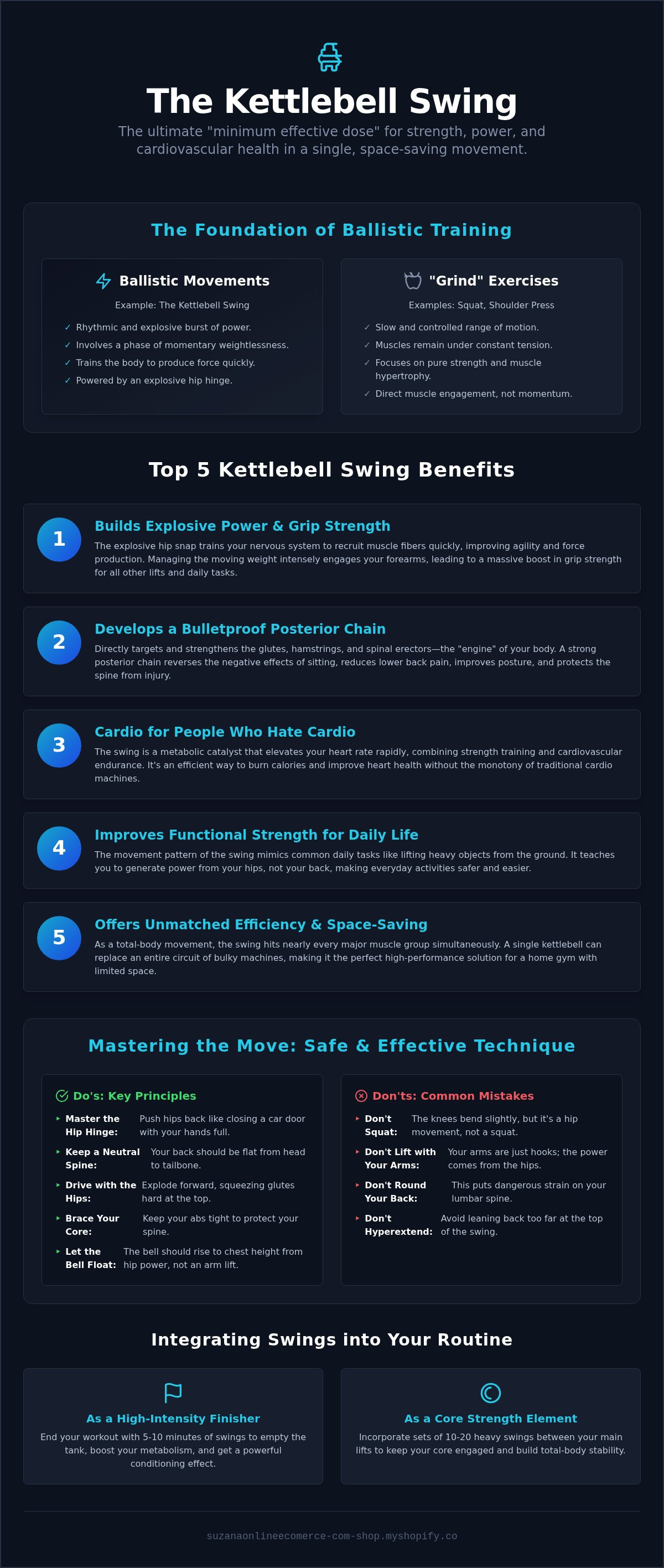
Understanding the kettlebell swing benefits starts with recognizing it's more than just a simple lift; it's a rhythmic, explosive movement that serves as the cornerstone of kettlebell training. Unlike a traditional weightlifting exercise, the swing is a ballistic movement. According to the technical definition of What is a Kettlebell Swing?, the weight moves in a pendulum-like arc, powered entirely by the hips rather than the arms. This creates a unique training stimulus that combines strength, power, and cardiovascular endurance in a single repetition.
In a "grind" exercise, such as a shoulder press or a squat, your muscles remain under constant tension through a slow and controlled range of motion. Ballistic moves are different. They involve a brief, intense burst of power followed by a phase of momentary weightlessness. This dynamic approach trains your body to produce force quickly, which is a critical skill for both athletic performance and avoiding injury during sudden movements in daily life.
To better understand how this explosive movement works in practice, watch this helpful video:
The Anatomy of a Swing
Targeting the posterior chain is the primary goal here. This group of muscles, often called the "engine" of the human body, includes your glutes, hamstrings, and spinal erectors. During the movement, these muscles work in unison to drive the bell forward. Your core plays an equally vital role as a stabilizer. It must remain braced to protect your spine during the high-velocity "snap" at the top of the swing. Success depends on the hip hinge, a movement where you push your hips backward to load the hamstrings like a bowstring before releasing that stored energy to propel the weight.
Kettlebells vs. Traditional Dumbbells
A common question for those setting up a home gym is whether a standard dumbbell can achieve the same results. While you can swing a dumbbell, it isn't nearly as effective. One of the most significant kettlebell swing benefits is derived from the tool's off-center mass. Because the weight hangs below the handle, the center of gravity shifts throughout the arc, forcing your stabilizer muscles to work harder than they would with a balanced dumbbell. Additionally, kettlebells are incredibly space-efficient. A single high-quality bell can replace several bulky machines, making it a professional-grade solution for limited home environments.
The Top 5 Kettlebell Swing Benefits for Total Body Transformation
One of the most immediate kettlebell swing benefits is the development of explosive power. This isn't just for professional athletes. It's for anyone who wants to move with more agility and force. By mastering the hip snap, you train your nervous system to recruit muscle fibers quickly. Additionally, your grip strength will see a massive boost. Managing a heavy, moving weight requires intense forearm engagement. This translates to better performance in other lifts and daily manual tasks.
Building a Bulletproof Posterior Chain
Modern life often involves hours of sitting, which weakens the glutes and hamstrings. The swing directly reverses this trend by forcing these "sitting muscles" to engage under load. Stronger glutes take the pressure off your lower back, effectively reducing chronic pain. The posterior chain acts as the body's primary structural support system, absorbing impact and stabilizing the spine to prevent acute injuries. A 2024 comprehensive review on kettlebell training confirms that these routines are highly effective for improving postural stability and overall muscular endurance.
Cardio for People Who Hate Cardio
You don't need a treadmill to improve your heart health. Moving a heavy weight at high velocity creates a massive metabolic demand. This elevates your heart rate rapidly, improving your VO2 max and heart rate recovery times. Research suggests that 10 minutes of high-intensity swings can provide cardiovascular benefits comparable to 30 minutes of steady-state jogging. This saves time and reduces the repetitive joint impact often associated with running.
The final advantage is the caloric burn. Because the movement is so taxing, your body experiences the "afterburn" effect, or Excess Post-exercise Oxygen Consumption (EPOC). This means you'll continue to burn calories at an elevated rate long after you've put the weight down. Having the right fitness equipment at home makes it easier to stay consistent with these high-intensity routines without needing a commercial gym membership.
Functional Strength: How Swings Improve Your Daily Life
Functional strength isn't just about the weight on a bar; it's about how your body handles force in the real world. One of the most practical kettlebell swing benefits is what experts call the "What the Heck" effect. This phenomenon describes how the swing improves unrelated movements, such as your deadlift, overhead press, or even your ability to carry heavy bags of groceries. Because the movement teaches you to hinge and stabilize under a dynamic load, you'll find that daily tasks like lifting a child or moving furniture feel significantly easier and safer.
Balance and coordination also see a marked improvement through this exercise. Unlike static lifts, the kettlebell’s shifting center of gravity forces your body to constantly adjust its position. This dynamic weight shifting sharpens your proprioception, which is your body's ability to sense its location in space. Medical professionals at the Ohio State University Wexner Medical Center often cite the Benefits of kettlebell swings as a primary way to combine cardiovascular health with functional muscle development.
Correcting Postural Imbalances
Modern lifestyle habits, such as hours spent hunching over laptops and smartphones, create a "forward-slump" posture. This weakens the upper back and rounds the shoulders. Swings counteract this by requiring you to maintain "packed" shoulders, where your lats and traps are actively engaged to keep the weight from pulling you forward. This constant tension in the upper back helps pull your shoulders into a neutral position, effectively correcting the imbalances caused by desk work. A stable core acts as the anchor during this process, ensuring your spine remains in proper alignment throughout the explosive movement.
Longevity and Bone Density
Resistance training is a proven method for increasing bone mineral density, which is a critical factor for long-term health. The high-velocity nature of the swing provides a unique stimulus that encourages bone growth more effectively than low-impact activities. For women managing hormonal transitions, pairing exercise with targeted support from Artemis Curated can help maintain bone health and energy levels. Additionally, the explosive "snap" of the hips is vital for maintaining fast-twitch muscle fibers. These fibers are the first to decline as we age, so training them regularly is weight essential for preserving your athletic capacity and preventing falls later in life.
Mastering the Move: How to Perform a Kettlebell Swing Safely
To fully experience the kettlebell swing benefits mentioned earlier, you must prioritize technical precision. A safe swing begins with a proper setup. Stand with your feet slightly wider than shoulder-width apart and place the kettlebell about 12 inches in front of you. Reach forward and tilt the bell toward you, gripping the handle firmly. The initial movement is the "hike," where you pull the weight back between your legs with force, exactly like a football center snapping the ball. This loads the hamstrings and prepares your body for the explosive drive.
The core of the movement is the hip hinge. Many beginners make the mistake of dropping their hips toward the floor, effectively turning the swing into a squat. Instead, your hips should move horizontally backward. Think of trying to touch a wall behind you with your glutes. Once your hips are loaded, snap them forward with maximum power. This glute-driven "snap" propels the bell upward. At the top of the movement, your body should resemble a "standing plank." Your glutes should be tight, your core braced, and your shoulders packed. Avoid leaning back at the top, as overextending the spine is a common source of injury.
Patience during the descent is just as important as the power in the drive. Let the bell fall naturally in an arc toward your body. You should wait until the bell is nearly at your groin during the descent before you begin hinging your hips backward. Hinging too early puts unnecessary strain on the lower back and disrupts the fluid rhythm of the movement.
Common Mistakes and How to Fix Them
The "Squat-Swing" is the most frequent error, which shifts the workload from your posterior chain to your quads, negating the primary kettlebell swing benefits. Another issue is "T-Rex Arms," where a lifter tries to use their shoulders to pull the weight up. Your arms are merely ropes; the power comes entirely from the hips. If you feel your lower back arching, it's usually a sign that your core isn't engaged. Focus on pulling your ribs down toward your pelvis to maintain a neutral spine throughout the arc.
Safety Checklist for Home Lifters
Training at home requires a few environmental considerations to ensure safety and equipment longevity. Protecting your floors is essential, so consider using professional-grade yoga mats or rubber flooring to absorb impact. When starting out, choose a weight that allows you to maintain perfect form for 10 repetitions before moving to a heavier bell. If you're ready to upgrade your setup, you can find high-quality fitness equipment designed for home use that will support your progress. Maintaining this technical discipline ensures you build strength without the risk of setbacks.
Integrating Swings into Your Home Fitness Routine
Slotted into a busy schedule, the kettlebell swing offers unparalleled flexibility. You can use it as a high-intensity finisher at the end of a weightlifting session or treat it as your primary strength movement for the day. Because the move combines resistance with a high heart rate, it's an ideal choice for those with limited time. To maintain the energy and mental focus required for such intense training, many individuals incorporate natural health supplements from Gara Health into their routine. To maximize the kettlebell swing benefits, you should pair these movements with other foundational exercises. For example, alternating swings with bodyweight push-ups or planks creates a comprehensive full-body circuit that requires zero extra floor space.
Recovery is just as important as the workout itself. After a high-intensity session, your muscles need specific care to repair and grow. Using targeted wellness products, such as recovery tools or supportive supplements, can significantly reduce post-workout soreness. Additionally, choosing the right home gym equipment to complement your kettlebell ensures you have a balanced setup that addresses all fitness goals, from flexibility to raw power.
Sample Beginner Kettlebell Circuit
An Every Minute on the Minute (EMOM) structure is one of the most effective ways to build volume safely. Set a timer for 15 minutes. At the start of every minute, perform 10 to 15 swings with perfect form. Use the remaining time in that minute to rest. As you get stronger, you can integrate push-ups or a 30-second plank into those rest periods. This approach allows you to experience kettlebell swing benefits like increased heart rate recovery and grip strength without overtaxing your central nervous system. Once you've mastered the two-handed version, progress to one-handed swings to challenge your core stability even further.
Creating a Holistic Wellness Environment
Mastering the hip hinge and the ballistic mechanics of the swing allows you to replace rows of bulky equipment with a single, versatile tool. You've learned how the kettlebell swing benefits your posture, explosive power, and heart health in a fraction of the time required by traditional workouts. By integrating these movements into a structured circuit, you turn your home into a professional training environment without sacrificing valuable floor space. Achieving a total body transformation is possible when you combine technical precision with the right tools.
Consistency is the final step toward reaching your long-term fitness goals. Upgrade your home gym with professional fitness equipment from SUZANA SHOP to ensure you have the durable exercise gear needed for lasting progress. We provide a wide selection of fitness and kitchen accessories to help you maintain a healthy lifestyle. With global shipping on all wellness products, you can access high-quality equipment regardless of your location. Start swinging today and build the resilient, powerful body you deserve.
Frequently Asked Questions
Is the kettlebell swing better than the deadlift?
Neither is objectively better; they complement each other by targeting different aspects of the posterior chain. While the deadlift builds absolute strength through a slow grind, the swing develops explosive power through ballistic movement. Integrating both into your routine ensures you have the structural strength to lift heavy loads and the athletic speed to move them quickly. Most enthusiasts use the deadlift for heavy sets and the swing for conditioning or high-intensity intervals.
Can I do kettlebell swings every day?
You can perform swings daily if you manage the volume and intensity to allow for adequate recovery. High-volume daily sessions may lead to overtraining or grip fatigue, so it's often better to alternate heavy days with light, technique-focused sessions. Pay attention to your body's signals and use professional wellness products to support muscle repair. Consistent, moderate daily practice can be more effective for skill acquisition than occasional high-intensity bursts that leave you sidelined.
What weight kettlebell should a beginner start with?
Beginners should start with a weight that allows for 10 repetitions with perfect form, usually between 8kg and 16kg. Most men find 16kg (35lb) and women 12kg (26lb) to be appropriate starting points for building power. A weight that is too light won't provide enough feedback to master the hip hinge. Conversely, using a bell that is too heavy too soon increases the risk of spinal injury while you are still learning the movement.
Are kettlebell swings safe for people with lower back pain?
Kettlebell swings are safe and often beneficial for lower back health if you prioritize the hip hinge over a squatting motion. By strengthening the glutes and hamstrings, you take the pressure off your lumbar spine and correct postural imbalances. However, you should consult a healthcare professional before starting if you have an existing injury. Focusing on core tension and avoiding spinal overextension at the top of the move is critical for maintaining safety during home training.
Do kettlebell swings help with weight loss?
Swings are highly effective for weight loss because they combine cardiovascular conditioning with resistance training. The movement creates a significant metabolic demand, leading to a high caloric burn during the session and a sustained afterburn effect afterward. This dual-action approach helps you build lean muscle while burning fat, making it a primary example of kettlebell swing benefits for body composition. Consistency in your routine is the most important factor for long-term fat loss.
What muscles do kettlebell swings work the most?
The primary movers are the glutes, hamstrings, and spinal erectors, which collectively form the posterior chain. Your core muscles, including the abs and obliques, work as stabilizers to protect your spine during the explosive phase of the movement. Your forearms and lats also receive a significant workout as they manage the bell's arc. This total-body engagement is why the exercise is considered a powerhouse for developing functional strength and improving your overall athletic performance.
How many reps of kettlebell swings should I do?
Repetition ranges depend on your specific training goals, such as building power, endurance, or strength. For explosive power, sets of 5 to 10 reps with a heavier weight are ideal. If your goal is cardiovascular conditioning or fat loss, higher volume sets of 15 to 25 reps are more effective. Always prioritize form over the total number of repetitions to maximize the kettlebell swing benefits and prevent fatigue-related technical errors during your home workout.
Can I do kettlebell swings with a dumbbell?
You can perform a swing with a dumbbell, but the experience is less effective than using a dedicated kettlebell. The kettlebell's handle and off-center mass create a unique pendulum effect that a balanced dumbbell cannot replicate. Holding a dumbbell by one end also limits your grip options and can make the movement feel awkward or unstable. For the best results in a home gym, investing in a professional cast-iron or adjustable kettlebell is the recommended choice.