

Stair Stepper for Glutes: Toning & Growth Guide (2026)

What if your favorite cardio machine was actually the secret to building a powerful, lifted posterior? Most people spend hours on the stair stepper machine for glutes only to end up with tired lungs and little change in muscle definition. It’s frustrating to put in the work without seeing the results you want, especially when improper form leads to lower back pain instead of the firm look you’re after.
You likely want a way to make your home workouts more efficient without needing a room full of bulky gym equipment. Mastering this machine requires shifting your mindset from steady-state cardio to vertical resistance training. When you apply specific postural adjustments, you move the load away from your quads and directly into your glutes for maximum hypertrophy and functional strength.
This guide explains how to transform your lower body by using professional-grade techniques. You’ll learn the foot placements and body angles that turn every step into a muscle-building movement. We’ll cover everything from basic safety to advanced strategies to ensure you get the best results from your home fitness routine and achieve a more toned, athletic appearance.
Key Takeaways
- Understand how vertical resistance targets the gluteus maximus more effectively than horizontal running or walking.
- Master the hip hinge and heel-drive techniques to maximize the efficiency of the stair stepper machine for glutes.
- Discover why the stair stepper provides superior hip range of motion and better joint protection than an incline treadmill.
- Identify the best fitness equipment for your home gym by evaluating different resistance types and machine footprints.
- Learn to combine stepping with specific activation protocols to ensure your muscles are fully engaged during every workout.
How the Stair Stepper Machine Targets Glute Muscles
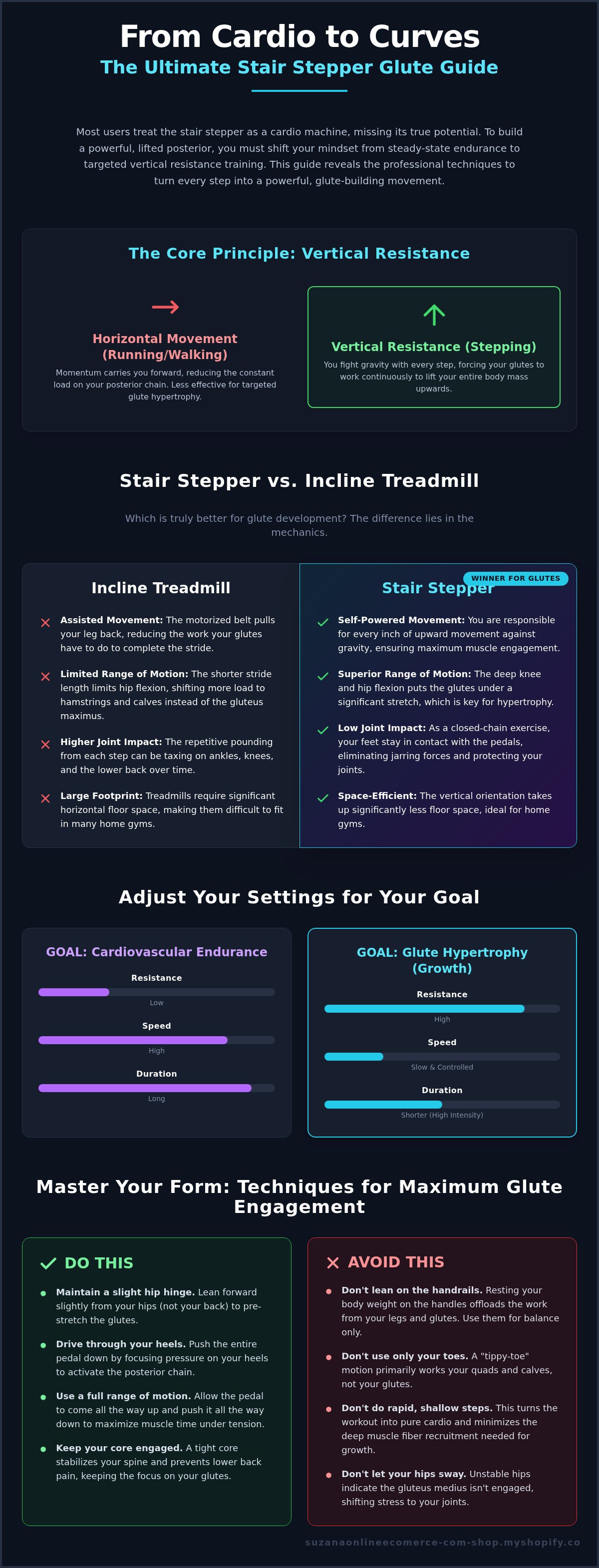
Using a stair stepper machine for glutes provides a unique mechanical advantage that standard cardio often lacks. The primary reason is gravity. When you run or walk on a flat surface, your momentum carries you forward. On a stepper, you're fighting a vertical resistance that never stops. This forces the posterior chain to work harder to move your center of mass upward with every single repetition.
The "push-off" phase is the most important part of the movement. As you drive your heel down to lift your body, your glutes engage to complete the extension. If you don't finish the step completely, you miss out on the peak contraction. High-quality movement beats high speed every time. Slow, deliberate steps ensure that the muscles stay under tension for a longer duration, which is a key requirement for physical change.
Anatomy of the Step: Maximus vs. Medius
The gluteus maximus is the largest muscle in your body and handles the heavy lifting. Deep steps recruit these fibers by putting the muscle through a large range of motion. While the maximus provides the power, the gluteus medius manages the balance. Because the machine requires a single-leg phase, the medius must stabilize your pelvis to keep your hips level. Hip extension is the primary driver of glute growth. Without this lateral stability, your body would tilt, shifting the weight away from the target area and onto your joints.
Cardio vs. Hypertrophy: Can You Build Muscle?
It's common to see people using the stepper for long, low-intensity sessions. This approach builds cardiovascular endurance but won't necessarily trigger significant muscle growth. To stimulate hypertrophy, you need to increase the resistance. You can do this by selecting a higher level on the machine or by skipping a step to create a deeper lunging motion. This increases the load on the muscle without needing external weights. The metabolic demand of climbing is much higher than walking. This means you can achieve a high-intensity workout in less time while specifically targeting the shape and firmness of your lower body.
Stair Stepper vs. Incline Treadmill: Which is Better for Glutes?
Choosing between these two popular machines often comes down to your primary goal: are you looking for general conditioning or targeted muscle growth? While both offer cardiovascular benefits, the stair stepper machine for glutes provides a mechanical advantage that a treadmill simply cannot match. The difference lies in how your muscles react to the surface beneath them. On a treadmill, the motorized belt assists in pulling your leg back. On a stepper, you're responsible for every inch of upward movement against gravity.
In terms of caloric burn, an incline treadmill can be highly effective if you're walking at a steep angle for long durations. However, the metabolic demand of lifting your entire body weight vertically on a stepper often results in a higher intensity in a shorter timeframe. For those with limited time, the stepper delivers a more concentrated stimulus to the posterior chain while simultaneously pushing your heart rate into the fat-burning zone.
The Range of Motion Factor
The secret to muscle hypertrophy is often found in the "stretch" phase of an exercise. A stair stepper requires a much higher knee drive than walking on an incline. This deep flexion at the hip puts the gluteus maximus under a significant stretch before you begin the push-off. Because the treadmill involves a shorter stride, the range of motion is limited, which shifts more of the workload to your hamstrings and calves. By using the stair stepper machine for glutes, you ensure that the largest muscle in your lower body is doing the majority of the work through its full functional range.
Joint Impact and Longevity
Joint health is a critical consideration for anyone building a long-term fitness routine. Stepping is a closed-chain exercise, meaning your feet stay in constant or near-constant contact with the equipment. This eliminates the repetitive pounding associated with treadmill use, which can be taxing on the ankles, knees, and lower back over time. The controlled, fluid motion of a stepper allows you to maintain high intensity without the jarring forces of a running strike. If you're managing previous injuries or want to prioritize joint longevity, you should explore our home gym equipment guide for more low-impact options.
Space requirements also play a role in home gym integration. Treadmills require a long, horizontal footprint that can dominate a room. Steppers are vertically oriented, taking up much less floor space, though you'll need to check your ceiling height. You can browse our latest fitness equipment to find a model that fits your specific home layout while delivering professional-grade results.
Proper Form and Techniques to Maximise Glute Engagement
Success on the stair stepper machine for glutes depends entirely on your posture. Most people make the mistake of leaning their upper body weight onto the handrails. While this might help you stay on the machine longer, it significantly reduces the workload on your legs. When you support yourself with your arms, you're essentially removing a portion of your body weight from the equation. Keep your hands light on the rails for balance only. Better yet, try swinging your arms naturally to engage your core and force your lower body to handle the full resistance.
Step depth is another critical factor that separates a cardio session from a muscle-building one. Short, shallow steps primarily target the calves and quads because the hip joint doesn't reach a deep enough angle. You need to allow the pedal to rise high enough to create a deep bend in the knee and hip. This puts the gluteus maximus under tension at its longest point. Regarding foot placement, keeping your feet parallel is the baseline. However, turning your toes out slightly can help some individuals achieve better mind-muscle connection with the outer glute fibers.
The Secret of the Hip Hinge
To isolate the posterior chain, you must master the slight hip hinge. Instead of standing perfectly upright, tilt your torso forward about 15 degrees at the hips. This adjustment shifts your center of gravity and places the glutes in a position of mechanical advantage. It's vital to maintain a neutral spine throughout this tilt; don't round your shoulders or arch your lower back. Pushing through the heel during the downward phase of the step directly activates the posterior chain. This simple change in pressure ensures the energy isn't wasted in the balls of your feet.
Advanced Step Patterns for Glute Isolation
Once you've mastered basic form, you can introduce variations to target specific areas. Cross-over steps, where you step laterally across the machine, are excellent for engaging the gluteus medius and improving pelvic stability. Another effective method is the skip-a-step technique. By taking two steps at once, you increase the resistance and force the glutes to work through a much larger range of motion, similar to a deep lunge. You might see people performing "kick-backs" between steps on social media. While this adds a small amount of extra contraction, it often leads to a rounded spine or loss of balance. It's usually more effective to focus on the power of the step itself rather than adding unnecessary movements that break your rhythm.
Selecting the Best Stair Stepper for Your Home Gym
Choosing the right stair stepper machine for glutes involves balancing your training goals with your available floor space. Not all machines are built for the same purpose. Some focus on low-impact movement for general health, while others are engineered for the high-resistance load required for muscle hypertrophy. You'll need to evaluate the resistance mechanism first. Hydraulic systems are typically found in smaller units and offer a compact solution. However, they can lose some tension as the fluid heats up during long sessions. Magnetic and motor-driven systems provide more consistent resistance, which is essential for tracking your progress and ensuring progressive overload.
Stability is paramount when you're performing the specific postural adjustments needed to target your posterior chain. A machine that wobbles during a skip-a-step interval isn't just distracting; it's a safety hazard. Look for heavy-duty base frames and a weight capacity that comfortably exceeds your own. Noise is another practical factor, especially for apartment dwellers. Magnetic resistance models are generally the quietest options, allowing you to complete your workout early in the morning or late at night without disturbing others in your household.
Full-Size Climbers vs. Mini Steppers
Mini-steppers are excellent for those with limited square footage who still want to maintain a consistent glute routine. While they offer a shorter range of motion than their larger counterparts, they're highly effective for high-repetition endurance and lateral movements. Full-size rotating stair climbers provide the most authentic climbing experience. These machines allow for the deepest hip flexion, which we've established is the key to maximum glute engagement. If you're trying to figure out how to maximize a small space without sacrificing your results, refer to our guide on workout equipment for space-saving tips.
Durability and Tech Features in 2026
The latest equipment models in 2026 focus heavily on digital connectivity and data tracking. Progress monitoring is essential for glute growth, as it allows you to see exactly how your resistance levels and step counts have increased over time. Many professional-grade machines now integrate directly with fitness apps to log your vertical climb and power output automatically. Beyond the tech, prioritize a sturdy frame construction and a comprehensive warranty. A home machine undergoes significant stress during high-intensity intervals, so durability is a long-term investment in your physical wellness. You can browse our full collection of professional fitness equipment to find the perfect match for your home gym setup.
Integrating the Stair Stepper into Your Wellness Routine
To achieve lasting physical changes, you must treat the stair stepper machine for glutes as one part of a structured training system. While the machine provides excellent vertical resistance, it works best when paired with a balanced schedule that prioritizes both intensity and rest. For most fitness levels, performing 20 to 30 minute sessions two or three times per week is sufficient to stimulate growth without overtaxing your central nervous system. Overtraining the lower body can lead to diminished returns and persistent fatigue, so you should monitor your recovery closely between sessions.
Integrating this equipment with other forms of resistance training creates a more comprehensive stimulus for the posterior chain. Many athletes use the stepper as a finisher after a session on machines for weight training like the leg press or hack squat. This combination ensures you've exhausted the muscle fibers through both heavy compound movements and high-repetition vertical climbing. This holistic approach builds both the raw strength and the muscular endurance required for a functional, athletic physique.
Pre-Activation and Mobility
For those prioritizing performance during these workouts, incorporating specialized athletic gear from ModMerch can provide the essential support and comfort needed for the intense range of motion required by vertical climbing.
Effective glute training starts before you ever step onto the machine. Using resistance bands for "glute activation" helps establish the mind-muscle connection, ensuring your posterior chain is ready to take the load instead of your quads. Focus on lateral walks or glute bridges to wake up the muscles. Dynamic stretches, such as leg swings and deep lunges, improve hip mobility, which allows you to achieve the deep range of motion discussed in earlier sections. Don't ignore your core strength; a stable midsection prevents your pelvis from rocking, allowing the glutes to remain the primary drivers of every step.
Recovery and Long-Term Results
Muscle hypertrophy doesn't happen during the workout; it happens while you sleep. High-intensity stepping creates micro-tears in the muscle tissue that require adequate protein and rest to repair. If you're consistently sore, you might need to evaluate your recovery protocol. Utilizing professional wellness products like foam rollers or percussion massagers can help manage muscle tightness and improve blood flow to the targeted areas. A balanced weekly schedule must include at least one or two full rest days to allow your tissues to adapt to the stress of climbing. By combining professional-grade equipment with a dedicated recovery plan, you ensure that every minute spent on the stair stepper machine for glutes contributes to your long-term wellness goals.
Achieve Your Lower Body Fitness Goals
Mastering the stair stepper machine for glutes requires a combination of deliberate form and consistent resistance. By implementing the hip hinge technique and prioritizing heel-driven steps, you shift the workload from your quads to your posterior chain for maximum hypertrophy. Success also depends on selecting professional-grade equipment that fits your home environment and supports your recovery with high-quality wellness products. Consistency is the most important factor in seeing the results you've worked for.
SUZANA SHOP provides a curated selection of fitness equipment and wellness products designed for home gym enthusiasts. Our global shipping reach ensures you can access essential exercise gear regardless of your location. We specialize in high-quality tools that offer the stability and durability needed for high-intensity training. Browse Professional Home Fitness Equipment at SUZANA SHOP to find the right machine for your specific training space.
Building a stronger, more athletic physique is a long-term journey that starts with the right tools and techniques. Don't settle for endless cardio when you can train with purpose and efficiency in your own home.
Frequently Asked Questions
How long should I use the stair stepper to see glute results?
You can expect to see noticeable muscle definition within 4 to 8 weeks of consistent use. This timeline requires using the stair stepper machine for glutes at least three times per week. Results depend on maintaining progressive overload by increasing resistance or duration. Your nutrition and recovery also play a massive role in how quickly muscle tissue repairs and grows after intense vertical climbing sessions.
Is the stair stepper better than squats for building a butt?
Neither is objectively better; they serve different roles in a training program. Squats allow for much higher absolute loads and mechanical tension. The stair stepper provides constant time under tension and a significant cardiovascular challenge. Using a stair stepper machine for glutes is often safer for those with lower back issues since it doesn't require spinal loading. Combining both methods usually yields the best aesthetic results.
Can I use a stair stepper every day for glutes?
Daily use is generally not recommended for muscle hypertrophy. Glutes need rest periods to repair the micro-tears created during high-resistance stepping. Training every day can lead to overtraining and reduced performance. Aim for three to four sessions per week to allow for recovery. On off days, focus on light mobility work or use wellness products like foam rollers to keep the muscles supple and ready for your next workout.
Does the stair stepper make your legs or glutes bigger?
It can increase muscle size if you use high resistance levels and maintain a caloric surplus. The machine targets the gluteus maximus, hamstrings, and quads simultaneously. If your goal is specifically glute growth without excessive leg bulk, focus on the hip hinge technique. This shifts the tension away from the quadriceps. Without a caloric surplus, the machine primarily tones and defines existing muscle rather than adding significant mass.
What is the best foot placement on a stair stepper for glutes?
Place your entire foot on the pedal and drive through your heel. Many users make the mistake of stepping on the balls of their feet, which overloads the calves and quads. Keeping your heels in contact with the surface ensures the posterior chain remains engaged. You can also try a slightly wider stance with toes turned out to target different fibers within the gluteus medius for better lateral stability.
Why do I only feel the stair stepper in my quads?
This usually happens because of an upright posture or pushing through your toes. If you stand perfectly vertical, your quads take over the movement to protect your knees. To fix this, implement a slight 15 degree forward tilt at the hips. This hinge stretches the glutes and forces them to fire during the push-off phase. Ensure you're taking full steps rather than short, shallow ones that limit hip extension.
Are mini steppers effective for glute growth?
Mini steppers are effective for maintaining muscle tone and cardiovascular health, though they have a shorter range of motion. They are an excellent space-saving choice for home gyms. While they might not offer the same hypertrophy potential as full-size rotating stairs, you can increase their effectiveness by using resistance bands. They provide a convenient way to stay active and keep the glutes engaged throughout a busy work week.
How many calories does a 30-minute stair stepper workout burn?
A 30 minute session typically burns between 200 and 400 calories, depending on your weight and intensity level. High-intensity interval training on the machine will land on the higher end of that scale. This metabolic demand makes the stepper more efficient than walking on a flat surface. It’s a powerful tool for those looking to improve cardiovascular health while simultaneously working on lower body muscle definition.