

Best Shoulder Exercises for Strength: 2026 Home Guide

If you think endless pushups are the secret to broad, stable shoulders, you're missing two-thirds of the equation. Most home athletes struggle with plateauing progress or nagging joint clicks because they focus almost exclusively on the front of the shoulder. It's frustrating to put in the effort and still feel like your posture is slumping or your delts lack that defined, capped look. Mastering a comprehensive shoulder workout at home with dumbbells is the most effective way to fix these imbalances and build genuine functional strength.
You deserve a physique that looks as strong as it feels. This guide provides a clear, actionable strategy to target the lateral and posterior heads of the shoulder, which are often neglected in standard routines. We'll demystify deltoid anatomy and show you exactly how to use quality home fitness equipment to achieve a stable, broad V-taper. This article outlines a 2026-ready plan to improve your posture and hit your strength goals without needing a commercial gym membership.
Key Takeaways
- Learn to target all three deltoid heads to build a balanced, stable shoulder structure and improve functional posture.
- Execute an effective shoulder workout at home with dumbbells by focusing on foundational movements that maximize muscle recruitment.
- Identify critical safety techniques, such as working within the scapular plane, to prevent common injuries and joint clicking.
- Select the right fitness equipment, including resistance bands for constant tension, to ensure consistent progress in a home environment.
- Follow a structured routine that prioritizes heavy compound pressing before transitioning to specific isolation exercises for the lateral and posterior delts.
Understanding Shoulder Anatomy: The Three Heads of the Deltoid
The shoulder is a highly mobile ball-and-socket joint. Its primary driver for movement and aesthetic shape is the deltoid muscle, which acts as the main engine for almost all upper body lifting. To perform an effective shoulder workout at home with dumbbells, you must understand how this muscle group functions. It isn't just one single muscle; it's comprised of three distinct heads that require specific angles to activate properly. Detailed deltoid muscle anatomy reveals that these sections work together to move the arm in nearly every direction.
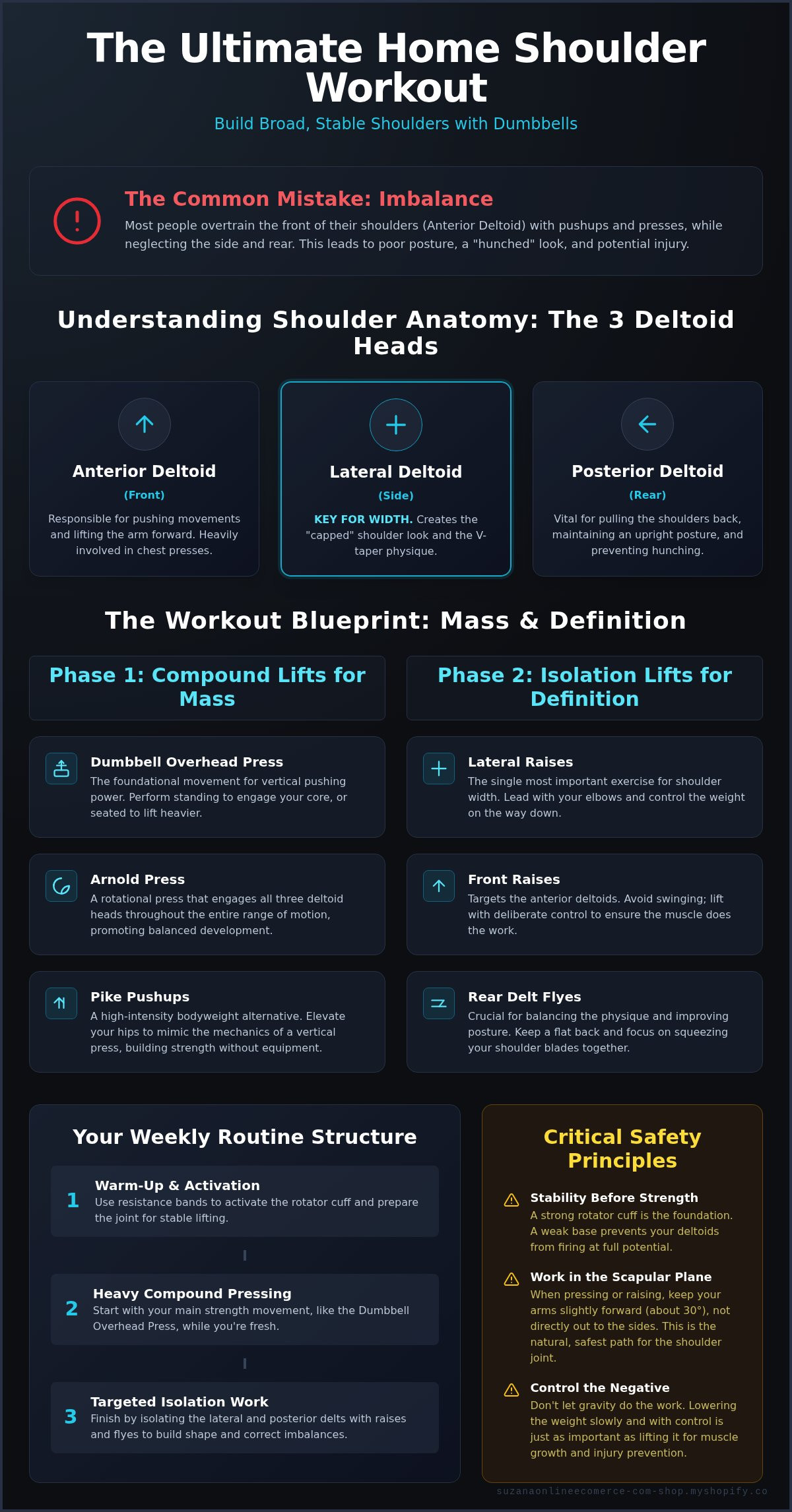
The Anterior Deltoid sits at the front of the shoulder. It's responsible for vertical pushing and bringing the arm forward. The Lateral Deltoid is located on the side. This is the section that creates the "capped" look and provides the lateral width many athletes desire. Finally, the Posterior Deltoid is found at the back. It's vital for pulling the shoulders back and maintaining an upright, healthy frame. Balancing the workload between these three areas is the only way to achieve a professional, symmetrical physique.
Why Target All Three Heads?
A common mistake in many home routines is focusing solely on the muscles you see in the mirror. Most people overtrain the front delts because they're heavily involved in chest presses and pushups. This often leads to a hunched appearance. Neglecting the rear delts is a primary cause of rounded shoulders and poor posture. It creates a muscular imbalance that can eventually lead to chronic pain.
If your goal is a defined V-taper, you must prioritize the lateral head. Developing this muscle increases your shoulder-to-waist ratio. This makes the waist appear smaller while the upper body looks broader. A balanced approach ensures your shoulder workout at home with dumbbells produces a 3D effect rather than a flat, forward-leaning physique. Consistency across all three heads is the key to both aesthetics and long-term joint health. To ensure your professional wardrobe matches your athletic progress, you can learn more about JANKS Tailoring for bespoke garments designed to fit a muscular frame.
The Role of the Rotator Cuff
While the deltoids provide the power, the rotator cuff provides the stability. This group of four smaller muscles keeps the ball of the humerus centered in the socket. Without a stable base, heavy lifting can lead to impingement or long-term injury. Stability must always come before strength. If the rotator cuff is weak, the larger deltoid muscles cannot fire at their full potential.
Integrating wellness products like resistance bands into your warmup can help activate these deep stabilizers. Proper shoulder mobility is a cornerstone of overall health; it allows for a full range of motion in daily life and prevents the chronic stiffness often associated with sedentary work. To maintain your posture between training sessions, you can explore Ergonomic Office Chairs that provide essential support during desk work. Ensuring these muscles are healthy is the first step toward building significant upper body strength with your fitness equipment.
Building powerful shoulders requires a strategic mix of heavy compound lifts and targeted isolation. A well-designed shoulder workout at home with dumbbells provides the versatility needed to challenge all three deltoid heads effectively. Scientific data supports this approach; ACE research on effective shoulder exercises identifies specific movements like the overhead press and lateral raise as top performers for muscle recruitment. By combining these with bodyweight alternatives, you can ensure consistent progress without a commercial gym.
Compound Movements for Mass
The Dumbbell Overhead Press is the foundational movement for vertical pushing power. When performed standing, it recruits the core and stabilizers for balance. Seated variations allow you to focus entirely on the shoulders, often enabling you to lift heavier loads. If you don't have access to heavy weights yet, Pike Pushups are a high-intensity bodyweight alternative. By elevating your hips and pushing your head toward the floor, you mimic the mechanics of a vertical press using your own body mass. The Arnold Press is a rotational movement that engages all three heads of the deltoid throughout the lift. These exercises build the structural strength necessary for more advanced training.
Isolation Movements for Definition
Isolation exercises are essential for maximizing shoulder width and achieving that defined V-taper. Lateral Raises should be a staple in your routine. To maximize activation, focus on leading with your elbows and slightly tilting the dumbbells at the top, similar to pouring water from a pitcher. Front Raises provide targeted work for the anterior deltoids, ensuring the front of the shoulder is well-developed. To balance the physique, Rear Delt Flyes are necessary to build the posterior head. Perform these with a slight hinge at the hips, pulling the weights out to the sides while keeping your chest down.
For those looking to improve posture while building strength, Face Pulls are the gold standard for rear delt activation. These can be easily performed at home using resistance bands anchored to a door frame. If you need to upgrade your setup, you can find a wide range of home fitness equipment to support your training goals. Combining these isolation moves with your heavy presses creates a comprehensive routine that leaves no muscle fiber untouched. Focus on controlled tempos and a full range of motion to get the most out of every repetition.
Essential Home Equipment for Shoulder Training
Building a powerful upper body doesn't require a membership to a commercial facility filled with heavy racks and Smith machines. In fact, a high-quality shoulder workout at home with dumbbells often provides a more natural range of motion than fixed-path gym equipment. To maximize your results, you need a few core pieces of gear that facilitate progressive overload and joint stability. Understanding a detailed breakdown of shoulder musculature helps you select tools that target the deltoids effectively while protecting the delicate rotator cuff.
Choosing the Right Dumbbells
Dumbbells are the most versatile tool in any home fitness arsenal. They allow for unilateral training, which is essential for identifying and fixing strength disparities between your left and right sides. Investing in high-quality home gym equipment allows you to scale your intensity as you get stronger. For most shoulder exercises, you'll need a range of weights. Heavy pairs are ideal for compound presses, while lighter sets are better suited for the high-repetition isolation work required for lateral raises. Aim for a weight that allows you to complete 8 to 12 clean repetitions with a controlled tempo.
The Versatility of Resistance Bands
While dumbbells provide consistent weight, resistance bands offer a unique benefit: variable resistance. This means the tension increases as the band stretches, providing peak tension at the point where your muscles are strongest. Bands are excellent for rehabilitative work and activating the rear deltoids. Exercises like Band Pull-Aparts and Face Pulls are gold standards for correcting rounded shoulders. You can find more accessory ideas in our guide on workout equipment to round out your training space. Using bands in combination with free weights ensures your muscles face different types of mechanical tension.
Beyond weights and bands, a few other items enhance your training experience. A durable yoga mat provides the necessary grip for floor-based stability work and post-workout stretching. If space permits, an adjustable bench is a significant upgrade. It supports your back during seated overhead presses, which helps isolate the deltoids by removing the need for core-heavy stabilization. These tools turn any small living space into a professional-grade training environment.
Common Mistakes and Safety: Protecting Your Shoulders
Training your upper body at home offers great flexibility, but the shoulder's high mobility makes it susceptible to injury if form is compromised. When performing a shoulder workout at home with dumbbells, your priority should always be joint integrity over the amount of weight lifted. Many lifters make the mistake of moving in a strictly lateral plane, which can crowd the joint. Instead, you should lift in the scapular plane, which is roughly 30 degrees in front of your body. This alignment allows the humerus to move freely without rubbing against the bone, significantly reducing the risk of long-term wear.
Internal rotation is another common pitfall. While some old-school cues suggest "pouring a pitcher" during lateral raises, excessive internal rotation can lead to pain. Keeping your thumbs slightly up or neutral is often safer for the average trainee. Additionally, a stable trunk is essential for safe overhead pressing. If your core isn't engaged, your lower back will likely arch to compensate for heavy weights. This shift puts unnecessary pressure on your lumbar spine. Always brace your midsection as if you're about to take a punch before you start any vertical press.
Preventing Shoulder Impingement
The biomechanics of the shoulder involve a narrow space between the acromion and the humerus. When you lift your arms overhead, this space can become even tighter. Shoulder impingement is the pinching of tendons during repetitive overhead motion. To prevent this, you must focus on proper scapular positioning. Use this checklist before every set:
- Pull your shoulder blades down and back, tucking them into your "back pockets."
- Keep your chest proud and avoid shrugging your shoulders toward your ears.
- Maintain a slight bend in the elbows to take the stress off the joint.
- Control the eccentric (lowering) phase of every repetition.
The Importance of Recovery
Muscles don't grow during the workout; they grow while you rest. Sleep and nutrition are the two most critical factors in muscle repair and inflammation management. Consuming adequate protein and staying hydrated ensures your tissues have the building blocks they need to recover. You can also integrate specific wellness products to support your body's natural healing processes after a strenuous session. For optimal growth and safety, limit your heavy shoulder training to 2-3 times per week. This frequency allows the smaller stabilizing muscles enough time to recover between sessions. If you're ready to upgrade your recovery or training gear, browse our selection of professional home fitness equipment to stay on track with your goals.
Building Your Weekly Home Shoulder Routine
A successful shoulder workout at home with dumbbells requires more than just a list of movements. You need a logical sequence that prioritizes energy for the most demanding lifts. Start your session with a heavy compound movement like the overhead press. These exercises recruit the most muscle fibers and require the highest level of coordination. Once your primary strength work is complete, move to lateral delt isolation to build width. Following this with rear delt and stability work ensures your joints remain balanced and healthy. Finally, you must apply progressive overload. At home, this often means adding an extra repetition to each set or decreasing your rest time by 10 seconds every week to keep the intensity high.
Sample Beginner Home Routine
If you're just starting, consistency is more important than complexity. This basic structure targets all three heads of the deltoid while allowing for adequate recovery. Perform this routine twice per week with at least 48 hours of rest between sessions to ensure muscle repair:
- Dumbbell Overhead Press: 3 sets of 8-10 reps. Focus on power and core stability.
- Lateral Raises: 3 sets of 12-15 reps. Keep the tempo slow and controlled to maximize tension.
- Rear Delt Flyes: 3 sets of 15 reps. Focus on the squeeze at the top of the movement without shrugging.
While dumbbells are excellent for home use, some trainees might have access to a multi-gym setup. In those cases, checking out our guide on machines for weight training can provide additional ways to add variety to your program. Machines offer unique tension curves that complement free weights perfectly by providing stability during the heaviest parts of a lift.
Tracking Progress and Consistency
Home trainees often hit plateaus because they stop tracking their data. A simple workout log is essential. Write down your weights, sets, and reps for every session. This allows you to see exactly where you're improving and where you need to push harder. Beyond the numbers, focus on the mind-muscle connection. Don't just move the weight from point A to point B. Instead, visualize the deltoid muscle contracting and doing the work. This mental focus increases muscle fiber recruitment and leads to better hypertrophy over time.
Developing a professional-grade physique requires the right tools. If you're ready to take your training to the next level, shop the latest fitness equipment at SUZANA SHOP to upgrade your home gym. With the right gear and a structured plan, you can achieve a defined V-taper and lasting shoulder health without ever leaving your house.
Take Command of Your Shoulder Health
Achieving a powerful, injury-free physique requires a strategic approach to training and the right environment. By balancing the workload across all three deltoid heads and prioritizing proper scapular alignment, you can build a stable frame that supports both aesthetics and functional strength. Consistency is the final piece of the puzzle. A structured shoulder workout at home with dumbbells provides the necessary resistance to drive muscle growth while allowing you to train on your own schedule.
To ensure your progress remains steady, you need gear that matches your dedication. You can upgrade your home gym with professional fitness equipment from SUZANA SHOP. We offer a curated selection of tools designed specifically for home-based athletes, supported by global shipping and professional expertise for all your wellness and fitness needs. Investing in quality equipment is an investment in your long-term health and performance. Start your transformation today and build the shoulders you've always wanted.
Frequently Asked Questions
How many times a week should I train my shoulders?
Two to three times per week is the ideal frequency for most home athletes. This schedule provides the necessary balance between stimulus and recovery. Since the shoulders are involved in almost every upper body movement, they need at least 48 hours of rest between dedicated sessions. Overtraining can lead to persistent fatigue and joint inflammation. Focus on high-quality repetitions during your scheduled days to ensure you're triggering growth without risking an overuse injury.
Can I build big shoulders with just dumbbells at home?
You can absolutely build significant muscle mass using only dumbbells at home. A strategic shoulder workout at home with dumbbells allows you to apply progressive overload by increasing weight or total volume. Dumbbells offer a more natural range of motion than barbells and help correct strength imbalances between sides. By consistently targeting all three deltoid heads with various dumbbell movements, you'll achieve a professional, well-rounded physique without needing commercial gym machines.
What is the best exercise for the side delts?
The lateral raise is widely considered the best exercise for building side delt mass and increasing shoulder width. To perform it correctly, lead with your elbows and lift the weights out to your sides until they reach shoulder height. It's important to keep the movement controlled and avoid using momentum. This isolation exercise specifically targets the lateral head, which is the primary muscle responsible for the broad, capped look that many lifters desire.
Why do my shoulders click when I do lateral raises?
Clicking in the shoulder during exercise is often the result of tendons or ligaments moving over bony structures. This frequently happens if you lift your arms directly out to your sides in a way that crowds the joint space. Adjusting your form to lift in the scapular plane can often eliminate this sensation. If the clicking is accompanied by sharp pain or weakness, it's best to rest and consult a professional to rule out impingement or joint issues.
How do I know if I have a shoulder injury or just muscle soreness?
Muscle soreness, or DOMS, typically feels like a dull, aching sensation that begins a day after your workout. It generally improves with light activity and stretching. An injury usually feels like a sharp or stabbing pain that occurs suddenly during a specific movement. If you notice swelling, limited range of motion, or pain that doesn't fade with rest, it may be an injury. Using recovery-focused wellness products can help manage standard post-workout inflammation effectively.
Are pushups enough to build strong shoulders?
Pushups are a great foundational movement, but they aren't enough for complete shoulder development. They primarily target the anterior deltoid and the chest. To build the side and rear portions of the shoulder, you need movements that involve abduction and external rotation. Incorporating a shoulder workout at home with dumbbells allows you to hit these neglected angles. This variety is necessary for building a balanced, 3D physique and preventing the rounded posture often caused by pushup-only routines.
What is the scapular plane and why does it matter?
The scapular plane is the natural angle where your shoulder blades sit, roughly 30 degrees forward from your sides. Lifting in this plane is much safer for the joint because it prevents the humerus from pinching the rotator cuff tendons against the acromion. Most people find that overhead pressing and lateral raises feel more fluid and powerful at this angle. It's a key technical adjustment that protects your long-term joint health while maximizing muscle recruitment.
Should I train shoulders on the same day as my chest?
Training shoulders on the same day as your chest is a common approach known as a push day. This is efficient because chest presses already involve the front deltoids. However, if your shoulders are a priority, you might want to train them on a separate day. This ensures you have the maximum energy to focus on heavy overhead presses. The best choice depends on your specific goals and how well your body recovers from high-volume sessions.