

Is Second-Hand Gym Equipment a Good Idea? The 2026 Buyer’s Guide

Would you pay $2.75 per pound for cast-iron plates when you could pay $1.00? With the median asking price for pre-owned gear sitting at 48% below retail in 2026, the financial appeal is obvious, but the real question remains: is second-hand gym equipment a good idea for your specific goals? It's natural to feel torn between the desire for a high-end setup and the fear of buying someone else's mechanical headache or a safety hazard that violates modern ASTM standards.
You deserve a professional-grade workout space that doesn't break the bank or compromise your physical safety. This guide will show you how to save thousands by identifying which structural "heavy iron" pieces are virtually indestructible and which electronic units are often ticking time bombs. We'll explore the current resale benchmarks, the hidden activation fees on smart hardware, and the specific items like mats and resistance gear that you should always purchase new for hygiene and longevity. You'll learn exactly how to inspect a used rack and when to invest in fresh essentials for a clean, reliable home gym.
Key Takeaways
- Learn how to determine if second-hand gym equipment is a good idea by identifying the 30-50% "depreciation cliff" that creates massive savings on structural iron gear.
- Discover the "Green Light" hierarchy of equipment that is safe to buy used, compared to high-risk mechanical units that may hide internal damage.
- Master professional inspection techniques like the "stress test" and "ghost noise" identification to ensure your gear is structurally sound and safe for heavy lifting.
- Calculate the true cost of used gear by factoring in the "truck and muscle tax," rental logistics, and the risks of improper disassembly.
- Implement a hybrid buying strategy that pairs indestructible used frames with new, hygiene-sensitive essentials like yoga mats and resistance accessories.
Evaluating the Value Proposition of Second-Hand Gym Equipment
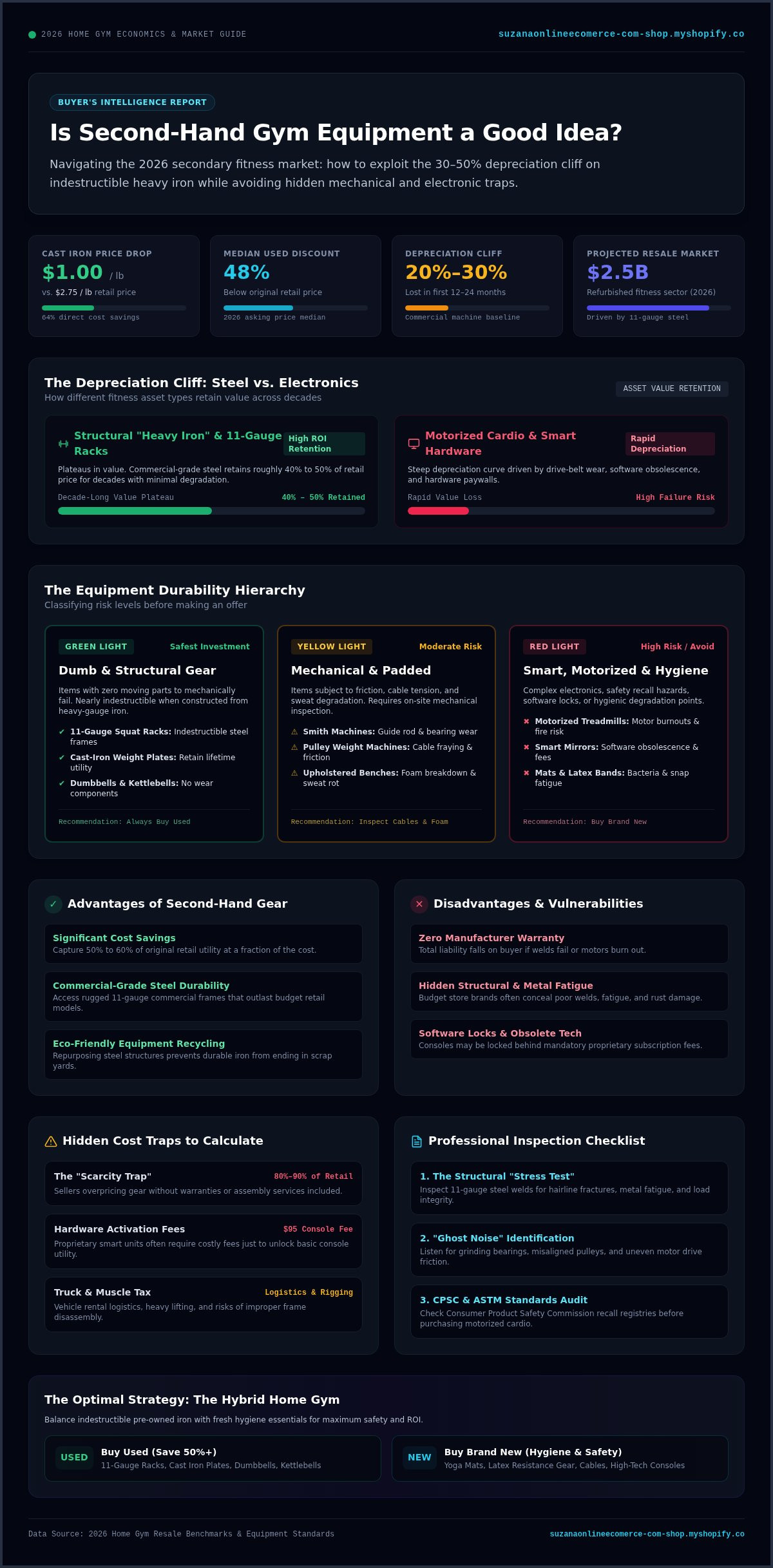
Deciding if second-hand gym equipment is a good idea requires understanding the "depreciation cliff." Most commercial fitness machinery loses 20% to 30% of its market value within the first 12 to 24 months. For home gym owners, this represents a massive financial opportunity. While a buyer at a retail store pays a premium for the "new" experience, a smart secondary market buyer captures that same utility for 50% to 60% of the original retail price.
When browsing various exercise equipment categories, you'll notice a clear divide in how value is retained. Structural steel items like power racks and cast iron plates often plateau in value. They retain roughly 40% to 50% of their retail price for decades. Conversely, motorized units with complex electronics depreciate rapidly as software becomes obsolete or drive belts wear down.
To better understand this concept, watch this helpful video:
- Pros: Significant cost savings, access to durable commercial-grade steel, and eco-friendly equipment recycling.
- Cons: Zero manufacturer warranty, potential for hidden structural wear, and lack of modern software updates.
The Economics of Home Gym Depreciation in 2026
In 2026, the refurbished fitness market is projected to reach $2.5 billion. This growth is driven by the longevity of 11-gauge steel. Top-tier commercial brands hold their value far better than budget "big box" store brands. If you buy a high-quality used rack, your return on investment is high; you can likely resell it for exactly what you paid three years later. Budget brands often suffer from "metal fatigue" or poor weld quality, making them nearly worthless on the secondary market.
When the "Used" Price is Actually a Bad Deal
Not every discount is a bargain. Some sellers fall into the "scarcity trap," attempting to list gear for 80% or 90% of retail. When you factor in the lack of a manufacturer warranty and the absence of professional assembly services, these deals fall apart. In 2026, market trends favor buyers due to increased studio liquidations. However, if the price doesn't account for the "hidden" wear on moving parts, you must ask yourself if second-hand gym equipment is a good idea for that specific machine. If a unit requires a $95 activation fee just to start the console, that "deal" might cost more than a brand-new alternative.
The Used vs. New Hierarchy: What to Buy and What to Avoid
Determining whether is second-hand gym equipment a good idea often depends on where the item sits on the "durability hierarchy." Not all gear ages equally. While a steel frame can last a lifetime, a motorized belt or a latex band has a finite lifespan. To maximize your budget, you should categorize your shopping list into three risk levels: Green, Yellow, and Red.
- The Green Light Category: This includes "dumb" equipment like dumbbells, kettlebells, weight plates, and any basic squat rack made of 11-gauge steel. These items have no moving parts to fail and are the safest second-hand investments.
- The Yellow Light Category: Benches with upholstery, Smith machines, and machines for weight training that use pulleys. These require a closer look at the cables and the foam integrity, as sweat and friction take a toll over time.
- The Red Light Category: High-end treadmills, smart mirrors, and hygiene-sensitive items. Motorized cardio units are prone to fire hazards and mechanical failure. Before buying used cardio, always check the Consumer Product Safety Commission recall notices to ensure the model isn't a known risk.
Why "Iron" is the Safest Bet
Solid steel is nearly indestructible. When evaluating a used rack or plates, don't let surface rust scare you off. Cosmetic oxidation can be sanded and repainted, but structural corrosion that thins the metal is a dealbreaker. Cast iron plates typically trade for $1.00 to $1.50 per pound on the used market, a massive drop from the $2.75 per pound you'll pay for new retail. Unlike rubber-coated weights, which can crack and peel, raw cast iron retains its utility and weight accuracy for decades, making it the smartest "buy once" investment for your home gym.
The Risk of Used Electronics and Cables
Modern workout equipment is increasingly digital, which complicates the secondary market. Smart trainers like Tonal or Peloton often come with "software paywalls." For example, a used Peloton requires a $95 activation fee, while a Tonal unit might be restricted to a "Basic Lift" mode without a $59.95 monthly subscription. Beyond software, internal cables in selectorized machines often hide fraying beneath their vinyl coating. Replacing a proprietary circuit board or a snapped cable can easily cost more than the initial savings you gained by buying used.
For items that directly touch your skin or rely on material elasticity, it's better to avoid the used market entirely. You can find high-quality, new fitness essentials like resistance bands and yoga mats that offer the hygiene and safety you won't find in a stranger's garage.
A Professional Inspection Checklist for Pre-Owned Fitness Gear
Determining if is second-hand gym equipment a good idea often comes down to a rigorous physical evaluation. You cannot judge a machine by its paint job alone. A professional inspection ensures that you aren't inheriting a safety liability that violates ASTM F2276-23 standards for mechanical integrity. While structural steel is durable, the joints and moving parts require a discerning eye before you hand over any cash.
The "Stress Test" is your most valuable tool. Never buy a machine without putting it under load. If you are buying a leg press or a cable station, load it with weights and perform several repetitions. Listen carefully for "ghost noises," such as rhythmic clicks, grinding, or high-pitched squeaks. These sounds often indicate worn-out ball bearings, misaligned pulleys, or a motor that is nearing the end of its life. In contrast, a simple setup of free weights requires less scrutiny, as discussed in the Mayo Clinic's guide to strength training, because solid iron lacks the complex internal failure points of motorized gear.
Weld inspection is equally critical for your safety. Look closely at the joints of a power rack or bench. Hairline fractures in the powder coating usually signal stress on the underlying weld. If you see a "spider web" pattern in the paint at a joint, the structural integrity is compromised. Additionally, check upholstery for hygiene and foam degradation. If the padding feels "crunchy" or doesn't spring back immediately, the internal wood board may be rotting from years of moisture absorption. This is why buying new touchpoint essentials is often the smarter choice for long-term health.
The 5-Point Physical Frame Check
Start with "Rack Sway." Give the top of a squat rack a firm shove; if it wobbles significantly, the bolt holes might be rounded out from over-tightening or poor assembly. Check every bolt for stripping or rust. For Smith machines or functional trainers, test the linear bearings by sliding the bar or handle slowly. Any "hitch" or grit in the movement suggests the guide rods are bent or the bearings are shot, which are expensive repairs that negate your initial savings.
Testing Moving Parts and Resistance
Inspect pulley alignment to ensure the cable isn't rubbing against the plastic housing, which causes premature snapping. Frayed vinyl on a cable is a red flag for internal wire fatigue. For stationary bikes or rowers, cycle through every magnetic resistance level. The transition should be smooth without a "slipping" sensation. Finally, verify that digital consoles power on and heart rate sensors respond. Replacing a dead console on a 2026 model can be nearly impossible if the manufacturer has discontinued the proprietary firmware.
Sourcing and Transport Logistics: Where the Real Costs Hide
Many buyers ask if second-hand gym equipment is a good idea based solely on the listing price. They often forget the "Truck and Muscle" tax. Moving a 300 lb commercial treadmill or a 250 lb selectorized weight stack requires more than a standard SUV. If you require professional delivery, residential liftgate fees typically range from $65 to $150 per drop-off. Standard curbside delivery explicitly excludes moving the machine over a door threshold or into a garage. You must factor in the cost of truck rentals, moving dollies, and the labor of at least two people to avoid equipment damage or personal injury.
Where to Find the Best Deals in 2026
Facebook Marketplace remains a primary source for private deals, but specialized refurbished dealers are gaining traction. These dealers conduct multi-point structural inspections and often replace drive belts before resale. In 2026, gym closures and franchise liquidations represent the best timing for buyers. These events allow you to source 11-gauge steel commercial racks at prices comparable to entry-level consumer models. While private sellers are often more flexible on price to clear space, liquidators provide a more reliable inventory of high-end brands.
Hidden Costs of Refurbishing Used Gear
A "bargain" machine often requires immediate maintenance. Replacing frayed pulley cables, worn bearings, or cracked grip tape can quickly add $100 to $200 to your total investment. Professional rust treatment and deep cleaning are non-negotiable for used gear. If a machine is offered for "free" but features seized guide rods or a dead motor, the parts and labor will likely exceed the cost of a new unit. Always price out replacement cables and upholstery before committing to a purchase.
Use the difficulty of the move as a negotiation tool. If a seller has a heavy leg press located in a basement, highlight the logistical challenge of removal to secure a lower price. Before you begin disassembly, take detailed photos of every joint and cable routing. This prevents a "puzzle" scenario when you attempt to reassemble the frame in your own space. Once the gear is home, follow a strict sanitization protocol using commercial-grade disinfectants on all frames and adjustment pins.
For items where hygiene and material integrity are paramount, it is often more cost-effective to buy new. You can find professional-grade, new fitness accessories to complement your used heavy iron without the risks of hidden wear or bacteria.
Building a Sustainable Home Gym: Balancing Used Iron with New Essentials
The smartest way to answer if is second-hand gym equipment a good idea is to adopt a hybrid acquisition strategy. You don't have to choose between a used garage gym and a premium retail setup. Instead, follow the 80/20 rule: invest 80% of your budget into "heavy iron" from the secondary market and 20% into new, high-quality touchpoints. This approach allows you to secure commercial-grade structural steel while ensuring your daily points of contact remain hygienic, safe, and modern.
When you buy a used power rack, you're getting raw durability. However, the accessories that complete that rack should often be purchased new. Items like barbell collars, lifting straps, and hitch pins are safety-critical. If a used collar has a weakened spring or a worn cam-lock, it can lead to plates sliding off during a lift. Allocating a specific "New Gear" budget for these small but vital components ensures that your hybrid gym remains as safe as a commercial facility. For your recovery and hygiene needs, it's best to consult wellness products experts who understand material longevity and antibacterial properties.
Items You Should Never Buy Second-Hand
- Resistance bands: These are the highest-risk used items. Latex and rubber develop invisible micro-tears over time. A used band can snap without warning under full tension, leading to significant facial or eye injuries.
- Yoga mats and foam rollers: These porous materials are designed to absorb impact, but they also absorb years of a stranger's sweat, bacteria, and skin cells. Even deep cleaning often fails to reach the core of the foam, leading to persistent odors.
- Lifting belts and wraps: Leather and nylon fibers break down and mold to the original owner's body shape. More importantly, the salt from sweat can degrade the structural integrity of the stitching and velcro, compromising the support you need during a heavy squat.
Integrating New Wellness Tools for a Complete Setup
A modern home gym in 2026 isn't just about the lifting; it's about the recovery environment. You can complement your heavy used iron with new recovery tools and aromatherapy essentials from SUZANA SHOP to create a professional-grade wellness space. Modern gym environments benefit from high-quality diffusers and massage tools that help transition your body from high-intensity training to a state of rest. This integration of old-school strength and new-school wellness is the key to a sustainable routine.
Before finalizing your setup, ensure compatibility between your used gear and new accessories. For example, older racks may use 1-inch holes while modern attachments require 2-inch spacing. Always verify these dimensions before ordering new J-cups or dip bars. The final verdict? If you prioritize structural iron for your used purchases and trust a reliable source like SUZANA SHOP for your new essentials, building a high-end home gym is an excellent idea that will save you thousands over its lifetime.
Master Your Home Gym Investment
Building a high-quality home workout space is a strategic balance between financial savvy and safety. When you prioritize used 11-gauge steel for your racks and weights while investing in new touchpoint accessories, you create a gym that lasts a lifetime. You've learned that determining if is second-hand gym equipment a good idea depends on your ability to spot structural wear and your willingness to avoid high-risk electronics that hide expensive software paywalls.
Don't compromise on the items that directly impact your hygiene and safety. While the secondary market is perfect for heavy iron, your recovery tools, resistance bands, and yoga mats should always be fresh from the box to ensure performance and longevity. At SUZANA SHOP, we provide hygiene-guaranteed fitness gear and professional wellness support to help you complete your hybrid setup. Our global shipping on home gym accessories makes it easy to source the professional-grade essentials you need without the risks of pre-owned wear.
Shop New Fitness Essentials at SUZANA SHOP and start building your sustainable home gym today.
Frequently Asked Questions
Is it safe to buy a used treadmill for a home gym?
Buying a used treadmill is safe only if you conduct a thorough mechanical inspection first. Cardiovascular machines represent over 50% of the resale market but suffer from the fastest mechanical failure and depreciation rates. You should check the drive belt for fraying and the motor for grinding noises. Always verify serial numbers against federal recall databases to ensure the model hasn't been flagged for safety hazards.
How do I know if I am overpaying for used dumbbells?
You're likely overpaying if the price exceeds $1.50 per pound for standard cast-iron weights. When asking if second-hand gym equipment is a good idea, you must compare used prices to current 2026 benchmarks. Used iron typically trades between $1.00 and $1.50 per pound, while new commercial plates cost upwards of $2.75. If a seller asks for more than 60% of retail, look elsewhere.
What is the best way to clean and disinfect second-hand gym equipment?
The best way to disinfect gear is using commercial-grade quaternary ammonium wipes or a 70% isopropyl alcohol solution on non-porous frames. Pay close attention to adjustment pins, pull-up bars, and handles. For porous items like yoga mats or foam rollers, cleaning is often insufficient to remove deep-seated bacteria. It's often better to purchase these hygiene-sensitive accessories new from a reliable source like SUZANA SHOP.
Do used gym equipment warranties transfer to the new owner?
Most manufacturer warranties do not transfer to secondary buyers. For instance, brands like Tonal explicitly state that warranties are void upon resale. Additionally, some smart equipment requires a mandatory activation fee, such as the $95 fee for Peloton bikes, before you can use the software. Always assume you are buying the hardware as-is and factor potential repair costs into your total budget.
How can I tell if a squat rack is structurally sound?
A structurally sound rack should have zero lateral sway when pushed. Inspect the weld points for spider web cracks in the powder coating, as these indicate metal fatigue. Ensure the frame is made of 11-gauge steel rather than thin-walled consumer grade metal. Check that the bolt holes aren't rounded or stripped, which can compromise the stability of the entire unit during heavy lifts.
Is commercial-grade used equipment better than new budget-grade equipment?
Used commercial-grade equipment is almost always a better investment than new budget-grade gear. Commercial machines use thicker 11-gauge steel and higher-quality bearings designed for constant use. While a budget rack might feel flimsy, a used commercial rack provides a stable platform that retains its value. This is why many enthusiasts believe that buying second-hand gym equipment is a good idea when sourcing heavy frames.
Where are the most reliable places to find used fitness gear in 2026?
In 2026, the most reliable sources are certified refurbished retailers and boutique studio liquidations. While Facebook Marketplace offers the lowest prices, certified dealers provide structural inspections and limited 90-day warranties. Local gym auctions are also excellent for finding 11-gauge steel racks at a fraction of retail. For smaller essentials that complete your setup, online stores like SUZANA SHOP offer the best value on new, hygienic accessories.
What tools do I need to disassemble used gym machines for transport?
You'll need a comprehensive socket set, adjustable wrenches, and a set of metric and imperial hex keys. A rubber mallet is helpful for loosening stuck joints without damaging the finish. Always bring a smartphone to document the cable routing and bolt placement before you begin. This ensures you can reassemble the unit correctly once it's moved to your home gym space.