

Medicine Ball Exercises: Full-Body Training Guide 2026

What if you could build explosive power and functional stability without a single bulky machine or an entire wall of heavy dumbbells? Many athletes find themselves stuck in repetitive, linear routines that don't always translate to real-world movement or athletic performance. It's frustrating to feel like your fitness has plateaued simply because you're limited by a small home workout space or confused about which equipment actually delivers the best results.
This guide will help you master the most effective medicine ball exercises to transform your training into a dynamic, full-body experience. You'll learn how to build a rock-solid core and improve coordination using professional-grade fitness gear that's easy to store. We'll solve the confusion around selecting the right weight and provide a clear, functional approach to your daily routine. We're covering a comprehensive library of movements and a structured 20-minute plan designed to maximize your home gym setup for 2026 and beyond.
Key Takeaways
- Understand how to engage your body across the sagittal, frontal, and transverse planes to develop functional athleticism that translates to daily life.
- Select the perfect equipment weight using our 2026 framework; this ensures you balance speed and resistance for optimal results.
- Master a library of over 12 essential medicine ball exercises to build explosive power and core stability from the comfort of your home.
- Learn to structure an efficient 20-minute routine by prioritizing dynamic joint preparation and high-velocity power movements.
- Discover how to pair your medicine ball with other home gym essentials to create a versatile and space-saving fitness environment.
The Science of Medicine Ball Training for Functional Strength
Medicine ball training stands out as a unique form of resistance because it allows for high-velocity, dynamic movements that traditional iron weights simply can't match. While a dumbbell requires you to slow down at the end of a rep to protect your joints, a medicine ball encourages you to accelerate through the entire range of motion. This capability is rooted in the History of the medicine ball, which has been used for centuries to bridge the gap between pure strength and athletic speed.
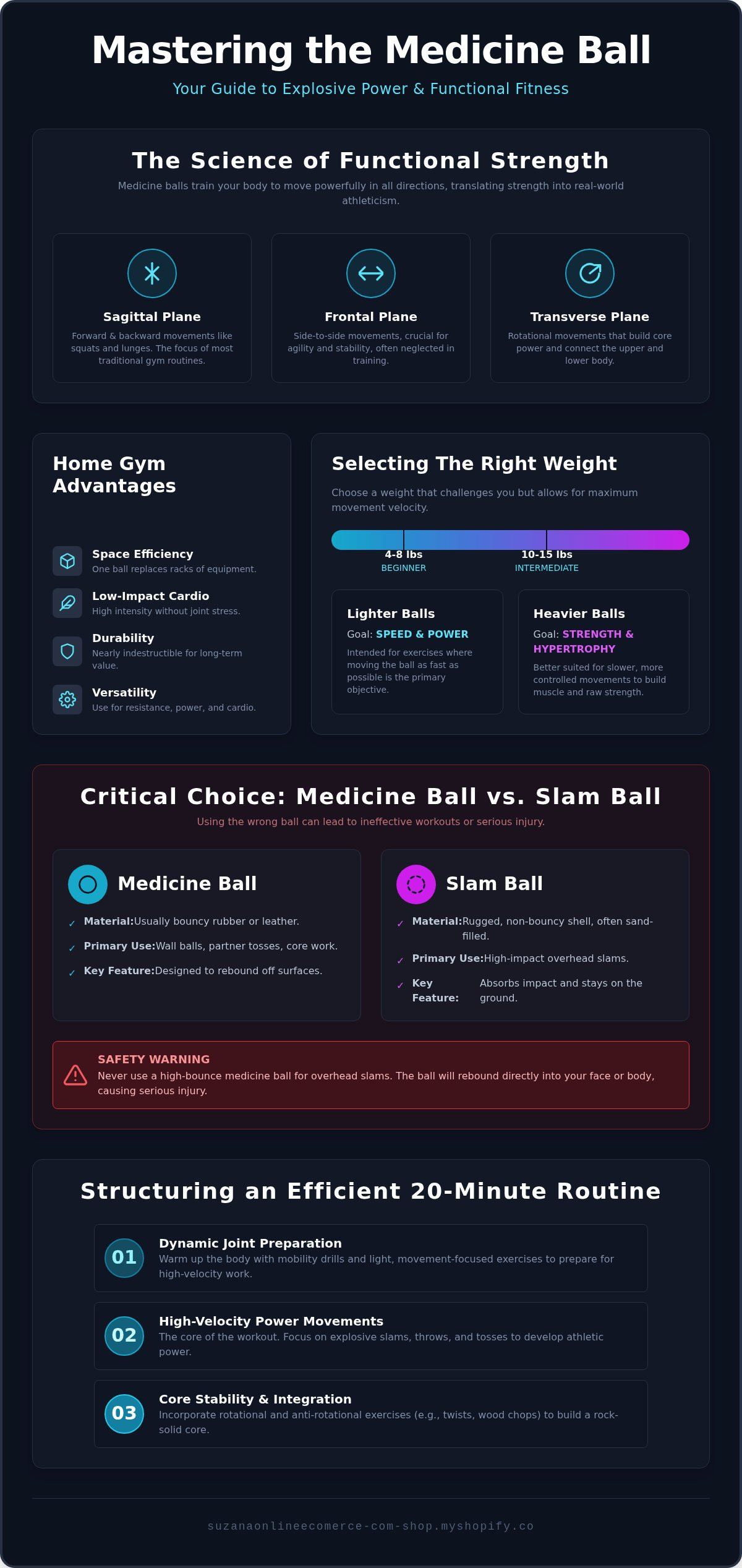
Functional strength depends on your ability to move through the Three Planes of Motion. Most gym routines stay in the sagittal plane, focusing on forward and backward movements like squats or lunges. Effective medicine ball exercises force you into the frontal plane (side-to-side) and the transverse plane (rotational). Training rotation builds power. By engaging these planes, you activate the kinetic chain, ensuring your lower and upper body work as a single, coordinated unit. It also enhances proprioception, which is your body's internal sense of its position and movement in space.
Why Medicine Balls Outperform Static Weights
Standard weightlifting often emphasizes isolation. In contrast, throwing or slamming a ball requires total-body integration. When you perform explosive medicine ball exercises, your core doesn't just sit still; it fires automatically to stabilize your spine against the shifting weight. This acceleration factor is the key difference. Because you don't have to worry about catching a heavy dumbbell at the top of a movement, you can release the ball with maximum force. This builds the type of explosive power that translates directly to sports and functional daily activities.
Key Benefits for Home Fitness Enthusiasts
For those building a home gym, space is usually the biggest constraint. A single weighted medicine ball provides a level of versatility that usually requires a full rack of equipment. It's an efficient tool for those who want professional results without the clutter of large machines. Integrating a ball into your home gym equipment collection offers several practical advantages:
- Space efficiency: One ball can be used for hundreds of movements, from overhead presses to floor-based core work.
- Low impact: You can achieve high-intensity cardiovascular benefits through slams and throws without the joint stress of high-impact jumping.
- Durability: Unlike electronic gear, a high-quality ball is nearly indestructible and offers long-term cost-effectiveness.
- Versatility: It serves as both a weight for resistance training and a tool for metabolic conditioning.
Selecting the Right Medicine Ball Weight and Type
Selecting the right equipment determines the success of your medicine ball exercises. If the ball is too heavy, your movement speed drops and your form breaks down. If it's too light, you miss out on the resistance needed for muscle growth. For most beginners, a weight between 4 and 8 lbs is the industry standard. This range allows you to focus on the mechanics of functional training with medicine balls while protecting your joints. Intermediate users who have established a baseline of strength should look toward the 10 to 15 lbs range to continue their progression.
Apply the 'Speed vs. Strength' rule to your selection. Lighter balls are intended for power and speed, where the goal is to move the object as fast as possible. Heavier balls are better suited for strength and hypertrophy. Before you begin your medicine ball exercises, perform a safety check of your environment. Ensure you have at least six feet of clear floor space in every direction. If you plan on doing throws, verify that your wall is solid masonry or reinforced wood, as standard drywall will not survive the impact.
Medicine Balls vs. Slam Balls
It's vital to distinguish between a traditional medicine ball and a slam ball. Standard medicine balls are usually bouncy. They are perfect for wall balls, partner tosses, and core-based floor work. In contrast, slam balls are non-bouncy and sand-filled. They often feature a rugged, tire-tread texture to prevent slipping when your hands get sweaty. They are specifically designed for high-impact overhead slams where the ball must stay on the ground upon impact. Warning: Never use a high-bounce medicine ball for overhead slams. The ball will rebound into your face, causing serious injury.
Grip and Texture Variations
Texture and material choice depend heavily on your workout environment. Dual-grip balls with integrated handles offer a hybrid experience, making them ideal for rotational lunges or upright rows. Standard round balls remain the gold standard for developing hand-eye coordination and reactive strength. For those training on concrete or outdoors, a thick rubber shell is necessary for durability. If you primarily use indoor mats, synthetic leather provides a softer touch that is easier on the hands. Finding high-quality fitness gear ensures your equipment lasts through years of high-intensity use.
Essential Medicine Ball Exercises for Every Muscle Group
Building a versatile routine requires a mix of movements that challenge your strength and your ability to stabilize under load. By categorizing your training, you ensure no muscle group is neglected during your home sessions. These medicine ball exercises are designed to activate the kinetic chain, forcing your body to work as a unified system rather than a collection of isolated parts.
Lower Body and Explosive Power
Explosive movements are the foundation of athletic performance. They bridge the gap between static strength and real-world agility. Incorporate these five movements for a powerful lower body:
- Medicine Ball Slams: Stand with feet shoulder-width apart. Lift the ball overhead and slam it into the ground with maximum force. This is the king of full-body power and metabolic conditioning.
- Lunge with Rotation: Step forward into a lunge while rotating the ball over your lead leg. This improves balance while engaging the obliques in the transverse plane.
- Single-Leg Deadlift: Hold the ball in front of you while hinging at the hip on one leg. It's a premier move for posterior chain strength and ankle stability.
- Overhead Squat: Hold the ball directly above your head with arms fully extended. Sit back into a squat. Focus on proper spinal alignment; your biceps should stay in line with your ears.
- Lateral Lunges: Step to the side while keeping the ball at chest height. This targets the frontal plane and strengthens the adductors.
- Glute Bridge Squeeze: Lie on your back with the ball between your knees. Squeeze the ball while lifting your hips to engage the inner thighs and glutes.
Upper Body and Core Stability
Core strength isn't just about aesthetics; it's about the ability to transfer force between your limbs. These six movements target the chest, arms, and deep abdominal muscles:
- Russian Twist: Sit with your heels off the ground and rotate the ball from side to side. Focus on controlled rotation rather than speed to ensure the obliques are doing the work.
- Medicine Ball Push-up: Place one hand on the ball and the other on the floor. This provides an advanced stability challenge for the chest and shoulder girdle.
- Woodchopper: Move the ball diagonally from your high shoulder to your opposite low hip. This illustrates transverse plane training and builds functional core power.
- Overhead Press to Triceps Extension: Press the ball toward the ceiling, then lower it behind your head. It's a compound move for sleek, strong arms.
- Medicine Ball V-Ups: Hold the ball and reach for your toes while folding your body into a "V" shape. This offers intense abdominal training for deep core strength.
- Chest Pass: Stand near a solid wall and throw the ball forward from your chest. This develops pushing power and reactive strength.
Mastering these medicine ball exercises will provide a comprehensive workout that fits into even the most limited home gym setups. Start with lower weight to perfect your form before increasing the intensity.
Designing an Effective Medicine Ball Workout Routine
Structuring your training session ensures that you maximize the benefits of medicine ball exercises without overtraining or risking injury. A professional routine follows a logical progression from joint preparation to high-intensity power work. Start with a five-minute dynamic warm-up using the ball for halos and light circles to prep your shoulders and hips. Once your joints are warm, move into the power phase. Perform high-energy moves like slams or chest passes while your nervous system is fresh. To support this level of intensity, many athletes use organic performance supplements from Earthbound to fuel their sessions naturally.
To further support your training and long-term health goals, you can learn more about My Wellness and their selection of high-quality natural health products and supplements.
The middle of your session should focus on a strength circuit. Alternate between upper and lower body movements to maintain an elevated heart rate and promote muscle growth. Follow this with a core finisher, utilizing high-rep abdominal work to fatigue the midsection. Finally, conclude with a cool down. Use the ball as a light prop for assisted stretching and mobility work to improve your recovery time.
The 20-Minute Full-Body Circuit
This high-intensity format is perfect for home training when time is limited. Set a timer for four rounds of the following movements, working for 45 seconds and resting for 15 seconds:
- Medicine Ball Slams
- Squat-to-Press
- Russian Twists
- Mountain Climbers (performed with hands on the ball)
Focus on the quality of movement over the quantity of reps. Fatigue-related form breakdown is the leading cause of training setbacks. If you find your back rounding during slams or your pace stumbling during mountain climbers, slow down and reset your stance. Consistency in form leads to better long-term gains than rushing through sloppy repetitions.
AMRAP vs. EMOM Training
Programming your medicine ball exercises depends on your specific goals. AMRAP (As Many Rounds As Possible) involves completing as many circuits as you can within a set time limit. This method is excellent for building metabolic endurance and testing your mental toughness. EMOM (Every Minute on the Minute) requires you to perform a specific number of reps at the start of every minute, resting for the remainder of that minute. This forces you to maintain consistent power output even as you tire.
To see real results, you must track your progress. Record the number of reps completed in your AMRAP sessions or plan to increase your ball weight over a four-week cycle. If you are ready to upgrade your routine, you can buy professional-grade fitness gear to ensure your equipment matches your performance goals. Consistent tracking transforms a simple workout into a professional training program.
Integrating Medicine Balls into Your Home Fitness Ecosystem
A medicine ball shouldn't exist in isolation within your workout space. To get the most out of your medicine ball exercises, you must learn how to pair this versatile tool with your existing home gym equipment. This integration creates a more dynamic training environment that challenges your body in ways that static weights cannot. For example, you can use a medicine ball as a 'stability marker' during machines for weight training sessions. Placing the ball between your knees during a leg press or holding it during a seated row helps maintain proper postural alignment and ensures your core remains engaged throughout the lift.
Organization is equally vital for a productive home setup. Because these balls are round, they can become a trip hazard if left on the floor. Use a dedicated corner rack or a simple floor ring to keep your workout area safe. A clean, organized space reduces the friction of starting your workout and protects your investment from unnecessary wear. Proper storage also allows you to transition quickly between different medicine ball exercises, keeping your heart rate elevated for better cardiovascular results.
Pairing with Resistance Bands and Mats
Creating a dedicated 'functional corner' in your home gym starts with a high-quality yoga mat. This is essential for floor-based core work like Russian twists or V-ups, as it provides the necessary grip and cushioning for your spine. You can also combine resistance bands with medicine ball lunges to create 'variable resistance' training. By anchoring a band to a fixed point and holding the ball, you add a horizontal pull that forces your stabilizers to work twice as hard. This combination bridges the gap between pure strength and athletic coordination.
The Wellness Connection
Physical training is only one half of a successful fitness strategy. The role of recovery and mental health is central to any health and wellness plan. Medicine ball slams, in particular, offer a unique 'explosive release' that serves as a powerful stress relief tool. This physical outlet for frustration can improve your mental clarity and focus after a long day.
Functional fitness supports long-term mobility, which is a core pillar of a comprehensive wellness products strategy. By moving through all three planes of motion, you protect your joints and maintain the ability to perform daily tasks with ease. High-quality gear makes this journey safer and more effective. If you're ready to enhance your home setup, Shop our selection of professional fitness gear at SUZANA SHOP to find the right tools for your 2026 training goals.
Elevate Your Functional Performance for 2026
Integrating medicine ball exercises into your daily routine is the most efficient way to build real-world power and core stability without a massive equipment footprint. By mastering movements that challenge your body across multiple planes of motion, you've taken a significant step toward a more versatile and functional physique. You now have the framework to select the right weight and structure a professional-grade 20-minute circuit that fits your specific home environment.
Maintaining a consistent practice requires the right tools. SUZANA SHOP provides professional-grade fitness gear and curated wellness products designed specifically for at-home enthusiasts. With global shipping available on all home gym essentials, you can easily build a high-performance training space regardless of your location. It's time to put these techniques into action and transform your physical potential. Upgrade your home gym with professional fitness equipment from SUZANA SHOP and start your journey toward superior functional strength today.
Frequently Asked Questions
What weight medicine ball should a beginner start with?
Beginners should start with a weight between 4 and 8 lbs. This range ensures you can maintain perfect form while learning the mechanics of dynamic movements. If you select a ball that's too heavy, your speed will decrease and your joints will take on unnecessary stress. Focus on mastering the movement patterns before progressing to intermediate weights like 10 or 15 lbs. Proper weight selection is the foundation of safe training.
Can medicine ball exercises help with weight loss?
Yes, these movements are excellent for weight loss because they facilitate metabolic conditioning. High-energy medicine ball exercises like slams and chest passes engage multiple large muscle groups simultaneously, which spikes your heart rate and increases caloric expenditure. When you perform these moves in a circuit format, you create an afterburn effect that keeps your metabolism elevated. Combining this training with a balanced wellness strategy leads to sustainable body composition changes.
How many times a week should I do medicine ball workouts?
Medicine balls offer unique advantages for core strength, particularly in the transverse and frontal planes. While dumbbells are great for linear resistance, a ball allows for explosive rotational movements that mimic real-world actions. The shifting weight inside the ball forces your deep core stabilizers to fire automatically. This makes medicine ball exercises superior for developing functional core power and stability that translates directly to sports and daily life activities.
What is the difference between a medicine ball and a slam ball?
The primary difference lies in the bounce and construction. A standard medicine ball is typically bouncy and designed for wall tosses or partner work. A slam ball is sand-filled and non-bouncy, specifically engineered to absorb the impact of high-velocity overhead slams. Using a bouncy ball for slams is dangerous, as it can rebound quickly and cause facial injuries. Always check the manufacturer's specifications to ensure your gear matches your intended workout.
Can I do medicine ball exercises if I have a back injury?
You must consult a medical professional before starting any new routine if you have a history of back injuries. While some stability moves can strengthen the supporting muscles, high-impact slams or rapid rotations can aggravate existing conditions. If cleared by a doctor, focus on slow, controlled movements that emphasize spinal alignment. Avoid pushing through pain and prioritize exercises that build a protective brace around your midsection rather than those involving extreme ranges of motion.
Do I need a partner for medicine ball training?
You don't need a partner to complete a full-body routine. Most movements, such as lunges, squats, and Russian twists, are performed solo. If you want to include throwing movements, a solid masonry or reinforced wood wall can act as a perfect substitute for a partner. Many athletes prefer solo training because it allows them to focus entirely on their own tempo and form. A wall provides consistent feedback for reactive strength training.
How do I clean and maintain my medicine ball?
Maintenance is straightforward but essential for the longevity of your equipment. Wipe the surface with a damp cloth and mild soap after every session to remove sweat and oils. Avoid using harsh chemicals that can degrade the rubber or synthetic leather shell. Store your gear in a cool, dry place away from direct sunlight, as UV rays can cause the material to crack over time. Regularly inspect the seams and surface for any signs of wear.