

Soundproof Your Apartment Gym: Quiet Workout Guide (2026)

Your downstairs neighbor shouldn't have the power to cancel your morning workout. For the 39 million Americans living in multi-family housing, the anxiety of receiving a noise complaint often outweighs the benefits of a home session. It's frustrating to feel restricted by thin floorboards or the fear of waking up your family during an early morning circuit. Finding the right quiet home workout equipment for apartments is the essential first step toward reclaiming your fitness routine without risking an eviction notice.
This guide will show you how to construct a professional-grade setup that stays well below the 60-decibel threshold of a standard conversation. You'll learn how to build a high-performance home gym that keeps your neighbors happy and your workouts whisper-quiet. We will explore the science of decoupling your equipment from the building's structure and identify the specific magnetic resistance machines that operate in near silence. You'll also discover how foundational gear from SUZANA SHOP, such as high-density mats and resistance accessories, can neutralize vibrations before they travel through your floor, giving you the confidence to exercise at any hour.
Key Takeaways
- Identify the difference between airborne and impact noise to stop vibrations before they reach your neighbors' ceiling.
- Select quiet home workout equipment for apartments by choosing magnetic resistance cardio and latex-free bands over traditional iron weights.
- Implement DIY soundproofing steps like building a "deadening platform" to neutralize structural impact from even the most intense sessions.
- Adjust your training style using Time Under Tension (TUT) to maximize muscle growth while minimizing the need for heavy, clanging equipment.
- Create a professional home oasis with specialized gear that balances high-performance fitness with a peaceful living environment.
Understanding Apartment Noise: Airborne vs. Impact Vibration
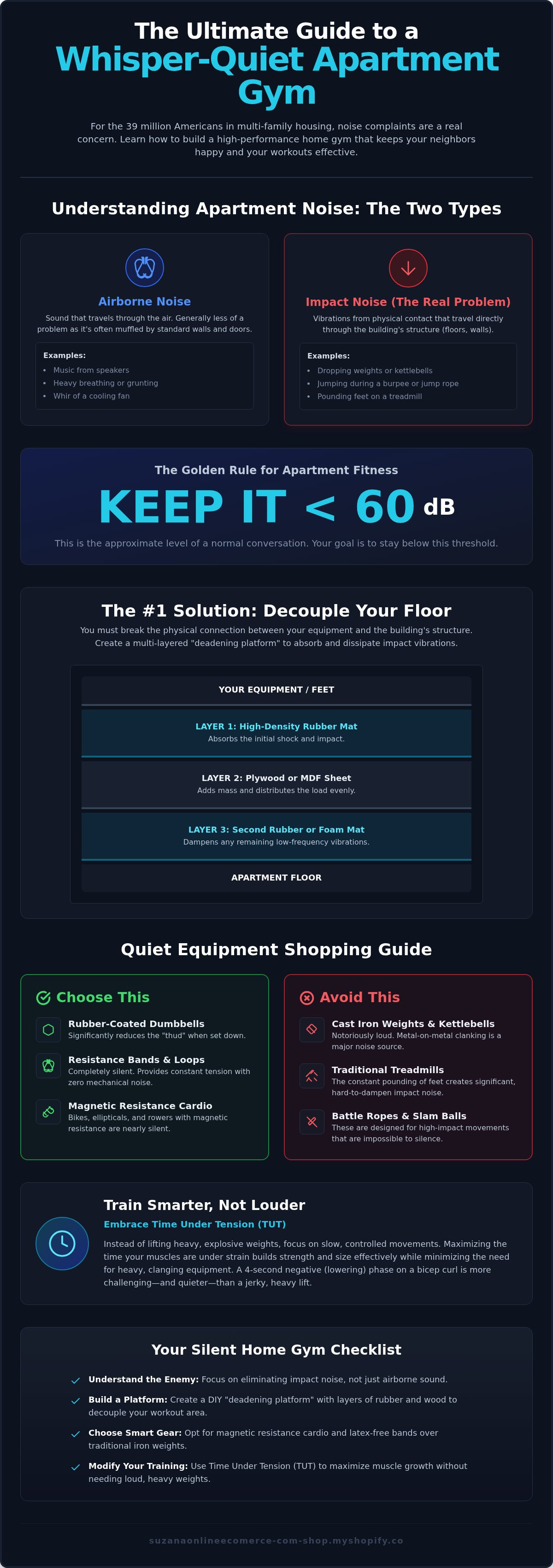
Living in a multi-story building means sharing a structural skeleton with your neighbors. When you set up a home gym, you're dealing with two distinct types of noise. Airborne noise includes sounds like your gym playlist, your heavy breathing, or the whir of a fan. These sounds travel through the air and are often muffled by standard drywall. Impact noise is different. It occurs when an object strikes a surface, such as a kettlebell hitting the floor or your feet landing during a burpee. This physical contact sends vibrations directly into the building's floor joists and wall studs.
Impact noise is the primary reason for neighbor disputes. While a thick wall might block the sound of a conversation, it won't stop the low-frequency vibration of a treadmill. These vibrations turn the floor into a giant speaker diaphragm that broadcasts every movement to the person living below you. To prevent this, you must focus on "decoupling," which is the process of breaking the physical connection between your gear and the building's structure. A decibel (dB) is a logarithmic unit used to measure sound intensity; in most apartments, keeping your workout noise below 60 dB is the standard for maintaining a peaceful environment.
How Sound Travels Through Apartment Floors
Floor joists play a significant role in amplifying gym noise. In many modern buildings, these supports act as bridges that carry vibrations across large distances. You might notice that a "hollow" thud from a jumping jack is far more disturbing than the consistent hum of a cooling fan. This is because sudden, sharp impacts create peak energy levels that the building's frame can't dissipate quickly. Effective Soundproofing requires a two-pronged approach. You need sound absorption to catch echoes within your room and sound blocking to prevent energy from entering the floor. Without decoupling, even the best quiet home workout equipment for apartments can still cause structural complaints if it's bolted directly to a hard surface.
The Science of Decoupling Your Gym
You don't need to perform a full renovation to decouple your workout space. The goal is to create a "floating" floor effect using layers of different materials. By stacking materials with varied densities, you force sound waves to change speed and lose energy as they pass through each layer. Mass is your best ally in this process. Heavier, denser materials are much harder to vibrate than light, flimsy ones. Using high-density rubber mats as a base layer provides the mass needed to dampen energy. When you pair these structural changes with quiet home workout equipment for apartments, such as magnetic resistance bikes, you create a system where noise has no path to travel. This layered approach ensures that your high-intensity training doesn't become a shared experience for the entire building.
Choosing the Best Quiet Home Workout Equipment for Apartments
Selecting the right gear is your first line of defense against noise complaints. While traditional commercial gyms thrive on the clanging of iron, your home environment requires a more strategic approach. The most effective way to maintain peace is to choose quiet home workout equipment for apartments that eliminates metal-on-metal contact and mechanical friction. High-density yoga mats are the essential starting point for any silent setup. These mats don't just provide comfort; they act as a primary dampening layer that catches high-frequency vibrations before they reach the building's subfloor. By creating this soft barrier, you can perform floor exercises and stretches without generating any detectable sound for those living below you.
Strength Training Without the Clank
Traditional iron dumbbells are notoriously loud, especially when they rattle on a rack or tap together during a chest press. Fabric resistance loops and latex-free strength bands offer a completely silent alternative. These tools provide constant tension through the entire range of motion without any mechanical noise. If you prefer the feel of weights, rubber-coated hex dumbbells or soft-shell kettlebells are far superior to cast iron versions. They significantly reduce the "thud" of setting weights down between sets. When you are browsing for fitness equipment, look for items that utilize sand-filled interiors or soft-touch surfaces to maximize sound dampening. These materials absorb energy rather than reflecting it as noise.
Cardio Solutions for Shared Walls
Standard treadmills are often the loudest pieces of equipment because of the motor whir and the heavy impact of your feet on the deck. Magnetic resistance machines, such as magnetic bikes and ellipticals, are the better choice for apartment dwellers. These machines use non-contact magnets to create tension, meaning there are no friction pads or air fans to create a loud whir. Research shows magnetic bikes usually operate between 40 to 55 dB, which is quieter than a standard conversation. Reducing noise isn't just about being a polite neighbor. The health effects of noise pollution can include increased stress and sleep disruption for everyone in your household. For those who enjoy jumping, "silent" cordless jump ropes use weighted handles to simulate the workout without the rope hitting the floor. You can find many of these versatile fitness gear options to keep your heart rate up while keeping your decibels down.
Bodyweight exercises are perhaps the most underrated tool in a quiet gym. Movements like slow-tempo squats, lunges, and planks require zero mechanical parts and generate almost no noise. By combining these low-impact movements with specialized quiet home workout equipment for apartments, you can maintain a rigorous routine without ever crossing the 60 dB threshold. This balanced approach ensures you get the results you want while keeping the environment stress-free for yourself and your neighbors.
DIY Soundproofing: Creating a Silent Floor and Wall Setup
Even the best quiet home workout equipment for apartments can't overcome a poorly insulated room on its own. While choosing magnetic resistance and resistance bands reduces noise at the source, you must still address how your space handles vibration. A DIY "deadening platform" is a highly effective solution for lifters who need to neutralize impact. By sandwiching a layer of high-density rubber between two sheets of plywood, you create a dedicated lifting zone that traps energy before it enters the subfloor. This structure relies on the principle of mass to resist movement, ensuring that a dropped dumbbell or a heavy step doesn't echo through the building's frame.
Interlocking EVA foam tiles provide an excellent secondary defense. These tiles are affordable and easy to install, offering maximum coverage for high-traffic areas. For a more aesthetic approach that doesn't sacrifice performance, use the "Rug-on-Mat" strategy. Placing a heavy area rug over your exercise mats adds an extra layer of acoustic dampening while helping the gym blend into your living space. This combination is particularly effective at catching high-frequency sounds like the clicking of a jump rope or the whir of a small motor.
Layering Your Flooring for Vibration Control
Effective floor soundproofing requires a multi-material approach to break up sound waves. Start with a base layer of 3/4-inch high-density rubber matting to provide the necessary mass. On top of this, add a middle layer of closed-cell EVA foam tiles to absorb the sharp energy of impact. The final layer should be a premium high-density yoga mat from SUZANA SHOP, which provides the necessary grip and a final surface for sound dampening. This layered system is backed by scientific principles found in the NIST study on Sound insulation of wall and floor constructions, which highlights how varied densities prevent sound from traveling through building materials. Using this method ensures your quiet home workout equipment for apartments remains truly silent for your neighbors.
Managing Airborne Sound on Walls and Ceilings
Airborne noise like heavy breathing or background music can still leak through thin apartment walls. You can manage this by strategically placing bookshelves or soft furniture against shared walls to act as natural sound diffusers. These objects break up flat surfaces, preventing sound from bouncing and creating an echo. Heavy "blackout" curtains are another essential tool; they block sound from escaping through glass windows, which are often the weakest point in a room's insulation. Finally, don't overlook the gym door. Applying simple weather-stripping to the door frame creates a tight seal that contains noise within a single room, protecting the peace of other family members in your home.
Silent Training Techniques: Modifying Your Routine for Peace
Technique is the final barrier between a productive session and a noise complaint. Even when using quiet home workout equipment for apartments, how you move determines the level of structural vibration. Time Under Tension (TUT) involves slowing down the tempo of each repetition, specifically the lowering phase. This method increases the metabolic stress on your muscles, allowing you to reach failure with lighter, quieter weights. The "No-Drop" rule should be your standard operating procedure. By never allowing weights to touch the floor with force, you protect your flooring and keep decibel levels well below the 60 dB threshold. Slow-motion repetitions maximize muscle fiber recruitment and hypertrophy while ensuring your equipment never makes a sound.
Focusing on the eccentric phase isn't just about noise; it's a proven strategy for strength. When you lower a weight slowly, you create more micro-tears in the muscle fibers compared to a fast, uncontrolled drop. This means you can get better results using the quiet home workout equipment for apartments you already own without needing to upgrade to heavier, louder iron plates. Controlling the weight all the way to the floor also prevents the sudden "peak" vibrations that travel most easily through floor joists. It turns a potentially disruptive "thud" into a silent, controlled movement.
Low-Impact Alternatives to High-Impact Moves
High-impact plyometrics like box jumps or jumping lunges are structural noise nightmares for anyone living below you. You can achieve similar cardiovascular intensity by replacing box jumps with weighted step-ups on a stable, padded surface. Instead of jumping your feet back during a burpee, use a "walk-back" technique to eliminate the landing impact entirely. Isometric holds, such as wall sits or planks, are perfect for reaching muscular failure in total silence. These movements allow you to push your limits without any mechanical noise or floor vibration. If you need tools to increase the difficulty of these silent moves, you can explore versatile fitness gear that focuses on resistance rather than impact.
The Etiquette of Apartment Lifting
Maintaining a peaceful home environment requires more than just physical dampening; it requires social awareness. Schedule your most intense training sessions during standard social hours, typically between 10:00 AM and 7:00 PM. Communicating with your neighbors to find their "quiet windows" can prevent conflicts before they start. Knowing when a neighbor is on a conference call or when a child is napping allows you to plan your heart-rate-climbing sessions accordingly. Using high-quality wireless headphones is a non-negotiable step for eliminating airborne noise from music or instructional videos. This ensures your workout environment remains contained, professional, and respectful of the shared building structure.
Building Your Peaceful Home Oasis with SUZANA SHOP
Creating a silent gym is a significant investment in your long-term health and wellness. When you remove the anxiety of disturbing your neighbors, your home becomes a true sanctuary for physical and mental growth. SUZANA SHOP understands the unique challenges of urban living, which is why we focus on providing versatile home fitness gear that prioritizes both performance and peace. Integrating quiet home workout equipment for apartments into your daily life ensures that your fitness goals never have to compete with your living situation. By starting with foundational pieces, you can gradually build a professional-grade setup that remains virtually silent.
Curating Your Silent Fitness Kit
For those living in limited square footage, every piece of workout equipment must earn its place. A high-quality yoga mat is the most critical item in this kit. The density of the material makes a measurable difference in sound dampening; a professional mat absorbs the high-frequency sounds of movement that lighter mats simply reflect. Beyond the gym floor, a holistic approach to health involves more than just exercise. Combining your fitness gear with specialized wellness products and kitchen accessories from SUZANA SHOP allows you to manage your recovery and nutrition with the same precision as your training. This integrated approach ensures that your home environment supports every aspect of a balanced life.
Next Steps: From Planning to Practice
The transition to a silent gym begins with a thorough assessment of your space. Measure your designated area and identify the spots where impact is likely to be highest, such as under a cardio machine or where you stand for resistance work. Always adopt a "flooring first" approach to soundproofing. Once your base layers are secure, you can confidently introduce quiet home workout equipment for apartments that matches your specific training style. We invite you to explore the SUZANA SHOP collection to find the foundational gear needed to transform your apartment into a peaceful, high-performance fitness oasis. Taking these small, intentional steps today will lead to a more consistent and stress-free workout experience for years to come.
Reclaim Your Training Schedule and Your Peace
Building a silent home gym is a strategic process that balances structural soundproofing with the right gear. You've learned that decoupling your equipment from the floor using high-density mats is the most effective way to stop vibrations before they reach your neighbors. When you combine these physical barriers with quiet home workout equipment for apartments, such as magnetic resistance bikes and fabric loops, you eliminate the primary sources of conflict. Modifying your technique through slow-tempo repetitions and low-impact movements further ensures your training remains a private, professional experience.
SUZANA SHOP is dedicated to supporting home fitness enthusiasts with a wide selection of high-quality equipment and wellness items. We offer a curated range of products designed to fit into small living spaces while maintaining high performance standards. With global shipping available for all wellness items, you can easily access the foundational tools needed for a holistic health routine. Upgrade your apartment gym with SUZANA SHOP fitness essentials today to start training on your own terms. Your fitness journey shouldn't be limited by your floor plan, and with these strategies, it won't be.
Frequently Asked Questions
How do I stop my treadmill from vibrating the floor in an apartment?
You can stop treadmill vibrations by using dedicated vibration isolation pads or building a multi-layered floating platform. These tools decouple the machine from the building's floor joists, which prevents the structural hum from traveling downward. Placing a 3/4-inch high-density rubber mat under the entire unit provides the mass needed to absorb the motor's mechanical energy and the impact of your stride. This layered approach is far more effective than using a thin yoga mat alone.
Are rubber mats enough to soundproof a home gym?
Rubber mats are an essential first step, but they are rarely enough to fully soundproof a space on their own. While they excel at absorbing high-frequency impact, they don't block low-frequency vibrations or airborne noise like music. For a truly silent setup, you must combine high-density mats with specialized quiet home workout equipment for apartments and modifications to your training tempo. This creates a comprehensive system that addresses both airborne and structural sound transmission.
What is the quietest cardio machine for a small apartment?
Magnetic resistance exercise bikes are the quietest cardio option because they use non-contact magnets to create tension. These machines typically operate at very low decibel levels, often staying well below the 60 dB "silent threshold." Unlike air bikes or friction-based rowers, magnetic models produce almost no mechanical friction or air-displacement noise. This makes them ideal for thin-walled buildings where a traditional treadmill would be too disruptive for neighbors living below or beside you.
Can I lift heavy weights in a second-story apartment without damage?
You can lift heavy weights safely if you distribute the load across multiple floor joists and avoid dropping the equipment. Modern apartment buildings are usually designed to handle 40 to 50 pounds of live load per square foot, but concentrated weight can still cause structural stress. Using a deadening platform to spread the weight and dampen impact protects the subfloor from damage. Always prioritize controlled eccentric movements to ensure the weight never strikes the floor with full force.
How can I tell if my home gym is too loud for my neighbors?
The most accurate way to check noise levels is to use a decibel meter app on your smartphone during a session. If your workouts consistently exceed 60 decibels at the floor level, the noise is likely reaching your neighbors. You can also perform a simple thump test with a family member in another room to see how much vibration travels through the shared walls. This proactive approach helps you identify which movements require more dampening before a complaint occurs.
Do acoustic foam panels actually block noise from leaving the room?
Acoustic foam panels are designed to reduce echo and improve sound quality within a room, but they don't block noise from escaping. These panels are too light and porous to stop sound waves from passing through drywall. To actually block sound, you need mass and density, such as heavy rubber matting or specialized sound-blocking curtains. Foam panels are best used as a secondary treatment to catch high-frequency echoes from heavy breathing or gym music.
What are the best exercises for a quiet home workout?
Slow-tempo strength movements and isometric holds are the best exercises for a silent routine. Exercises like wall sits, planks, and slow-count squats generate zero impact and no mechanical noise. These techniques allow you to reach muscular fatigue without the need for high-impact jumps or the clanging of heavy iron plates. For those who want to refine their form with expert help, you can check out Yogaathome for specialized private sessions that bring professional, quiet training directly to your living space. By focusing on time under tension, you can maintain a high level of fitness while ensuring your session remains completely undetectable to others.
Is it better to use resistance bands or dumbbells in an apartment?
Resistance bands are generally better for apartments because they are inherently silent and don't require heavy impact on the floor. While dumbbells are effective, they carry the risk of being dropped or clanking together during sets. Selecting quiet home workout equipment for apartments like fabric resistance loops allows you to maintain high intensity while completely eliminating the risk of a noise complaint. Bands also take up significantly less space and offer a safer alternative for late-night sessions.