

Confident Home Workouts: A Professional 2026 Guide

What if the most effective gym in 2026 isn't the one you pay a monthly membership for, but the one you build between your living room walls? Many people struggle with the transition to domestic fitness, often feeling uncoordinated or distracted by household chores and family demands. Learning how to feel confident working out at home is the essential first step to moving past that initial hesitation and achieving professional-level results.
It's natural to worry about performing exercises incorrectly or missing the high-energy atmosphere of a commercial facility. You deserve a fitness routine that makes you feel proud and capable rather than self-conscious. This guide provides a structured roadmap to mastering your workout mindset, selecting the right professional-grade equipment, and designing a space that eliminates distractions.
We'll examine the specific strategies needed to professionalize your home setup, ensuring you have the tools and the confidence to see visible progress. From smart equipment investments to recovery techniques, you'll learn how to transform your home into a dedicated wellness sanctuary that supports your long-term health goals.
Key Takeaways
- Learn how to overcome the mental shift from relaxation to exertion by defining your workout space with intentionality and purpose.
- Discover how to feel confident working out at home by optimizing environmental factors like lighting and dedicated equipment setups.
- Understand why professional-grade fitness equipment, such as high-quality mats and resistance gear, is essential for maintaining safety and performance.
- Implement a frictionless routine by pre-setting your gear and scheduling sessions to eliminate decision fatigue and ensure consistency.
- Integrate recovery tools and wellness products into your journey to transition effectively between high-intensity training and daily life.
The Psychology of Home Fitness: Overcoming the "Awkward" Phase
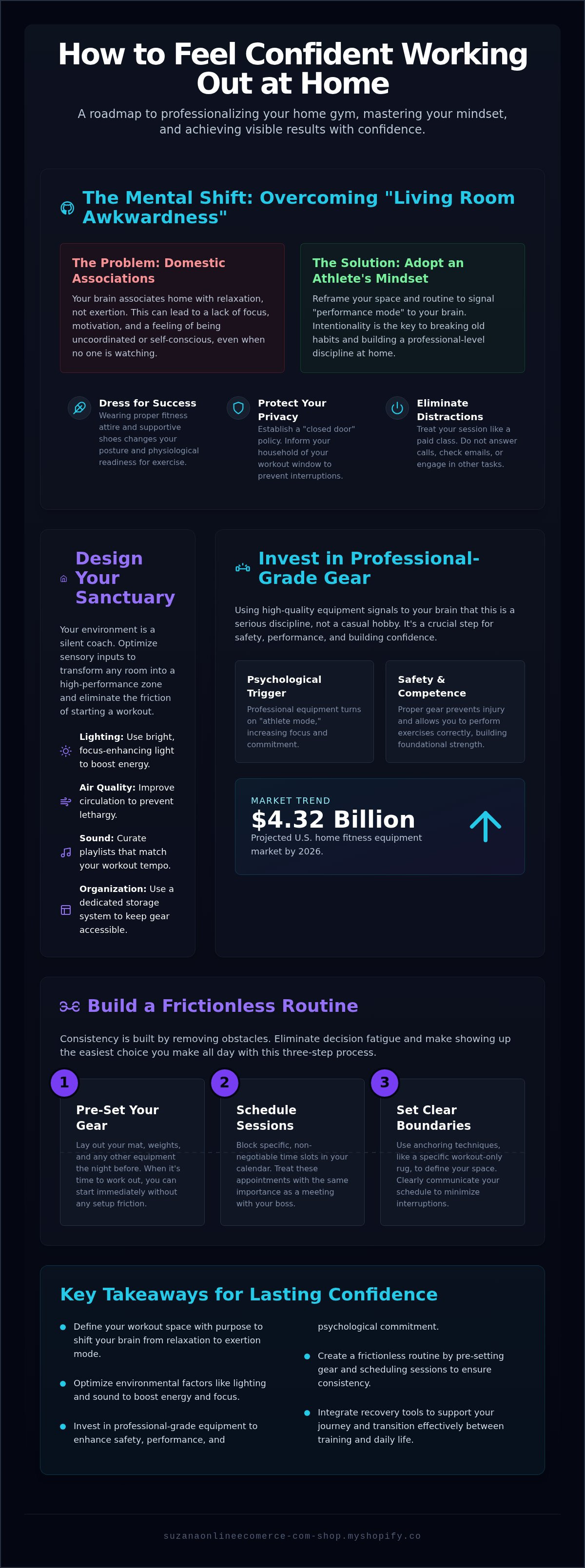
Confidence in a home setting is often harder to maintain than in a commercial gym. True home workout confidence exists at the intersection of competence, privacy, and intentionality. Many individuals experience what professionals call "Living Room Awkwardness." This occurs because the brain naturally associates the home with relaxation and recovery. When you attempt to switch into a high-exertion state in the same space where you watch television, your mental focus can falter. Learning how to feel confident working out at home requires you to break these domestic associations and establish a professional mindset.
One primary advantage of home training is the absence of "gymtimidation." You have the freedom to practice complex movements or fail at a heavy rep without the pressure of an audience. This privacy is essential for building foundational strength and technical competence. However, using flimsy or improvised gear often reinforces the feeling that home fitness is a secondary, less serious option. Transitioning to professional-grade fitness equipment triggers a psychological shift. It signals to your brain that you have entered "athlete mode," turning a casual hobby into a dedicated discipline. The U.S. market for home fitness equipment is projected to reach USD 4.32 billion by 2026, which highlights a global trend toward professionalizing personal training spaces.
Mindset Shifts for the Solo Athlete
You must treat your home session with the same respect as a scheduled, paid boutique class. If you would not answer a phone call or check emails during a professional session, do not allow those distractions at home. Overcoming the fear of being watched by family members or neighbors is another hurdle. Establish a firm "closed door" policy to protect your privacy. Additionally, the "Dress for Success" rule is critical. Wearing proper fitness attire and supportive shoes changes your posture and physiological readiness. It is significantly harder to abandon a difficult set when you are dressed for the task.
Setting Boundaries with Your Space and Time
Clear communication is the foundation of a successful routine. Inform everyone in your household of your specific workout window to prevent interruptions. You can also use "anchoring" techniques by designating a specific corner or rug that is used only for exercise. Applying Positive Psychology Principles to your routine helps you focus on personal progress rather than perceived flaws. Workout intentionality is the primary driver of home fitness success. By creating these boundaries, you ensure that your home environment supports your goals instead of hindering them.
Designing Your Sanctuary: Environmental Factors That Boost Confidence
Your physical environment acts as a silent coach. Professional gyms prioritize high-quality lighting and air circulation because these factors directly influence energy levels and focus. In a home setting, stale air or dim lighting can quickly lead to lethargy. Improving air quality and utilizing bright, focus-enhancing light helps maintain the intensity required for a productive session. A dedicated "Gym-in-a-Box" system, where all your tools are stored in a single, organized container, also reduces the mental friction of starting. When you don't have to hunt for gear, you can transition immediately into your routine. This level of organization is central to learning how to feel confident working out at home.
Sound also plays a critical role in your psychological readiness. Curating professional-grade playlists that match the tempo of your movements can help you enter a "flow state" more quickly. By controlling these sensory inputs, you transform a standard living area into a high-performance zone. Selecting professional fitness equipment helps ensure your sanctuary feels like a legitimate training ground rather than a temporary setup.
Optimizing Small Spaces for Big Results
You don't need a large floor plan to achieve professional results. The 2026 trend toward compact, multi-functional equipment makes it possible to build a complete gym in any room. Use high-density yoga mats to protect your joints and clearly define your "workout zone." This physical boundary tells your brain that the space has changed functions. Vertical storage solutions, such as wall racks or slim shelving, keep the area clutter-free and professional. You can also create a "sensory bridge" by using a specific scent, such as peppermint or eucalyptus, to signal the start of your session. This consistent cue builds a powerful mental association between the environment and peak performance.
The Role of Visual Feedback
Visual cues are essential for both safety and self-efficacy. Mirrors are not just for aesthetics; they allow you to monitor your form and make real-time corrections. Seeing your muscles engage improves the mind-muscle connection, which is a key factor in seeing visible progress. Position your equipment so your view is directed away from household distractions like laundry piles or workstations. If possible, utilize natural light during the day to boost mood. For evening training, use adjustable LED setups that mimic the bright, energetic atmosphere of a professional studio. This visual clarity eliminates the "cluttered" feel that often causes mental distraction during home exercise.
Choosing Professional-Grade Equipment for Safety and Competence
Professional-grade equipment is not just about aesthetics; it is about psychological security. Using cheap, unstable gear significantly erodes confidence because it introduces a constant fear of mechanical failure or injury. If a yoga mat slides during a plank or a resistance band shows signs of fraying, your focus shifts from muscle engagement to self-preservation. Understanding how to feel confident working out at home begins with trusting the tools you use. Professional tools provide the specific tactile feedback required to maintain proper form, allowing you to push your limits without hesitation.
The "Core Essentials" for a high-functioning home gym typically include high-density mats, professional resistance gear, and versatile weights. According to 2026 market data, a quality starter setup often requires a budget between $500 and $1,500 to ensure the equipment is durable and safe. Matching your gear to your specific goals is equally important. Strength training requires tools that support progressive overload, while flexibility goals are best served by supportive, high-grip surfaces that prevent slipping during deep stretches.
Essential Tools for Every Home Setup
Safety starts from the ground up. Non-slip surfaces are vital for high-intensity movements where sudden shifts in weight occur. For those with limited space, resistance bands are often the most underrated alternative to bulky machines for weight training. They offer a unique resistance profile that maintains tension throughout the entire movement, which is excellent for building functional strength. It is important to select gear that can scale with your progress. Investing in adjustable systems or tiered resistance levels prevents the common frustration of hitting a plateau early in your fitness journey.
Safety and Form: The Foundation of Confidence
Confidence is a byproduct of competence, and competence is built on correct form. Using professional home gym equipment ensures that your body remains in proper alignment during complex movements. Stability is particularly crucial for heavy lifts where a slight wobble can lead to significant joint strain. Equipment quality is the silent partner in injury prevention. When your equipment is reliable, you can concentrate on your mind-muscle connection and the intensity of your sets. This reliability allows you to transition from a tentative beginner to a confident, self-sufficient athlete within your own home.
Establishing a Frictionless Routine to Eliminate Decision Fatigue
Decision fatigue is a significant barrier to home fitness. When you arrive at your workout space without a plan, you spend mental energy deciding what to do instead of actually doing it. Establishing a frictionless routine is the most effective way to maintain momentum and ensure every session counts. Step 1 involves scheduling your sessions in a digital or physical planner. Treat these blocks as non-negotiable professional appointments. Step 2 requires you to pre-set your equipment the night before. This simple act lowers the activation energy needed to begin. Step 3 is choosing a structured program. Research shows that personalized, structured workouts around 30 minutes are becoming the standard in 2026. Step 4 is tracking your metrics, such as reps, weight, or time, to visualize tangible growth. Finally, Step 5 is reviewing your routine every four weeks to adjust for progress or boredom.
Learning how to feel confident working out at home relies on these systems. When you follow a proven path, you eliminate the self-doubt that comes from "winging it." This structured approach ensures that you are always moving toward your professional fitness goals without the need for constant willpower. To start building your professional setup, you can view professional fitness equipment that fits your specific routine.
The Power of Progressive Overload
Small, incremental wins are the foundation of long-term psychological confidence. Progressive overload isn't just about lifting heavier weights; it involves improving your range of motion or decreasing rest periods. Tracking "non-scale victories," such as improved mobility or reduced daily stress, provides concrete proof that your system is working. During the first 90 days, consistency is more important than intensity. Building the habit is the primary goal. Physical transformation naturally follows the established routine once the "awkward" phase has passed.
Finding Your Digital Coach
Professional digital platforms provide the "form-first" instruction needed to avoid injury and build competence. You should select apps that align with your available workout equipment. For example, if you have a minimalist setup, apps like Nike Training Club or FitOn offer excellent free tiers. If you prefer data-driven strength training, platforms like Hevy ($23.99/year) or Fitbod ($95.99/year) provide detailed tracking and AI-powered personalization. Balancing solo training with a digital community can also provide the social accountability often missing from home environments, further helping you understand how to feel confident working out at home.
The Holistic Approach: Integrating Wellness into Your Fitness Journey
Confidence is built through more than just physical exertion. While the previous sections focused on the activity itself, true mastery comes from how you manage the hours between sessions. Recovery is the phase where your body actually adapts and grows stronger. Without a professional approach to rest, your performance will plateau, leading to a loss of motivation. Integrating wellness products like aromatherapy or high-quality foam rollers helps your nervous system transition out of a high-intensity state. This transition is vital for learning how to feel confident working out at home because it prevents the burnout often associated with solo training.
Sleep and hydration are the two most influential factors in mental clarity and physical output. Dehydration can significantly reduce strength, which directly impacts your ability to perform exercises correctly. Similarly, a lack of sleep impairs the cognitive focus required to maintain proper form during complex movements. To further support your internal health and energy levels, you can check out Nutrahara for guidance on specific women's health supplements. By treating these factors as part of your training system, you ensure that you show up to every session with the energy required for professional-level results. Using self-care rituals as a reward for consistency further reinforces the habit, turning fitness into a sustainable lifestyle choice rather than a temporary chore.
Post-Workout Recovery Rituals
The "next-day dread" of muscle soreness can quickly derail a new routine. Stretching and mobility work are essential tools in preventing this stiffness and ensuring you remain ready for your next session. You can enhance this process by using specific scents and wellness items to create a spa-like cool-down experience. This sensory shift signals to your brain that the "athlete mode" mentioned earlier has concluded. A balanced health and wellness routine supports your physical gains by ensuring your body has the resources it needs to repair tissue and restore energy levels.
Fueling Your Confidence
Nutrition provides the raw materials for your physical transformation. Utilizing simple kitchen accessories, such as high-quality meal prep containers or precision scales, makes healthy eating frictionless and organized. There is a strong psychological link between clean eating and workout motivation. When you fuel your body correctly, you feel more capable and energized during your sessions. For professionals managing high-pressure environments, Shop-Satisfied offers insights into how science-backed supplements can further optimize energy and focus. This increased competence is a primary driver in learning how to feel confident working out at home. Consistency in wellness acts as the bedrock for fitness longevity, allowing you to maintain your progress for years rather than weeks. By professionalizing your kitchen and recovery space, you complete the transformation from a hesitant beginner to a dedicated home athlete.
Elevating Your Home Fitness Standards
Building a sustainable fitness practice requires more than just space; it demands a professional system that eliminates doubt. By mastering the psychological transition into "athlete mode" and designing an organized sanctuary, you remove the environmental barriers that often lead to inconsistency. Understanding how to feel confident working out at home is ultimately about trust. You must trust your routine, your recovery process, and the equipment you use to support your physical progress.
Professionalizing your setup ensures that every session feels like a deliberate step toward your goals rather than a domestic chore. High-quality tools provide the stability needed for safe, effective training, while holistic wellness integration protects your longevity as a home athlete. With global shipping on all fitness and wellness orders, you can access professional-grade accessories, high-quality yoga mats, and resistance gear designed for performance. Upgrade your home gym with professional-grade fitness equipment from SUZANA SHOP to finalize your transition. You have the knowledge and the strategy to succeed. Now, it's time to execute your plan with the confidence you've earned.
Frequently Asked Questions
Is working out at home as effective as going to a professional gym?
Yes, home workouts are equally effective if you utilize structured programming and professional-grade equipment. The key is progressive overload and consistency. You don't need a commercial facility to build strength or improve cardiovascular health when you have a dedicated system. By following a plan that tracks your reps and weight, you can achieve the same physiological adaptations as you would in a traditional gym setting.
What is the most essential piece of equipment for a beginner home gym?
A high-density, non-slip yoga mat is the most essential foundation for any home setup. It defines your workout boundaries and protects your joints during high-impact movements. Once you have a stable surface, adding a set of resistance bands or adjustable weights allows for full-body strength training. Starting with these core items ensures safety and helps you learn how to feel confident working out at home by providing a professional feel.
How do I stay motivated to exercise at home when I am tired?
Reduce the friction of starting by pre-setting your gear and following a 30-minute structured program. Motivation often follows action, so commit to just five minutes of movement to break the initial resistance. Using sensory cues, such as a specific playlist or aromatherapy, can also help your brain transition from work mode to exercise mode. Focus on the "non-scale victory" of improved mood and energy levels that follow a completed session.
How much space do I really need for a confident home workout?
You only need enough space to fully extend your arms and legs, which is roughly a 6-by-6 foot area. Compact and multi-functional equipment designs in 2026 make it possible to train effectively even in small apartments. Utilizing vertical storage and foldable gear keeps your environment professional and clutter-free. Proper organization allows you to maintain focus without worrying about bumping into furniture or household items during your routine.
How can I ensure my form is correct without a personal trainer?
Use mirrors for real-time visual feedback and utilize AI-powered fitness apps that track form and performance. Recording your sets on a smartphone and comparing them to professional demonstrations is another effective strategy. Many 2026 workout apps, such as Fitbod or Nike Training Club, provide detailed "form-first" instruction. This technical guidance is crucial for preventing injury and building the competence necessary to feel secure in your solo training sessions.
What should I do if I feel silly or awkward exercising in my living room?
Establish clear boundaries by closing the door and wearing professional fitness attire to signal a mental shift. Learning how to feel confident working out at home often involves overcoming initial self-consciousness through repetition and intentionality. Treating your session as a scheduled appointment helps legitimize the activity. Over time, the results you see in the mirror will replace any initial awkwardness with a genuine sense of accomplishment and pride.
How often should I change my home workout routine to see results?
Review and adjust your routine every four to six weeks to maintain progress and avoid plateaus. You don't need to change the entire program; small adjustments to resistance, repetitions, or rest periods are often sufficient. This approach, known as progressive overload, ensures your muscles continue to adapt. Consistency in your core movements during the first 90 days is the most important factor for establishing long-term fitness longevity.
Can I build significant muscle using only resistance bands at home?
Yes, resistance bands are highly effective for building muscle because they provide constant tension throughout the entire range of motion. They are excellent alternatives to bulky machines and can be used for both isolation and compound movements. To see significant gains, you must use bands with high resistance levels and focus on slow, controlled repetitions. They offer a versatile, space-saving solution for home athletes who want professional-level strength results.