

How to Build a Home Gym on a Budget: The 2026 Tax Deduction Guide

What if the most expensive part of your fitness routine wasn't a personal cost, but a strategic tax asset? Many professionals feel the sting of high upfront costs when researching how to build a home gym on a budget, often settling for consumer-grade gear that fails after a few months of heavy use. You likely already know that professional-grade equipment is a superior long-term investment, but the initial price tag often feels out of reach without a clear financial strategy.
We understand that the intersection of IRS rules and personal wellness feels like a minefield of audit anxiety and confusing terminology. This guide changes that. You'll discover how to strategically select durable fitness equipment that qualifies for 2026 tax deductions, effectively allowing specific tax incentives to help fund your professional-grade setup. We'll provide a clear roadmap to tax-deductible gear, explain the nuances of Section 179 for fitness creators, and offer a simple compliance checklist to keep your records audit-ready. Please remember that this article provides general information and does not constitute professional tax or legal advice; you should always consult with a certified tax professional regarding your specific situation.
Key Takeaways
- Learn the legal framework for how to build a home gym on a budget by leveraging business and medical tax deductions in 2026.
- Identify whether you qualify for deductions through the "Fitness Professional" business path or the "Medical Necessity" path using HSA/FSA funds.
- Understand why choosing professional-grade fitness equipment with a documented "useful life" of three or more years is essential for tax depreciation.
- Establish a robust compliance system by maintaining usage logs and contemporaneous records to substantiate your equipment as a legitimate expense.
- Discover how investing in high-quality wellness products ensures your home gym remains a durable financial asset rather than a disposable personal expense.
Understanding the Legal Framework for Home Gym Tax Deductions
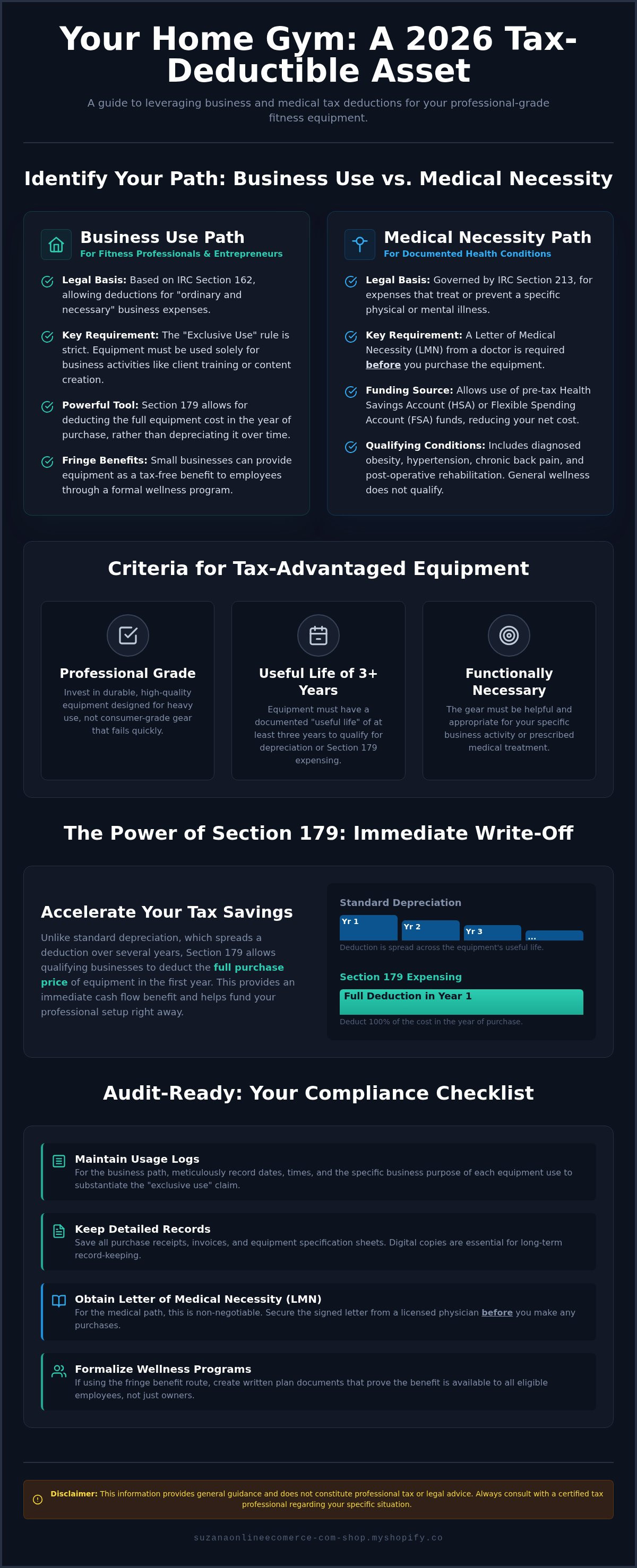
Learning how to build a home gym on a budget requires more than just finding sales; it involves mastering the "Ordinary and Necessary" rule for business expenses. For 2026, the IRS defines an ordinary expense as one that's common and accepted in your specific trade or business. A necessary expense is one that's helpful and appropriate for your work. If you're a fitness creator or a remote personal trainer, professional-grade equipment isn't a luxury. It's a functional requirement for your income-generating activities.
There are two primary legal paths for these deductions. IRC Section 162 allows for the deduction of business expenses, which is the standard route for the self-employed. Conversely, IRC Section 213 covers medical expenses. While Section 213 is harder to claim, legislative efforts like the Personal Health Investment Today (PHIT) Act continue to highlight the push for expanded eligibility. This dual-path approach is the most effective way to understand how to build a home gym on a budget while securing professional-grade tools.
The "Exclusive Use" rule remains the strictest hurdle for home-based fitness deductions. To qualify as a business expense, the equipment must be used solely for business purposes. If you use a treadmill for a recorded coaching session and then use it for a personal workout later that evening, the IRS may disqualify the deduction. For remote employees, 2026 standards prioritize documented wellness initiatives. If your employer requires a home fitness setup as part of a formal, written health program, you may find additional avenues for tax-advantaged spending.
The Role of Section 179 in Equipment Expensing
Employee Wellness Programs as Fringe Benefits
Small business owners can provide fitness equipment as a tax-free fringe benefit to their employees, including themselves if they're incorporated. In 2026, corporate wellness stipends for home office setups are increasingly viewed as a standard part of competitive compensation packages. To qualify, you must maintain written plan documents that prove the benefit is available to all eligible employees rather than just top-tier executives. Proper documentation ensures the program is non-discriminatory and keeps the business compliant during an audit.
Business Use vs. Medical Necessity: Identifying Your Path
Identifying the right path is the first hurdle in understanding how to build a home gym on a budget while remaining tax-compliant. For most taxpayers, the decision falls into three categories: professional necessity, medical prescription, or home office integration. Each path carries different documentation requirements and potential savings for the 2026 tax year. Understanding where you fit ensures you don't leave money on the table or trigger an unnecessary audit.
Qualifying via Medical Necessity (IRC Section 213)
To qualify under IRC Section 213, your equipment must be primarily used to alleviate or prevent a physical or mental defect or illness. This requires a Letter of Medical Necessity (LMN) from a licensed physician before you make the purchase. According to IRS Publication 502, expenses for general health, such as a gym membership or equipment for weight loss without a specific diagnosis, aren't deductible. However, if a doctor prescribes exercise to treat a specific condition, you can often use pre-tax HSA or FSA funds for high-quality wellness products, effectively reducing the net cost of your setup.
Conditions that typically qualify for this path include:
- Obesity (when diagnosed as a specific disease)
- Hypertension or heart disease
- Chronic back pain requiring specific physical therapy
- Post-operative recovery or injury rehabilitation
The Professional Fitness Deduction Requirements
Fitness professionals, including YouTubers, influencers, and remote coaches, have a different set of rules. If your gym equipment is used to create revenue-generating content or host virtual training sessions, it may qualify as an "ordinary and necessary" business expense. You must calculate and document the percentage of business versus personal use. For example, if you use a weight bench for five hours of filming and one hour of personal exercise, only a portion of the cost is deductible. Dual-purpose assets are viewed with high scrutiny during audits, as the IRS generally assumes equipment in a residence is for personal enjoyment unless proven otherwise through a rigorous usage log.
Selecting durable workout equipment ensures your investment lasts long enough to satisfy multi-year depreciation schedules if you don't choose an immediate write-off. When you analyze how to build a home gym on a budget, the professional path typically offers the most significant tax savings for the 2026 filer. Always consult with a CPA to confirm your specific eligibility before claiming these deductions on your return.
For standard remote workers, justifying a treadmill desk or yoga mat as a business expense is more difficult. Unless the equipment is a required business tool or part of a formal employer-sponsored wellness program, it's usually considered a personal expense. Comparing these paths shows that business owners see the highest savings, followed by those with specific medical needs, while general employees must rely on corporate stipends to offset costs.
Criteria for Choosing Tax-Advantaged Home Gym Equipment
Selecting the right equipment isn't just about the workout; it's about the financial lifecycle of the asset. When you research how to build a home gym on a budget, durability should be your primary metric. The IRS requires capital assets to have a "useful life" of more than one year, and most professional-grade machinery is expected to last at least three to seven years. Investing in professional gear, such as the commercial-grade options found at Gym Pros, satisfies these requirements more effectively than consumer-grade disposables that might break within six months. This longevity allows you to claim the equipment as a legitimate business or medical asset over several tax cycles.
Professional-Grade vs. Consumer-Grade Gear
Commercial-rated equipment provides enhanced protection during a tax audit because it's specifically built for high-volume use, making its status as a business tool or medical necessity easier to defend. High-ticket items like multi-functional machines for weight training are categorized as capital investments rather than simple supplies. While large machines are easily tracked on a balance sheet, smaller items like yoga mats or foam rollers often fall under "materiality" rules. This means their cost is so low that they're usually deducted in full immediately as supplies rather than being depreciated over time. According to IRS Publication 502, even these smaller items must be directly related to a diagnosed condition if you're pursuing the medical deduction path.
Depreciation Categories for Fitness Assets
Fitness assets typically fall into specific MACRS (Modified Accelerated Cost Recovery System) categories. Most gym machinery is classified under a 5-year or 7-year depreciation cycle depending on its specific use and construction. If you're buying smart equipment with integrated software, you must distinguish between the hardware cost and the ongoing subscription fees. The hardware is a depreciable asset, while the subscription is generally a recurring operational expense. To ensure you're selecting gear that meets these professional standards, refer to our Home Gym Equipment Buyer's Guide for a breakdown of high-quality materials like stainless steel and durable composites. This strategic approach is the most effective way to understand how to build a home gym on a budget while maximizing your long-term tax benefits.
Documentation and Compliance: How to Prove Your Deduction
Documentation is the only thing standing between a legitimate deduction and a rejected claim. The "Golden Rule" of tax compliance is maintaining contemporaneous records. This means you record the business or medical use of your equipment at the time it happens. Don't wait until tax season to reconstruct a year of activity from memory. When you're learning how to build a home gym on a budget, these records are as valuable as the receipts themselves. They protect your investment from being disqualified during an audit.
Digital storage is the standard for audit-ready records in 2026. Physical receipts fade, especially thermal paper versions. Scan every invoice immediately and store it in a secure cloud folder. Ensure your purchase dates align with your business launch or the date of your medical diagnosis. Consistency in these dates proves the equipment was acquired for a specific, non-personal purpose. Please remember that this information does not constitute legal or tax advice; always consult a professional before filing.
Creating a Defensible Usage Log
A usage log is your primary defense against the assumption of personal use. If you're a fitness creator, you must track every hour spent filming or training clients. Your log should include:
- Date and Duration: Exactly when and how long the gear was used.
- Specific Purpose: The video title, client name, or prescribed exercise.
- User Identification: Proof that the equipment wasn't used by family members.
Visual evidence helps. Take photos of your equipment in its dedicated space to prove the area isn't used for general living. Use asset-tracking software or simple spreadsheets to maintain this data. For fitness professionals who want to present their business metrics or tax-deductible assets more clearly, PowerPoint infographic templates can provide a professional visual structure for your records. This level of detail is essential for anyone figuring out how to build a home gym on a budget while seeking tax relief.
If you're following the medical path, your LMN must be explicit. It shouldn't just suggest general exercise. It must state that the equipment is a treatment for a specific, diagnosed condition like hypertension. The LMN must be dated before the equipment purchase takes place. The IRS rarely accepts retroactive prescriptions. For chronic conditions, these letters typically require annual renewal to remain valid for multi-year depreciation schedules.
To start your setup with gear that meets professional durability standards, browse our professional fitness equipment.
Investing in Your Health and Wealth with SUZANA SHOP
Building a professional-grade space on a budget requires a shift in perspective. You aren't just buying tools for a workout; you're acquiring capital assets that must withstand the scrutiny of a potential audit. SUZANA SHOP understands this intersection of fitness and finance. By providing high-quality fitness equipment and wellness products, we ensure your home setup meets the durability standards required for long-term tax depreciation. Cheap, consumer-grade gear often fails before it can even reach the end of a standard five-year depreciation cycle. Investing in professional-grade materials like stainless steel and durable composites is the most effective strategy for those researching how to build a home gym on a budget while maximizing fiscal benefits.
Our commitment to professional standards extends beyond the physical products. In 2026, the IRS prioritizes clear, contemporaneous documentation. SUZANA SHOP provides professional invoicing that clearly identifies your purchases, making it easier for you to categorize items as business equipment or medical necessities. This level of transparency is vital when you present your records to a tax professional. As a global e-commerce leader, we offer shipping capabilities that support home-based professionals regardless of their location. Before finalizing any significant investment, you must consult with your CPA to ensure your specific equipment choices align with your 2026 tax strategy.
Selecting Durable Fitness Gear
Prioritizing specific categories of equipment can simplify your asset tracking. Larger items, such as weight training machines, are easier to categorize as capital investments compared to small, consumable supplies. These high-intent assets are designed for heavy use, which justifies their "useful life" on a tax return. Choosing professional-grade workout equipment supports your physical health while providing a stable foundation for your business or medical deductions. A balanced lifestyle approach is key to long-term success. You can explore our guide on health and wellness to learn how to integrate these professional tools into a sustainable daily routine.
Wellness and Recovery Essentials
A holistic health plan often includes more than just heavy machinery. Integrating wellness products into your medically prescribed routine can further enhance the value of your home gym. Whether you're recovering from an injury or managing a chronic condition, the quality of your recovery gear matters. SUZANA SHOP is the preferred choice for those who demand durability and professional standards in every piece of equipment they own. High-quality yoga mats and recovery tools are essential components of a deductible health plan when backed by a Letter of Medical Necessity. Don't settle for disposable alternatives that won't last the year. Review your 2026 tax strategy, verify your eligibility with a professional, and upgrade your home gym today to secure your health and your wealth.
Building Your Tax-Advantaged Fitness Future
Mastering the 2026 tax landscape turns a high-cost personal expense into a strategic business or medical asset. By prioritizing durable materials and maintaining rigorous usage logs, you ensure your setup remains audit-ready and compliant. Learning how to build a home gym on a budget isn't just about finding the lowest sticker price; it's about maximizing every dollar through documented tax deductions. Professional-grade equipment provides the necessary "useful life" to satisfy IRS depreciation schedules, making it a far superior choice over consumer-grade alternatives.
SUZANA SHOP supports your fitness goals with a comprehensive selection of wellness products and professional-grade gear suitable for detailed tax tracking. With global shipping capabilities, you can source high-quality equipment regardless of your location. Please remember to consult with your CPA before finalizing your return to confirm your specific eligibility. Take the first step toward a healthier lifestyle and a smarter financial future today.
Shop Professional-Grade Fitness Equipment at SUZANA SHOP
Your health is your most valuable investment. With a clear roadmap and the right equipment, your home gym will serve as a cornerstone for both your physical well-being and your financial growth.
Frequently Asked Questions
Can I deduct home gym equipment if I work for a company but work from home?
W2 employees who work for a company generally cannot deduct home gym equipment as a business expense on their federal taxes. The Tax Cuts and Jobs Act suspended miscellaneous itemized deductions for unreimbursed employee expenses through 2025, and this remains the standard for the 2026 tax year. You should instead look for employer-sponsored wellness stipends or corporate reimbursement programs. These often provide tax-free funds for the fitness gear you need for your home office.
What is a Letter of Medical Necessity (LMN) and do I need one for my gym gear?
A Letter of Medical Necessity (LMN) is a formal document from a licensed physician stating that specific equipment is required to treat or prevent a diagnosed medical condition. You need one if you plan to use HSA or FSA funds or claim a medical expense deduction for your gym gear. This letter must clearly link the equipment to a specific diagnosis, such as hypertension, rather than general health improvement. It's a critical piece of your 2026 audit trail.
How much can I actually save on my taxes by writing off a home gym?
Your actual savings depend on your marginal tax rate and the total cost of the equipment. If you're in the 24% tax bracket and deduct a $2,000 professional-grade machine, you could effectively reduce your tax bill by $480. When learning how to build a home gym on a budget, these savings significantly lower the net cost of high-quality gear. Always calculate the after-tax price to see the true value of your investment in 2026.
Is a treadmill desk considered office equipment or fitness equipment for taxes?
A treadmill desk is typically viewed as a dual-purpose item, which makes it difficult to categorize solely as office equipment. If it's used exclusively during work hours to perform your job, it might qualify as a business expense for self-employed individuals. However, the IRS often classifies these as personal items unless you can prove they're ordinary and necessary for your specific trade. You should consult your CPA to determine the best filing strategy for your situation.
Can I use my HSA or FSA card to buy equipment on SUZANA SHOP?
SUZANA SHOP accepts standard payment methods for our professional-grade fitness equipment and wellness products. While you can use HSA or FSA debit cards for eligible purchases, you must ensure you have a valid Letter of Medical Necessity on file for your records. We provide detailed, professional invoicing that satisfies the documentation requirements for most health account administrators. This makes it easier to substantiate your wellness investments during a 2026 account review.
What happens if I use my tax-deducted gym equipment for personal workouts too?
If you use tax-deducted equipment for personal workouts, you can only deduct the portion of the cost that corresponds to business use. For example, if you use a machine for client training 60% of the time and personal exercise 40% of the time, only 60% of the expense is deductible. Maintaining a rigorous usage log is essential to prove these percentages during an audit and protect your financial standing with the IRS in 2026.
Are yoga mats and small accessories deductible as business expenses?
Yes, yoga mats and small accessories are deductible as business expenses if they're essential for your fitness-related trade. Because these items often have a lower cost, they're typically treated as supplies rather than capital assets. This allows for an immediate deduction in the year of purchase rather than a multi-year depreciation schedule. These small purchases are a vital part of how to build a home gym on a budget while maintaining professional standards.
How do I depreciate a high-end weight machine over several years?
High-end weight machines are usually depreciated over a five or seven-year period using the MACRS system. This allows you to deduct a portion of the machine's cost each year of its useful life. Alternatively, many fitness professionals use Section 179 to deduct the full purchase price in a single year. Your choice depends on whether you need a large immediate deduction or a steady reduction in taxable income over several years. Consult your CPA for guidance.