

Mastering Power Tower Exercises: The Ultimate Vertical Home Gym Guide

Your home gym doesn't need more floor space to deliver professional results; it simply needs more vertical ambition. Many fitness enthusiasts purchase a station with high hopes, only to find themselves bored by a repetitive cycle of standard pull-ups and dips. It's common to feel limited by your equipment or worried that improper form might lead to a nagging shoulder injury. By expanding your repertoire of power tower exercises, you can break through these plateaus and turn a single piece of equipment into a complete calisthenics laboratory.
We've designed this guide to help you master bodyweight movements and maximize the utility of your vertical gym. You'll learn the precise mechanics required to build a strong upper body and core while keeping your joints safe. We'll provide a clear roadmap that includes essential safety tips, technical form breakdowns, and diverse routines to keep your training sessions challenging. Prepare to transform your physique and discover the true potential of your home fitness setup.
Key Takeaways
- Learn why the power tower is the ultimate centerpiece for modern home gyms by maximizing vertical space without sacrificing workout variety.
- Master the "Big Four" foundational movements, including pull-ups and dips, to build professional-grade upper body strength.
- Discover advanced power tower exercises and variations like the Vertical Knee Raise (VKR) to target your core and rotational power.
- Implement structured 3-day and full-body routines designed to help you progress safely from beginner to intermediate levels.
- Understand how to integrate complementary fitness equipment like resistance bands to assist with difficult movements and accelerate your results.
Understanding the Power Tower: Your Vertical Home Gym Centerpiece
A power tower serves as the foundational anchor for any serious home setup. It's a multi-functional, freestanding station designed to facilitate a wide range of bodyweight movements, including pull-ups, dips, and vertical knee raises. Unlike bulky equipment that occupies significant floor area, this gear utilizes vertical space, making it an ideal choice for enthusiasts with limited room. By focusing on power tower exercises, you can target every major muscle group without needing a rack of heavy weights or multiple specialized benches.
To visualize how this equipment functions in a real-world setting, watch this helpful demonstration:
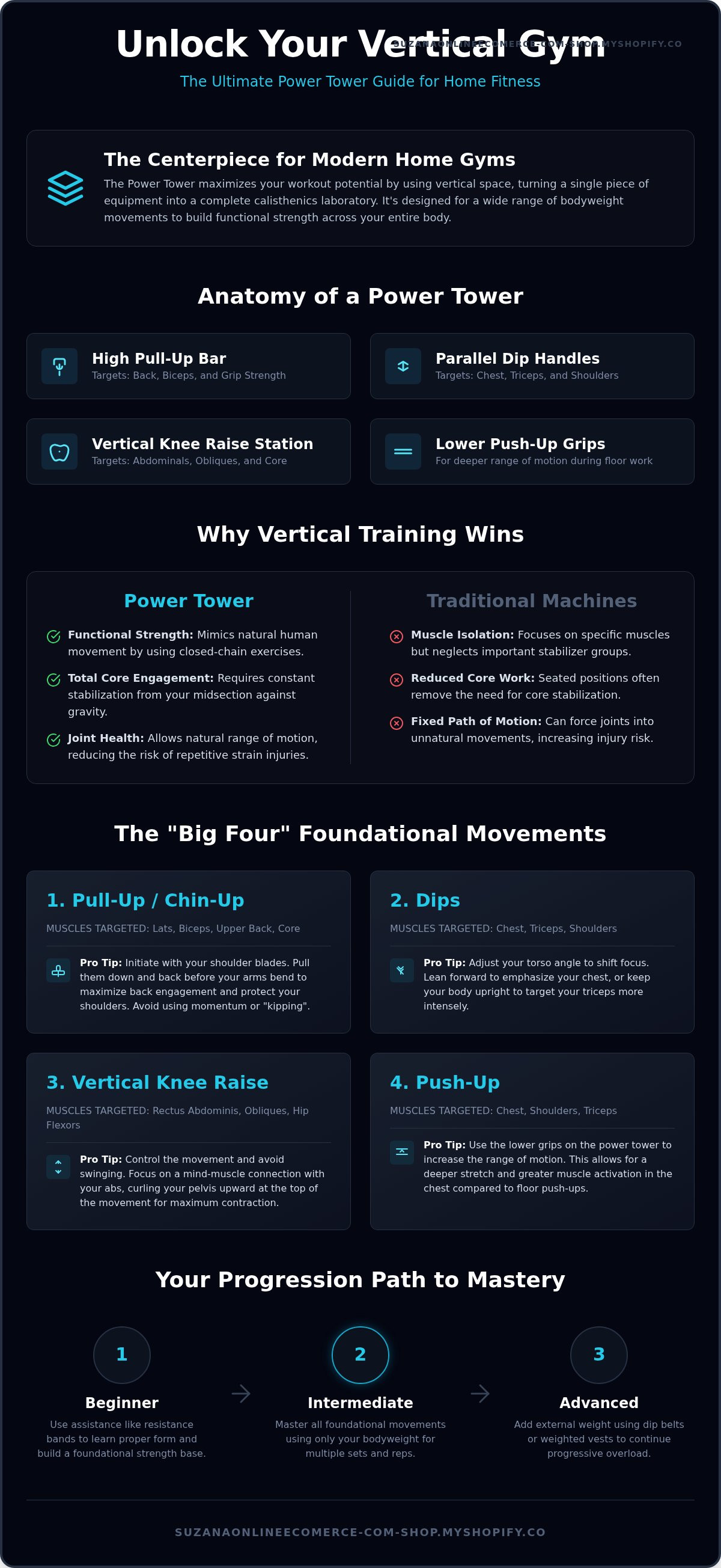
The core anatomy of a standard unit typically includes several integrated stations:
- High Pull-Up Bar: For back, biceps, and grip strength.
- Parallel Dip Handles: To target the chest, triceps, and shoulders.
- Padded Backrest and Armrests: For stable vertical knee and leg raises.
- Lower Push-Up Grips: To allow for a deeper range of motion during floor work.
This configuration supports the principles of calisthenics, where your own body weight provides the resistance necessary for muscle hypertrophy and endurance. Training in this vertical plane improves functional strength and mobility while promoting better joint health. Because these movements aren't restricted by a machine's fixed path, your joints can move through their natural range of motion, which helps reduce the risk of repetitive strain injuries.
Power Tower vs. Traditional Gym Machines
Many beginners struggle to choose between a tower and standard machines for weight training. While fixed machines often isolate specific muscles through open-chain movements, the power tower emphasizes closed-chain exercises. In a closed-chain movement, your hands or feet remain in a fixed position while your body moves through space. This approach recruits more stabilizer muscles and improves overall functional strength because it mimics natural human movement patterns. You gain the freedom to adjust your grip and body angle, which isn't possible on fixed-path equipment.
Bodyweight Mastery: Why Vertical Training Wins
Vertical training turns gravity into your most effective training partner. Every movement on a tower requires intense core engagement to stabilize the torso against the pull of gravity. Seated machines often remove this requirement, which can lead to weaknesses in your midsection over time. The scalability of these stations is another major advantage for long-term progress. You can start with assisted variations using resistance bands and eventually progress to advanced weighted movements once you've mastered the basics. This progression ensures that your workout remains challenging as you get stronger.
The Big Four: Foundational Power Tower Exercises
The power tower is built around four primary compound movements that target the entire upper body and core. These foundational power tower exercises provide the stimulus needed for significant muscle growth and functional strength. Research from Harvard Health Publishing suggests that calisthenics is an effective way to keep in shape, and mastering these four movements is the first step toward that goal.
Perfecting the Pull-Up and Chin-Up
The pull-up is the gold standard for back development. To perform it correctly, grip the bar slightly wider than shoulder-width and engage your core into a hollow body position. Initiate the movement with scapular retraction, pulling your shoulder blades down and back before your arms bend. Many beginners make the mistake of "kipping" or using momentum to clear the bar; however, this reduces muscle tension. If you can't perform a full rep yet, use a resistance band looped over the bar or utilize the tower's side frame to assist your ascent until your strength improves.
Mastering the Dip for Chest and Triceps
Dips are exceptional for building the pushing muscles. You can shift the emphasis by adjusting your torso angle; leaning forward targets the chest, while staying upright focuses on the triceps. Safety is paramount here to protect the rotator cuff. Maintain an active shoulder position by pushing your hands firmly into the handles to keep your shoulders depressed and away from your ears throughout the entire movement. Avoid dropping too low, as excessive depth can strain the shoulder joints. Selecting high-quality home gym equipment ensures you have the stability needed for these high-intensity movements.
The Captain’s Chair: Vertical Knee and Leg Raises
The VKR station, or Captain's Chair, isolates the abdominals by removing the need to grip a bar. Press your lower back firmly against the backrest to stabilize your spine. Beginners should start with knee raises, pulling the knees toward the chest while maintaining a slow tempo. Advanced users can progress to straight leg raises for increased leverage and difficulty. The slow and controlled rule is vital here; swinging your legs uses momentum rather than muscle, which stalls your progress in core hypertrophy.
Don't overlook the incline push-up grips at the base of the unit. These handles allow for a deeper range of motion than standard floor push-ups, leading to better chest activation and improved wrist comfort during your workout.
Advanced Variations and Full-Body Integration
While the foundational moves build the base, advanced power tower exercises allow you to fine-tune specific muscle groups and integrate the lower body. Most users view the tower strictly as a chest and back station, but its stable frame supports a much wider range of movement. It's a versatile centerpiece in the category of home fitness equipment, offering a way to challenge your body beyond standard repetitions. By varying your grip and body angle, you can transform a simple pull-up or dip into a completely different stimulus.
Wide-grip pull-ups increase the demand on the outer latissimus dorsi, which helps create a wider back profile. Conversely, a close-grip neutral position shifts the load onto the brachialis and lower lats. Switching your grip every few weeks prevents your muscles from adapting to a single movement pattern. You can also add bicycle crunches and oblique twists on the VKR station to build rotational power. This rotational strength is essential for athletic performance and functional daily movements, as it engages the internal and external obliques more effectively than static raises.
The "Bodyweight Row" is another often overlooked movement. By placing your feet on the floor and gripping the dip handles or the vertical uprights, you can perform horizontal pulling. This balances the vertical pulling of the pull-up bar, which is vital for shoulder health and maintaining a balanced posture. It's a simple adjustment that ensures your rear deltoids and rhomboids receive adequate attention.
Targeting the Core: Beyond Simple Knee Raises
If standard knee raises no longer feel challenging, it's time to increase the isometric demand. The L-sit is a premier test of core strength; you'll hold your legs parallel to the floor while supporting your weight on the dip bars. For advanced oblique training, windshield wipers involve hanging from the pull-up bar and rotating your legs from side to side in a controlled arc. If you haven't mastered the full range of motion yet, focus on negative reps. Slowly lowering your legs from the top position builds the eccentric strength needed to eventually perform full, controlled repetitions.
Creative Full-Body Use of the Tower Frame
Transforming your station into a total-body tool requires some creativity with the frame. You can use the dip handles or the base bars as a rear-foot elevator for Bulgarian split squats. This targets the quads and glutes with high intensity without needing a separate bench. For the posterior chain, lie on the floor and use the base bar to stabilize your hands during glute bridges. You can also perform single-leg calf raises by using the uprights for balance. These adjustments ensure your lower body stays as conditioned as your upper body, making the power tower a truly comprehensive home gym solution.
Designing Your Power Tower Routine and Safety
Translating individual movements into a structured program is the key to long-term physique transformation. Without a plan, power tower exercises often become stagnant. A successful routine balances intensity with recovery, ensuring your central nervous system isn't overtaxed while your muscles receive enough stimulus to grow. To enhance this recuperation, integrating home spa solutions from Santeco can help soothe tired muscles and promote deep relaxation between training sessions. Whether you're just starting or you're an experienced calisthenics athlete, your programming should evolve as your strength increases.
Sample Workout Frameworks for Every Level
Beginners should focus on a 3-day split, prioritizing volume and mastering form. Start with three sets of assisted pull-ups, dips, knee raises, and incline push-ups. This high-frequency approach builds the neurological pathways needed for bodyweight mastery. Once you can perform five clean, unassisted pull-ups, transition to the Intermediate Full-Body Blast. This phase introduces chin-ups and straight leg raises while decreasing rest intervals to 60 seconds to improve metabolic conditioning.
Advanced trainees often benefit from a "Push-Pull" routine. This separates movements like dips and push-ups from pull-ups and rows, allowing for higher intensity and better hypertrophy. At this level, you can incorporate weighted variations using a belt and isometric holds like L-sits to challenge your core stability. Always prioritize the quality of each rep over the total count to prevent injury and ensure you're targeting the intended muscle groups effectively.
Safety, Stability, and Floor Protection
Maintaining your equipment is just as vital as the workout itself. Most towers require one to two hours for assembly; it's essential to re-torque all bolts after the first week of use to prevent wobbling. Continue these bolt checks monthly to ensure the frame remains rigid during dynamic movements. Safety research suggests choosing a unit with a weight capacity at least 40% higher than your body weight, especially if you plan to incorporate more explosive movements or weighted vests.
Protecting your home environment is another critical consideration. High-density rubber floor mats are necessary to prevent the steel base from scratching your flooring and to provide extra stability. You also need to clear a "swing zone" around the unit. Ensure there's at least three feet of clearance in every direction to avoid hitting walls or furniture during wide-grip pull-ups or leg raises. For those looking to upgrade their setup, you can find professional-grade fitness equipment that fits perfectly into modern home spaces.
Expanding Your Home Gym: Complementary Fitness Equipment
To truly master your physique, you must look beyond a single piece of equipment. While power tower exercises form the core of your strength training, integrating other tools prevents plateaus and addresses muscle imbalances. Pairing your tower with additional home gym equipment like dumbbells allows for hybrid routines. For instance, you can superset bodyweight dips with dumbbell lateral raises to fully exhaust the shoulders. This variety ensures that every muscle fiber is targeted from multiple angles, leading to a more symmetrical and functional build.
Resistance bands are indispensable for both assistance and mobility. If you're struggling with high-volume pull-up sets, looping a band over the bar provides the necessary lift to maintain perfect form throughout the entire session. Conversely, once bodyweight alone becomes too easy, a weighted vest adds the resistance needed for continued muscle hypertrophy. Progressive overload in bodyweight training is achieved by either increasing the total repetitions performed or by adding external weight to the movement. This approach keeps your muscles under constant tension and forces new physical adaptations over time.
Wellness and Recovery for the Home Athlete
Training is only one part of the success equation. Achieving a balanced life requires a deep focus on health and wellness. High-intensity calisthenics puts significant stress on your tendons and central nervous system. Using professional-grade wellness products like foam rollers and massage tools helps clear metabolic waste from muscle tissue and improves overall flexibility. This proactive approach to recovery reduces lingering soreness and prepares your body for the next high-intensity session.
Don't ignore the foundations of sleep and nutrition, as they are the hidden drivers of your progress on the tower. Without adequate protein intake and restorative sleep, your body cannot effectively repair the micro-tears caused by intense training. Creating a holistic fitness environment with the right workout equipment essentials ensures that your home gym supports every stage of your fitness journey. By combining a professional-grade tower with recovery-focused tools, you build a sustainable routine that delivers long-term health benefits.
Elevate Your Home Training Potential
Mastering a vertical workout routine is one of the most efficient ways to build professional-grade strength without sacrificing living space. By focusing on the foundational "big four" movements and progressing toward advanced power tower exercises, you can transform your physique using little more than your own body weight. Success in a home gym environment requires a balance of disciplined training, regular equipment maintenance, and a commitment to proper recovery protocols. Integrating tools like resistance bands or weighted vests will ensure your progress never plateaus. If you're looking for specialized combat gear to complement your training, you can discover The Fight Club for high-quality fightwear.
We provide high-quality home gym gear designed for durability and performance. Our expertly curated wellness products and fitness accessories are available with global shipping to support your long-term health goals. Whether you're a beginner aiming for your first pull-up or an athlete looking to master the L-sit, having the right equipment is essential for safety and results. Shop our premium Fitness Equipment for your home gym today and take the first step toward a stronger, more functional body. Your journey to bodyweight mastery starts with the right foundation.
Frequently Asked Questions
Can I build muscle using only power tower exercises?
How much space do I need for a power tower in my home?
You typically need a floor area of about 4 feet by 3 feet, but you must also account for a "swing zone." Ensure there's at least 3 feet of clearance on all sides and sufficient ceiling height to clear your head during pull-ups. Most units stand between 80 and 90 inches tall, so check your room's vertical dimensions before installation to avoid hitting the ceiling.
What is the difference between a power tower and a pull-up bar?
A power tower is a multi-station freestanding unit, whereas a pull-up bar is usually a single-purpose tool mounted to a door or wall. The tower includes additional stations for dips, vertical knee raises, and push-ups, making it a more versatile centerpiece for power tower exercises. It doesn't require permanent mounting, which makes it a preferred choice for renters or those who want a portable vertical gym.
Is a power tower safe for heavy users?
Yes, provided you choose a model with a weight capacity that exceeds your body weight by at least 40%. High-quality towers often feature 11-gauge steel construction and support between 300 and 450 lbs. Always verify the manufacturer's weight limit and ensure the base is wide enough to prevent tipping during dynamic movements or when using weighted vests for added resistance.
How can I do legs on a power tower?
You can perform lower-body movements by using the frame for stabilization or as a rear-foot elevator. Bulgarian split squats are highly effective when you place one foot on the dip handles or the base bar. Additionally, you can perform single-leg calf raises or glute bridges by using the uprights for balance. These variations ensure your power tower exercises contribute to a balanced, full-body physique.
How do I stop my power tower from shaking or wobbling?
Ensure all bolts are tightened correctly and place the unit on a high-density rubber mat. It's essential to re-torque all hardware after the first week of use, as vibrations from training can naturally loosen the connections. If the floor is uneven, use shims or choose a model with adjustable leveling feet to create a stable, safe foundation for your workouts.
Can beginners use a power tower if they can’t do a pull-up?
Beginners can absolutely use this equipment by incorporating regression techniques and assistance tools. You can loop resistance bands over the pull-up bar to reduce the effective weight you need to lift. Many towers also have frames that allow you to perform "negative" reps or incline push-ups, which build the foundational strength required to eventually master unassisted compound movements.
How often should I do power tower workouts per week?
A frequency of 3 to 4 sessions per week is ideal for most users to allow for adequate muscle recovery. Beginners should start with a 3-day full-body split, while more advanced athletes might use a push-pull routine over 4 days. Always listen to your body and prioritize sleep and nutrition to ensure your muscles repair effectively between these high-intensity calisthenics sessions.